Suffering or spin-offs ahead?
pp. 30-31 · Read in the full issue
Fear of terrorism and fuel costs have hit, ■ . . i r-\ • r • ii II , . , but the Pacific outlook has some twists
By Robin Bromby
THE South Pacific was quick to feel the effects of the invision on Kuwait by Iraqi forces. Within two months the world panicked over oil and prices rocketed, and it seemed that it would not be long before that hit the basic economic functions in the islands electricity generation and transport and then filtered through out the daily life of the region.
That happened, but not to the extent that some feared. When it was realised that the world had plenty of oil and the Gulf crisis did not threaten supplies, prices fell again. Analysts, who a few months earlier had talked of US$5O a barrel, now predict an average for the first six months of 1991 of around US$l9.
Unfortunately for the South Pacific,
r#u v , 1 .1 • -i manyof he Sma ' ler na ‘ lOnS bay t ,be ' r 01 ‘ 1,1 a fe , W lar g" shl P mems > f ‘ hat “ took s f veral , mon ! hs , to « ork the i r way ‘ hrou B h s !° cks bou jj ht J ust after ,he uwait cnsis erupted.
This will have a blip effect on economies (in Tonga, for example, the latest figures show that a sharp rise in transport cost gave the country’s inflation rate an unhealthy boost), and it has certainly dented the performance of some of the smaller regional airlines which have to refuel in places like Tonga and Western Samoa, where price hikes lingered longer than in their larger neighbours. Shipping costs went up, too, and that is going to have some effect on consumer prices, and on local fishing fleets as they pay more for fuel.
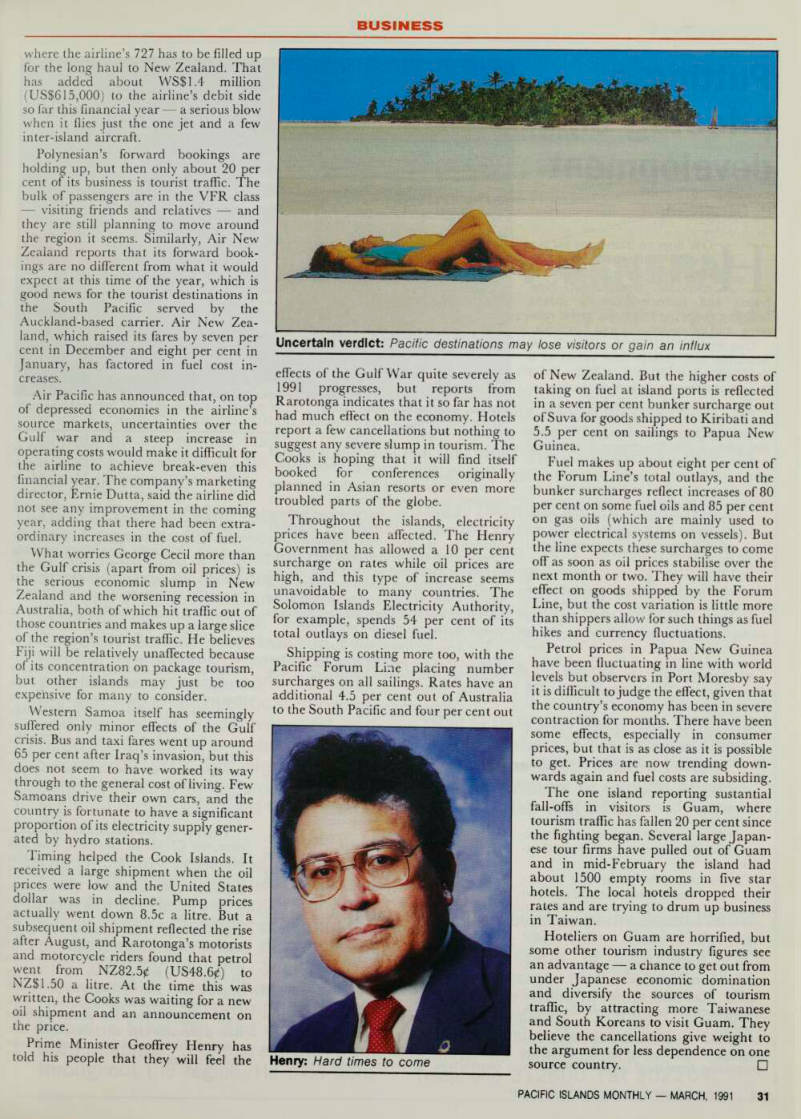
However, the oil impact will be relatively short-lived. On that other part of the Gulf equation the effect on tourism the jury is still out. The airlines in the southern half of the Pacific say there is little sign that tourists are pulling out, but Guam has been hit by substantial Japanese cancellations which have left a hefty number of vacant rooms in five star hotels. Apart from an attack of nerves among travellers out of Tokyo, there is a theory that the Pacific will benefit from the war in that travellers who have cancelled European or Middle East trips will look to take vacations as far from the action as possible.
The general manager of Polynesian Airlines George Cecil said fuel prices had risen dramatically after the Gulf crisis began - and have been slow to drop.
Many of the smaller countries had bought oil at the time of peak prices.
While Polynesian takes on aviation fuel in Auckland or Sydney at much lower prices, it is stuck with high prices in its other destinations: Cook Islands, Fiji, Apia itself, and particularly Tonga
where the airline’s 727 has to be filled up for the long haul to New Zealand. That has added about WSSI.4 million (U 55615,000) to the airline’s debit side so far this financial year a serious blow when it flies just the one jet and a few inter-island aircraft.
Polynesian’s forward bookings are holding up, but then only about 20 per cent of its business is tourist traffic. The bulk of passengers are in the VFR class visiting friends and relatives - and they are still planning to move around the region it seems. Similarly, Air New Zealand reports that its forward book ings are no different from what it would expect at this time of the year, which is good news for the tourist destinations in the South Pacific served by the Auckland-based carrier. Air New Zea land, which raised its fares by seven per cent in December and eight per cent in January, has factored in fuel cost in creases.
Air Pacific has announced that, on top of depressed economies in the airline’s source markets, uncertainties over the Gulf war and a steep increase in operating costs would make it difficult for the airline to achieve break-even this financial year. The company’s marketing director, Ernie Dutta, said the airline did not see any improvement in the coming year, adding that there had been extra ordinary increases in the cost of fuel.
What worries George Cecil more than the Gulf crisis (apart from oil prices) is the serious economic slump in New Zealand and the worsening recession in Australia, both of which hit traffic out of those countries and makes up a large slice of the region’s tourist traffic. He believes Fiji will be relatively unaffected because of its concentration on package tourism, but other islands may just be too expensive for many to consider.
Western Samoa itself has seemingly suffered only minor effects of the Gulf crisis. Bus and taxi fares went up around 65 per cent after Iraq’s invasion, but this does not seem to have worked its way through to the general cost of living. Few Samoans drive their own cars, and the country is fortunate to have a significant proportion of its electricity supply gener
ated by hydro stations.
Timing helped the Cook Islands. It received a large shipment when the oil prices were low and the United States dollar was in decline. Pump prices actually went down 8.5 c a litre. But a subsequent oil shipment reflected the rise after August, and Rarotonga’s motorists and motorcycle riders found that petrol went from NZ82.50 (U 548.60) to NZSI.SO a litre. At the time this was written, the Cooks was waiting for a new oil shipment and an announcement on
the price.
Prime Minister Geoffrey Henry has told his people that they will feel the
effects of the Gulf War quite severely as 1991 progresses, but reports from Rarotonga indicates that it so far has not had much effect on the economy. Hotels report a few cancellations but nothing to suggest any severe slump in tourism. The Cooks is hoping that it will find itself booked for conferences originally planned in Asian resorts or even more troubled parts of the globe.
Throughout the islands, electricity
prices have been affected. The Henry Government has allowed a 10 per cent surcharge on rates while oil prices are high, and this type of increase seems unavoidable to many countries. The
Solomon Islands Electricity Authority,
for example, spends 54 per cent of its total outlays on diesel fuel.
Shipping is costing more too, with the Pacific Forum Line placing number surcharges on all sailings. Rates have an additional 4.5 per cent out of Australia to the South Pacific and four per cent out
of New Zealand. But the higher costs of taking on fuel at island ports is reflected in a seven per cent bunker surcharge out of Suva for goods shipped to Kiribati and 5.5 per cent on sailings to Papua New Guinea.
Fuel makes up about eight per cent of the Forum Line’s total outlays, and the bunker surcharges reflect increases of 80 per cent on some fuel oils and 85 per cent on gas oils (which are mainly used to power electrical systems on vessels). But the line expects these surcharges to come off as soon as oil prices stabilise over the next month or two. They will have their effect on goods shipped by the Forum Line, but the cost variation is little more than shippers allow for such things as fuel hikes and currency fluctuations.
Petrol prices in Papua New Guinea have been fluctuating in line with world levels but observers in Port Moresby say it is difficult to judge the effect, given that the country’s economy has been in severe contraction for months. There have been some effects, especially in consumer prices, but that is as close as it is possible to get. Prices are now trending down wards again and fuel costs are subsiding.
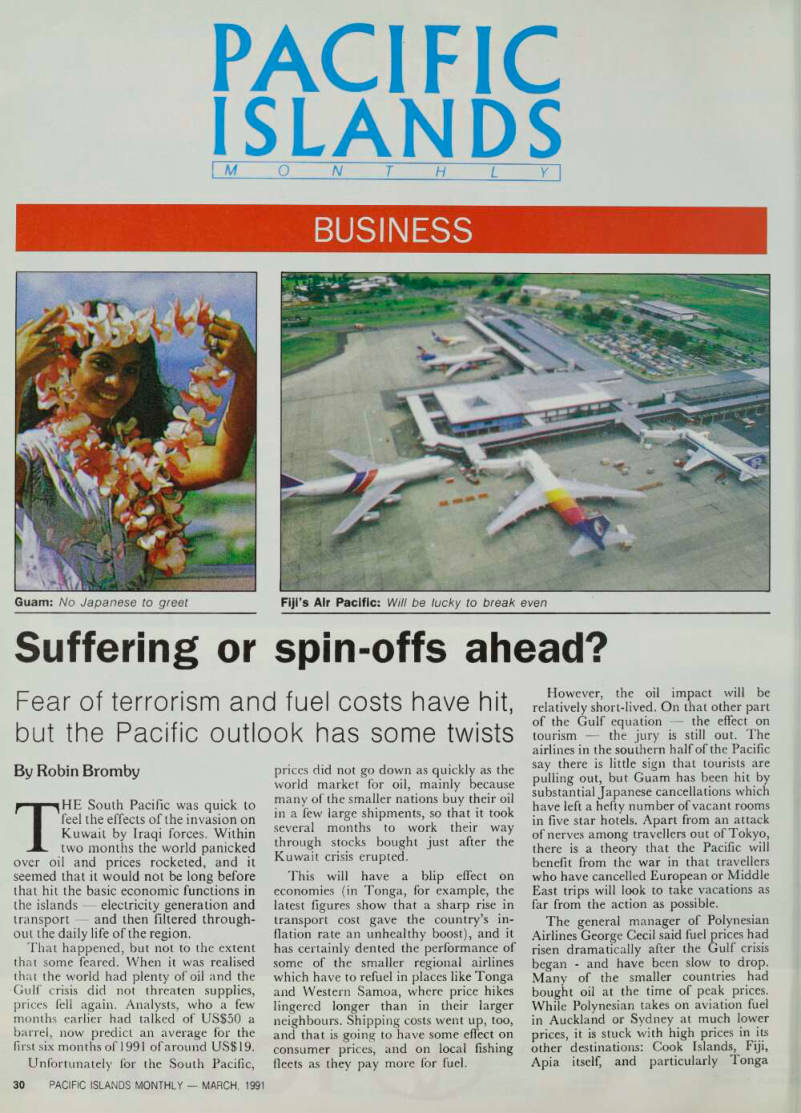
The one island reporting sustantial fall-offs in visitors is Guam, where tourism traffic has fallen 20 per cent since the fighting began. Several large Japan ese tour firms have pulled out of Guam and in mid-February the island had about 1500 empty rooms in five star hotels. The local hotels dropped their rates and are trying to drum up business in Taiwan.
Hoteliers on Guam are horrified, but some other tourism industry figures see an advantage a chance to get out from under Japanese economic domination and diversify the sources of tourism traffic, by attracting more Taiwanese and South Koreans to visit Guam. They believe the cancellations give weight to the argument for less dependence on one source country. □
Henry: Hard times to come
Uncertain verdict: Pacific destinations may lose visitors or gain an influx