parody of
pp. 20-21 · Read in the full issue
Grim urban parody of village life
By Irene Nisbet
IN the bar of the Menen Hotel in Nauru, a national crisis was being discussed. It had nothing to do with politics or phosphate, and had lasted for several weeks. Quite simply, there was no beer on the island.
What was irritating customers was that they could see a cargo ship known to be carrying beer, anchored right opposite the bar, in Anibare bay. Bad weather was preventing discharging of cargo.
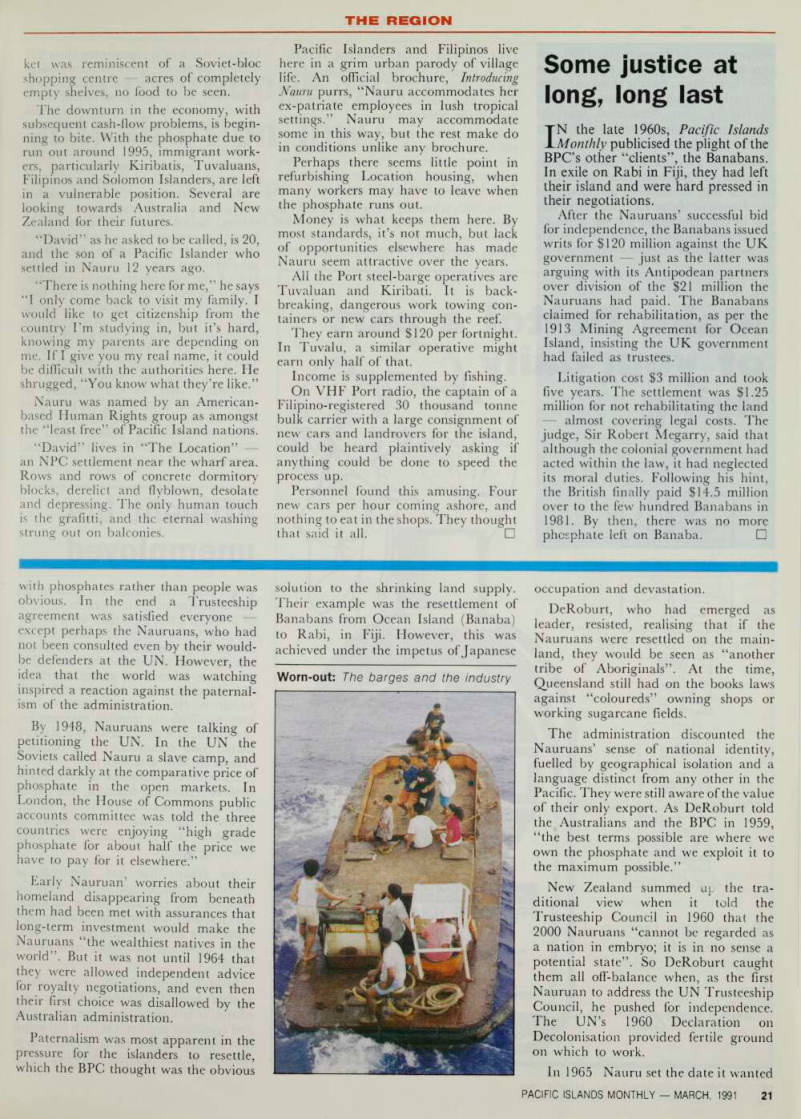
Nauru has no port, the small boat harbour being built on the reef, and only capable of taking boats of very shallow draft. Special deep-sea moorings located offshore are reputed to be amongst the deepest in the world, the outer ones being 500 metres deep at about 330 metres off the reef. The moorings are huge cylindri cal concrete structures to which ships attach lines.
Today, in practice, this port system means that ships must drift offshore, relying on the caprices of the weather to see if steel barges and lighters can actually get out over the reef to decant cargo.
Ashore, the manager of the Government-owned Civic Centre super market anxiously asked an off-duty ships officer when the beer would be unloaded.
With more bad weather on the cards, it was anyone’s guess. His entire supermar
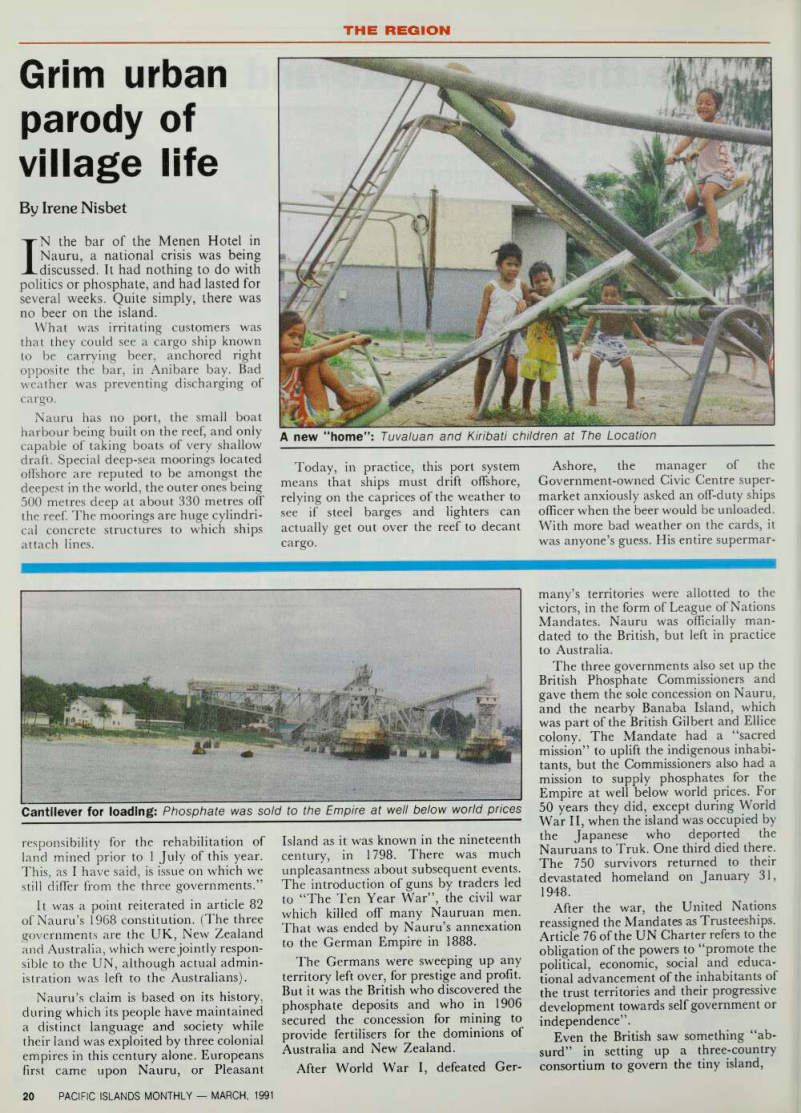
A new “home”: Tuvaluan and Kiribati children at The Location
ket was reminiscent of a Soviet-bloc shopping centre acres of completely empty shelves, no food to be seen.
The downturn in the economy, with subsequent cash-flow problems, is begin ning to bite. With the phosphate due to run out around 1995, immigrant work ers, particularly Kiribatis, Tuvaluans, Filipinos and Solomon Islanders, are left in a vulnerable position. Several are looking towards Australia and New Zealand for their futures.
“David” as he asked to be called, is 20, and the son of a Pacific Islander who settled in Nauru 12 years ago.
“There is nothing here for me,” he says “I only come back to visit my family. I would like to get citizenship from the country I’m studying in, but it’s hard, knowing my parents are depending on me. If I give you my real name, it could be difficult with the authorities here. He shrugged, “You know what they’re like.”
Nauru was named by an American based Human Rights group as amongst the “least free” of Pacific Island nations.
“David” lives in “The Location” an NPC settlement near the wharf area.
Rows and rows of concrete dormitory blocks, derelict and flyblown, desolate and depressing. The only human touch is the graffiti, and the eternal washing strung out on balconies.
Pacific Islanders and Filipinos live here in a grim urban parody of village life. An official brochure, Introducing Nauru purrs, “Nauru accommodates her ex-patriate employees in lush tropical settings.” Nauru may accommodate some in this way, but the rest make do in conditions unlike any brochure.
Perhaps there seems little point in refurbishing Location housing, when many workers may have to leave when the phosphate runs out.
Money is what keeps them here. By most standards, it’s not much, but lack of opportunities elsewhere has made Nauru seem attractive over the years.
All the Port steel-barge operatives are Tuvaluan and Kiribati. It is back breaking, dangerous work towing con tainers or new cars through the reef.
They earn around SI2O per fortnight.
In Tuvalu, a similar operative might earn only half of that.
Income is supplemented by fishing.
On VHF Port radio, the captain of a Filipino-registered 30 thousand tonne bulk carrier with a large consignment of new cars and landrovers for the island, could be heard plaintively asking if anything could be done to speed the process up.
Personnel found this amusing. Four new cars per hour coming ashore, and nothing to eat in the shops. They thought that said it all. □