Where the phosphate and time
pp. 19-22 · Read in the full issue

are running out
After 80 years of extraction Nauru wants compensation from three colonial powers
By Ian Williams
AUSTRALIA, one of the largest countries in the World, de livered its legal counterblast against Nauru, the world’s smallest nation, in the International Court of Justice at the Hague, in Holland on January 16. In 1989 Nauru filed for compensation for the period between 1919 and 1967 when it was under Australian administration and its phosphates were sold at below market prices.
Both parties accept the jurisdiction of the court, whose rules forbid canvassing pending the oral hearings. However, Barry Connell, one of Nauru’s counsels told Pacific Islands Monthly that the Australian submission, “apart from some odd pieces of material, is designed only to address the questions of admissibility of the claim and the Court’s jurisdic tion”. Mr Fred Keke, Nauru’s deputy Minister of Justice, confirmed this to PIM, and anticipated that his govern ment would consider the issue in Febru ary. On February 8, the court gave Nauru until July 19 to reply to the Australian submission, and it is possible that the Court will deal with these objections by the end of this year.
Connell says, “At the earliest, I would not expect a merits hearing before the end of 1982.” The court would then need
more time for its judgment, and even more to assess damages if it found for Nauru. It seems probable that Nauru’s only export, the phosphates, will have run out before the final verdict comes out. Aus tralia’s only comment comes in a press release, issued February 1 which states, “The Australian Government has pre viously expressed its re gret at Nauru’s action in bringing this matter be fore the court in 1989”, and claims that the issue was “definitively settled in the UN-supervised
independence arrange
ments. These arrange ments gave Nauru the
total control and benefit of the phosphate mining industry. The revenues generated provided its citizens with the highest per capita income in the world and would have allowed the Nauruan government to rehabilitate the mined areas if it so wished. It has not done so, even in respect of lands mined since Indepen dence’’.
Nauru’s case, filed May 19, 1989, claimed that between 1919 and 1967 its
only natural resources, the phosphate, were sold at considerably be low market prices when Australia administered the island under the League of Nations Man date and later United Nations trusteeship.
Therefore, Australia has a duty to pay for re habilitation of the one third of the island laid waste by the mining.
Nauru is an eight square-mile outcrop of coral on which millions of birds over the centuries left their
phosphorous-rich drop-
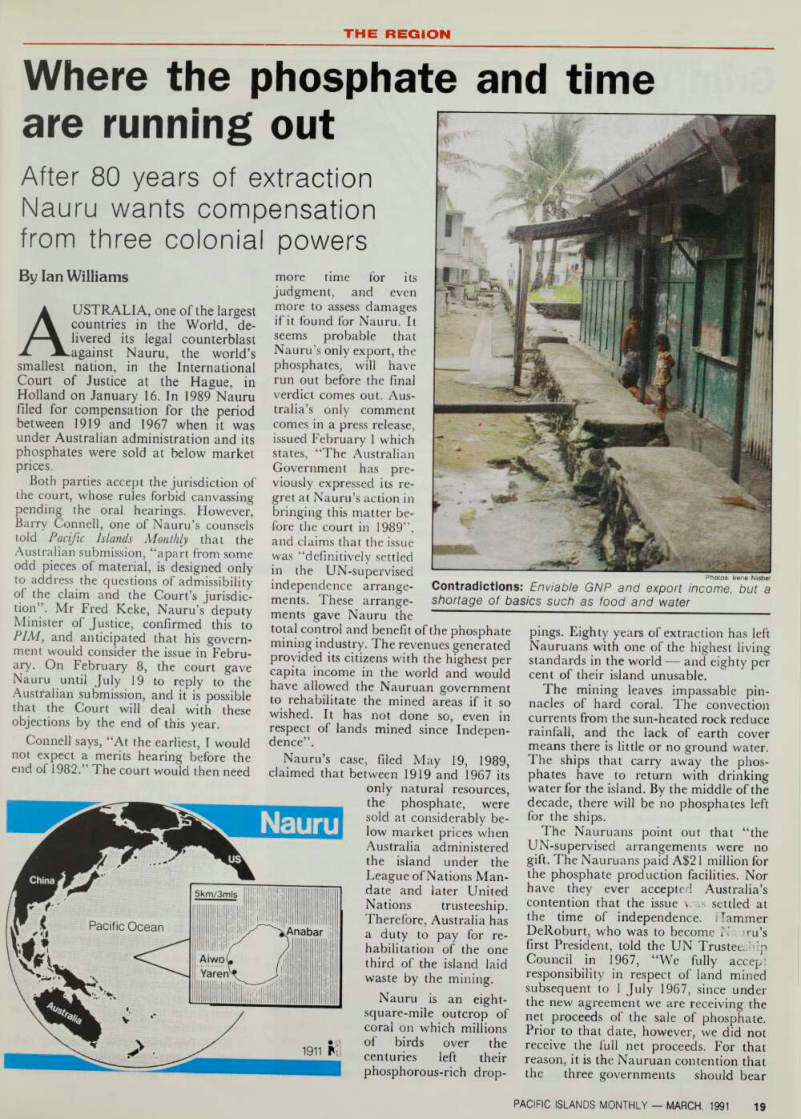
pings. Eighty years of extraction has left Nauruans with one of the highest living standards in the world and eighty per cent of their island unusable.
The mining leaves impassable pin nacles of hard coral. The convection currents from the sun-heated rock reduce rainfall, and the lack of earth cover means there is little or no ground water.
The ships that carry away the phos phates have to return with drinking water for the island. By the middle of the decade, there will be no phosphates left for the ships.
The Nauruans point out that “the UN-supervised arrangements were no gift. The Nauruans paid AS2I million for the phosphate production facilities. Nor have they ever accepted Australia’s contention that the issue \. as settled at the time of independence, slammer Deßoburt, who was to become N :ru’s first President, told the UN Trustee, ip Council in 1967, “We fully accep: responsibility in respect of land mined subsequent to 1 July 1967, since under the new agreement we are receiving the net proceeds of the sale of phosphate.
Prior to that date, however, we did not receive the full net proceeds. For that reason, it is the Nauruan contention that the three governments should bear
Photos: Irene Nisbet Contradictions; Enviable GNP and export income, but a shortage of basics such as food and water
responsibility for the rehabilitation of land mined prior to 1 July of this year.
This, as I have said, is issue on which we still differ from the three governments.”
It was a point reiterated in article 82 of Nauru’s 1968 constitution. (The three governments are the UK, New Zealand and Australia, which were jointly respon sible to the UN, although actual admin istration was left to the Australians).
Nauru’s claim is based on its history, during which its people have maintained a distinct language and society while their land was exploited by three colonial empires in this century alone. Europeans first came upon Nauru, or Pleasant
Island as it was known in the nineteenth century, in 1798. There was much unpleasantness about subsequent events.
The introduction of guns by traders led to “The Ten Year War”, the civil war which killed off many Nauruan men.
That was ended by Nauru’s annexation to the German Empire in 1888.
The Germans were sweeping up any territory left over, for prestige and profit.
But it was the British who discovered the phosphate deposits and who in 1906 secured the concession for mining to provide fertilisers for the dominions of Australia and New Zealand.
After World War I, defeated Ger
many’s territories were allotted to the victors, in the form of League of Nations Mandates. Nauru was officially man dated to the British, but left in practice to Australia.
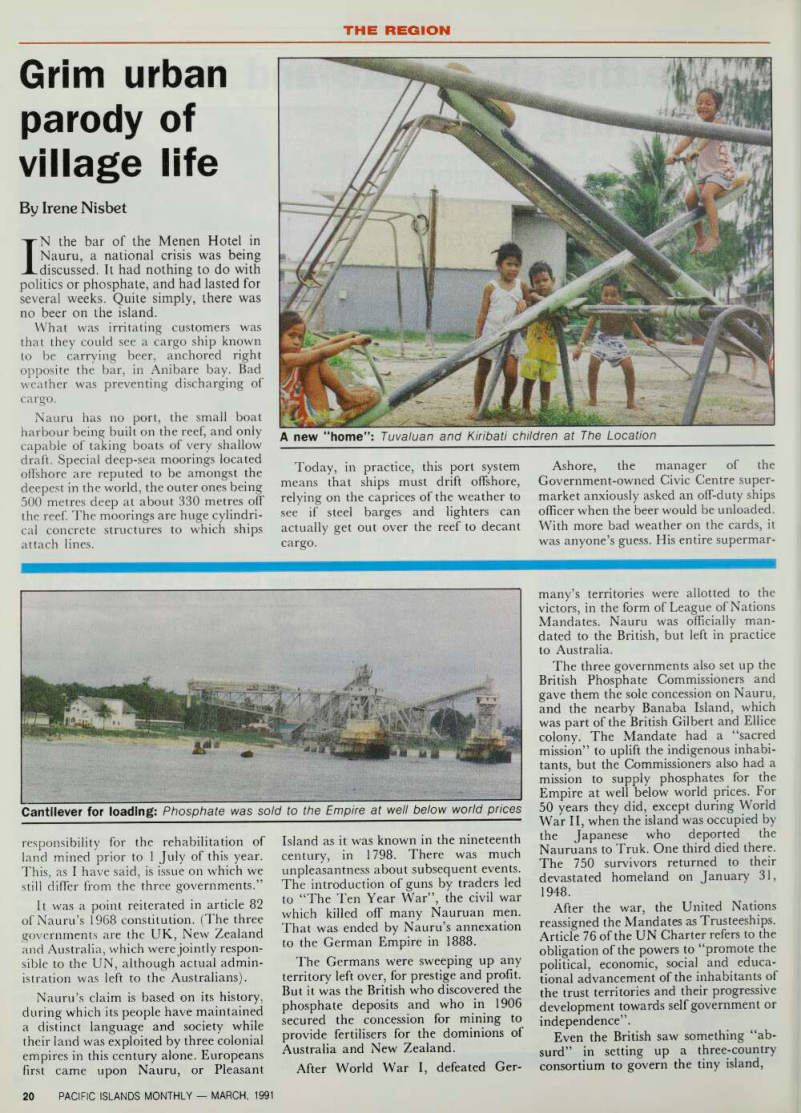
The three governments also set up the British Phosphate Commissioners and gave them the sole concession on Nauru, and the nearby Banaba Island, which was part of the British Gilbert and Ellice colony. The Mandate had a “sacred mission” to uplift the indigenous inhabi tants, but the Commissioners also had a mission to supply phosphates for the Empire at well below world prices. For 50 years they did, except during World War 11, when the island was occupied by the Japanese who deported the Nauruans to Truk. One third died there.
The 750 survivors returned to their devastated homeland on January 31, 1948.
After the war, the United Nations reassigned the Mandates as Trusteeships.
Article 76 of the UN Charter refers to the obligation of the powers to “promote the political, economic, social and educa tional advancement of the inhabitants of the trust territories and their progressive development towards self government or
independence”.
Even the British saw something “ab surd” in setting up a three-country consortium to govern the tiny island,
Cantilever for loading: Phosphate was sold to the Empire at well below world prices
with phosphates rather than people was obvious. In the end a Trusteeship agreement was satisfied everyone except perhaps the Nauruans, who had not been consulted even by their would be defenders at the UN. However, the idea that the world was watching inspired a reaction against the paternal ism of the administration.
By 1948, Nauruans were talking of petitioning the UN. In the UN the Soviets called Nauru a slave camp, and hinted darkly at the comparative price of phosphate in the open markets. In London, the House of Commons public accounts committee was told the three
countries were enjoying “high grade
phosphate for about half the price we have to pay for it elsewhere.”
Early Nauruan’ worries about their homeland disappearing from beneath them had been met with assurances that long-term investment would make the Nauruans “the wealthiest natives in the world”. But it was not until 1964 that they were allowed independent advice for royalty negotiations, and even then their first choice was disallowed by the Australian administration.
Paternalism was most apparent in the pressure for the islanders to resettle, which the BPC thought was the obvious
solution to the shrinking land supply.
Their example was the resettlement of Banabans from Ocean Island (Banaba) to Rabi, in Fiji. However, this was achieved under the impetus of Japanese
occupation and devastation, Deßoburt, who had emerged as leader, resisted, realising that if the Nauruans were resettled on the main land, they would be seen as “another tribe of Aboriginals”. At the time, Queensland still had on the books laws against “coloureds” owning shops or working sugarcane fields.
The administration discounted the Nauruans’ sense of national identity, fuelled by geographical isolation and a language distinct from any other in the Pacific. They were still aware of the value of their only export. As Deßoburt told the Australians and the BPC in 1959, “the best terms possible are where we own the phosphate and we exploit it to the maximum possible.”
New Zealand summed the tra ditional view when it told the Trusteeship Council in 1960 that the 2000 Nauruans “cannot be regarded as a nation in embryo; it is in no sense a potential state”. So Deßoburt caught them all off-balance when, as the first Nauruan to address the UN Trusteeship Council, he pushed for independence.
The UN’s 1960 Declaration on Decolonisation provided fertile ground on which to work.
In 1965 Nauru set the date it wanted
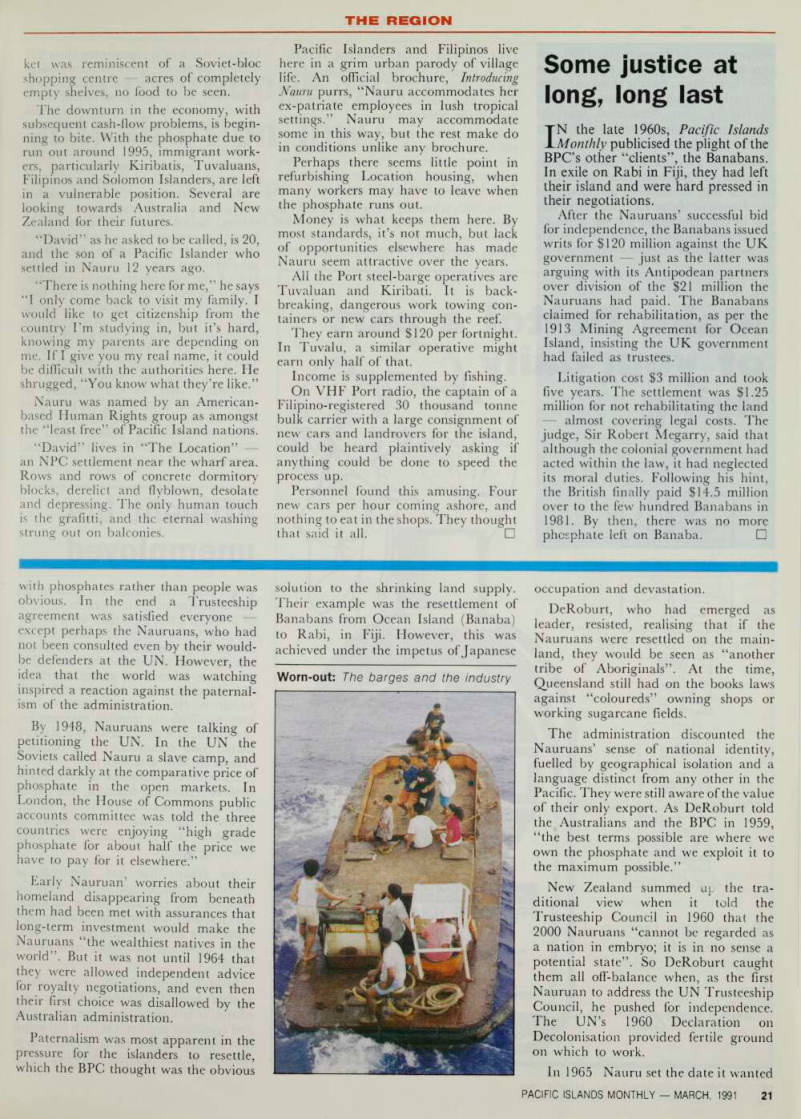
Worn-out: The barges and the industry
independence as January 31, 1968, the anniversary of their return from Truk in 1946. In addition, having ruled out offers of resettlement which did not give them sovereignty, they demanded that the three governments should rehabilitate the mined-out land.
Australia fought a rearguard action to maintain a hand in the phosphate business but, in the end, it was agreed that Nauru would pay $2l million to buy out BPC’s operations on its territory.
Similarly, Australia’s attempts to retain responsibility for defence foundered on
their inability to do so during WWII.
On January 31, 1968, the Republic of Nauru became the world’s smallest nation and one of its richest, since it now owned the phosphates.
It negotiated special membership of the Commonwealth, and is a member of the South Pacific Forum and other regional bodies. And it acceded to the International Court of Justice.
In 1985, when the Nauruans heard the international assets of the BPC were to be wound up, it whetted their appetite for parity with the Banabans, not least
because much of it represented their S2l million payment. They determined to restate their demand for rehabilitation.
In 1987, the Nauru government estab lished a Commission to study the prob lem of rehabilitation, to which the Australian government refused to give evidence. Based upon its findings, the Republic initiated proceedings in the International Court of Justice in 1989.
By then there were more consider ations than simply righting a historic wrong. Nauru’s financial future was no longer as secure as it had appeared earlier, and the deadline for serious rehabilitation was approaching, as the last of the phosphates were extracted.
Nauru maintains that it has a trust fund to reclaim the land affected by mining since 1967, but that the project needs a comprehensive plan for the whole island.
Roger Clark, Professor of Interna tional Law at Rutgers University told PIM, “I think the Nauruans have a reasonable shot it’s certainly an arguable case. If they win, the precedent has interesting possibilities for other Trust territories like Palau, which has always held that US has not functioned under the UN Character.” □