Seeking a smoother ride for aid
pp. 17-18 · Read in the full issue
The Region
In the nervous '9os, the Pacific must iron out bumps in the supply and use of aid
MORE foreign aid dollars per person are being poured in the South Pacific than any other part of the developing world.
Yet economic growth in island countries has fluctuated wildly from year to year, and struggled to keep pace with
steadily increasing populations.
Somewhere, somehow, something has gone seriously wrong in the aid and
development game.
Faced with this, the South Pacific Forum Secretariat convened an unprece dented gathering of officials from island governments, donor countries and aid organisations at its Suva headquarters last month.
Dubbed simply as the “Pacific Island Countries-Donors Meeting”, it took three days to tackle the fundamental problem of how the millions spent could be used more efficiently, and so reap a greater developmental reward.
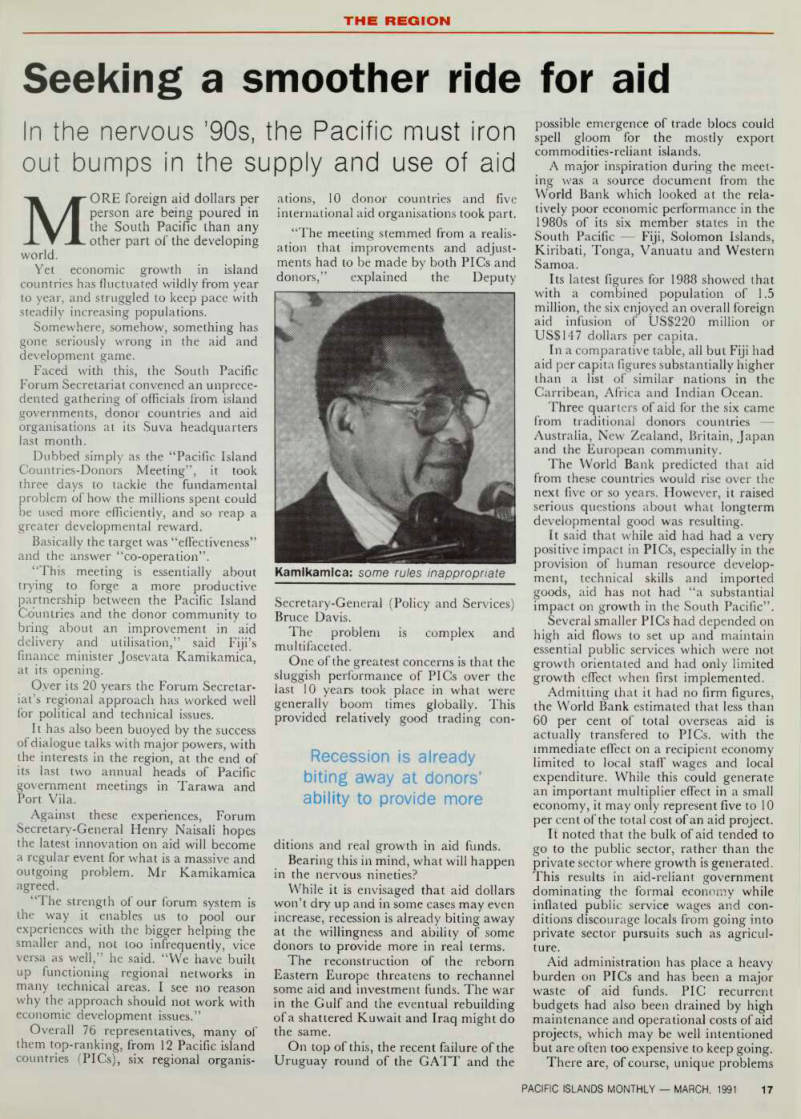
Basically the target was “effectiveness” and the answer “co-operation”, “This meeting is essentially about trying to forge a more productive partnership between the Pacific Island Countries and the donor community to bring about an improvement in aid delivery and utilisation,” said Fiji’s finance minister Josevata Kamikamica, at its opening.
Oyer its 20 years the Forum Secretar iat’s regional approach has worked well for political and technical issues.
It has also been buoyed by the success of dialogue talks with major powers, with the interests in the region, at the end of its last two annual heads of Pacific government meetings in Tarawa and Port Vila.
Against these experiences, Forum
Secretary-General Henry Naisali hopes
the latest innovation on aid will become a regular event for what is a massive and outgoing problem. Mr Kamikamica agreed.
“The strength of our forum system is the way it enables us to pool our
experiences with the bigger helping the
smaller and, not too infrequently, vice versa as well,” he said. “We have built up functioning regional networks in many technical areas. I see no reason why the approach should not work with economic development issues.”
Overall 76 representatives, many of them top-ranking, from 12 Pacific island countries (PICs), six regional organis
ations, 10 donor countries and five international aid organisations took part.
“The meeting stemmed from a realis ation that improvements and adjust ments had to be made by both PICs and donors,” explained the Deputy
Secretary-General (Policy and Services)
Bruce Davis.
The problem is complex and multifaceted.
One of the greatest concerns is that the sluggish performance of PICs over the last 10 years took place in what were generally boom times globally. This
provided relatively good trading con-
Recession is already biting away at donors’ ability to provide more
ditions and real growth in aid funds.
Bearing this in mind, what will happen in the nervous nineties?
While it is envisaged that aid dollars won’t dry up and in some cases may even increase, recession is already biting away at the willingness and ability of some donors to provide more in real terms.
The reconstruction of the reborn Eastern Europe threatens to rechannel some aid and investment funds. The war in the Gulf and the eventual rebuilding of a shattered Kuwait and Iraq might do the same.
On top of this, the recent failure of the Uruguay round of the GATT and the
possible emergence of trade blocs could spell gloom for the mostly export commodities-reliant islands.
A major inspiration during the meet
ing was a source document from the World Bank which looked at the rela tively poor economic performance in the 1980 s of its six member states in the South Pacific Fiji, Solomon Islands, Kiribati, Tonga, Vanuatu and Western Samoa.
Its latest figures for 1988 showed that with a combined population of 1.5 million, the six enjoyed an overall foreign aid infusion of USS22O million or USSI47 dollars per capita.
In a comparative table, all but Fiji had aid per capita figures substantially higher than a list of similar nations in the Carribean, Africa and Indian Ocean.
Three quarters of aid for the six came from traditional donors countries - Australia, New Zealand, Britain, Japan
and the European community.
The World Bank predicted that aid from these countries would rise over the next five or so years. However, it raised serious questions about what longterm
developmental good was resulting.
It said that while aid had had a very positive impact in PICs, especially in the provision of human resource develop ment, technical skills and imported goods, aid has not had “a substantial impact on growth in the South Pacific”.
Several smaller PICs had depended on high aid flows to set up and maintain essential public services which were not growth orientated and had only limited growth effect when first implemented.
Admitting that it had no firm figures, the World Bank estimated that less than 60 per cent of total overseas aid is actually transfered to PICs. with the immediate effect on a recipient economy limited to local staff wages and local expenditure. While this could generate an important multiplier effect in a small economy, it may only represent five to 10 per cent of the total cost of an aid project.
It noted that the bulk of aid tended to go to the public sector, rather than the private sector where growth is generated.
This results in aid-reliant government dominating the formal economy while inflated public service wages and con ditions discourage locals from going into private sector pursuits such as agricul ture.
Aid administration has place a heavy burden on PICs and has been a major waste of aid funds. PIC recurrent budgets had also been drained by high maintenance and operational costs of aid projects, which may be well intentioned but are often too expensive to keep going.
There are, of course, unique problems
Kamikamica: some rules inappropriate
in the Pacific isolation between islands and the rest of the world; diseconomies of scale of tiny popu lations and local markets; lack of manpower, skills and natural resources and vulnerability to natural disasters.
But, according to the World Bank and last month’s meeting, much of the solution lies in a more strategic ap proach. Traditionally many PICs have produced comprehensive five-year plans often little more than shopping lists aimed at donors. The consensus now is that this should be replaced by the development of sound Macro- Economic policies followed by detailed planning in key economic sectors, to produce private and public investment projects more likely to succeed.
Last month’s meeting agreed that this could only be achieved if donors and PICs co-ordinated their efforts via regular consultation. There are so many donor organisations now active in the region, they must talk more.
A major topic for such consultation will be how to foster the private sector.
It is often seen as the engine for growth, so the Secretariat would work more closely with PICs and donors on this.
A major breakthrough at the meet ing was that donors saw the need to help PICs cope with the aid planning.
Officials noted that for years consult ants had come to an island country and laid down a plan which was often accepted without hard questions on its
suitability or viability.
“Consultants come in, set up a project and walk out,” said secretariat
economic development director Garry
Wiseman. “Often the project then falls apart or becomes a drain on tiny
recurrent budgets.”
Because of the small nature of some PICs, existing regional organisations could play a major cost-effective role in areas including transport and com munications and marine resources. But such regional programs should be
driven by national priorities.
Mr Kamikamica bemoaned the lack of expertise in PICs and said many rules and regulations imposed by foreign donors for aid should be relaxed.
“To apply the same rules to a project costing a few thousand dollars on a remote Pacific atoll to one costing millions in China, is absurd and wasteful,” he said. “It is an old criticism that many donors find it difficult to get to grips with the micronature of the South Pacific.”
Most PICs are former colonies with relatively few years of independence and, with new found sovereignty, they want a greater say. If they are eased into the driver’s seat with the help of donors, the road to economic growth may not be so bumpy. □