to Clive and Coalition
pp. 15-16 · Read in the full issue
Adi Kuini’s vows ... to Clive and Coalition
Marriage is only one part of the party leader’s plans for the next three years
IN a way it was a bombshell. So perhaps it was fitting that the surprise announcement by Adi Kuini Bavadra that she will marry Australian lobbyist Clive Speed shared the front page of The Fiji Times with the outbreak of the Gulf War, “A few people are disturbed about it,” admitted the 41-year-old head of Fiji’s deposed Coalition.
“But friends and members of the party generally feel that I have been through a traumatic experience in the last three years and that I deserve a bit of
happiness.
“They are being very understanding about it and very human to the extent that they are not even worried about the political implications of my marrying Nevertheless those implications could be crucial to the Coalition.
Barely a year ago she was made leader following the death from cancer of her then husband, Fiji’s last elected Prime Minister and the number one victim of two 1987 military coups, Timoci Bavadra.
Dubbed by the media as a “widow of democracy”, she was likened to Benazir Bhutto of Pakistan and Corazon Aquino of the Philippines, who also had been thrust into politics by tragedy.
Now, with a diamond and sapphire engagement ring on her finger and a wedding date set for April 27 in Canberra, her image has been trans formed.
It will be her third marriage (her first, to a now senior-ranking Fiji army officer, ended in divorce) and Mr Speed’s second. She has four children and he two.
Like Adi Kuini he also lost his spouse from cancer in 1989.
There is a certain degree of irony in their relationship. They first met in 1982 when Speed, a former Australian Broad
casting Corporation radio producer, was
consultant to Prime Minister Ratu Sir Kamisese Mara in an election campaign
marred by allegations of “dirty tricks”.
At that time, the Bavadras had not entered politics. Speed and Adi Kuini worked closely when she was a public servant in the Ministry of Information.
“Timoci and Clive were good friends as well and that is im portant to me,” she said. “Nothing will change my memories of Timoci.”
Five years later Dr Bavadra’s multi racial Coalition ended Ratu Mara’s
uninterrupted 17 years of power since independence, in a shock election win which sparked the first coup a month later.
Today Adi Kuini and Ratu Mara, now Interim Prime Minister, are politi cal opponents while Speed, now a Canberra-based assistant direct of the Australian Business Council, says he has nothing to do with Fiji politics.
Adi Kuini says their longtime friend ship was rekindled when she visited Australia last year and deepened after his son was married in Fiji a few months later.
“Clive lost his wife about the same year I lost my husband . . . shared ex periences have brought us together.”
Although Adi Kuini intends to keep her late husband’s name, questions have been raised about her political viability.
Soon after dropping the news of her romance she declared “it’s business as usual” as far as her leadership was concerned. Besides, having a companion would make her a happier person and therefore a better leader, she argued.
Senior Coalition members quietly con curred, adding that it was a personal matter.
But there is little doubt that they could do without such a complication. By its own admission the party’s structure and finances have fallen into disarray since the coups. There is also speculation of a
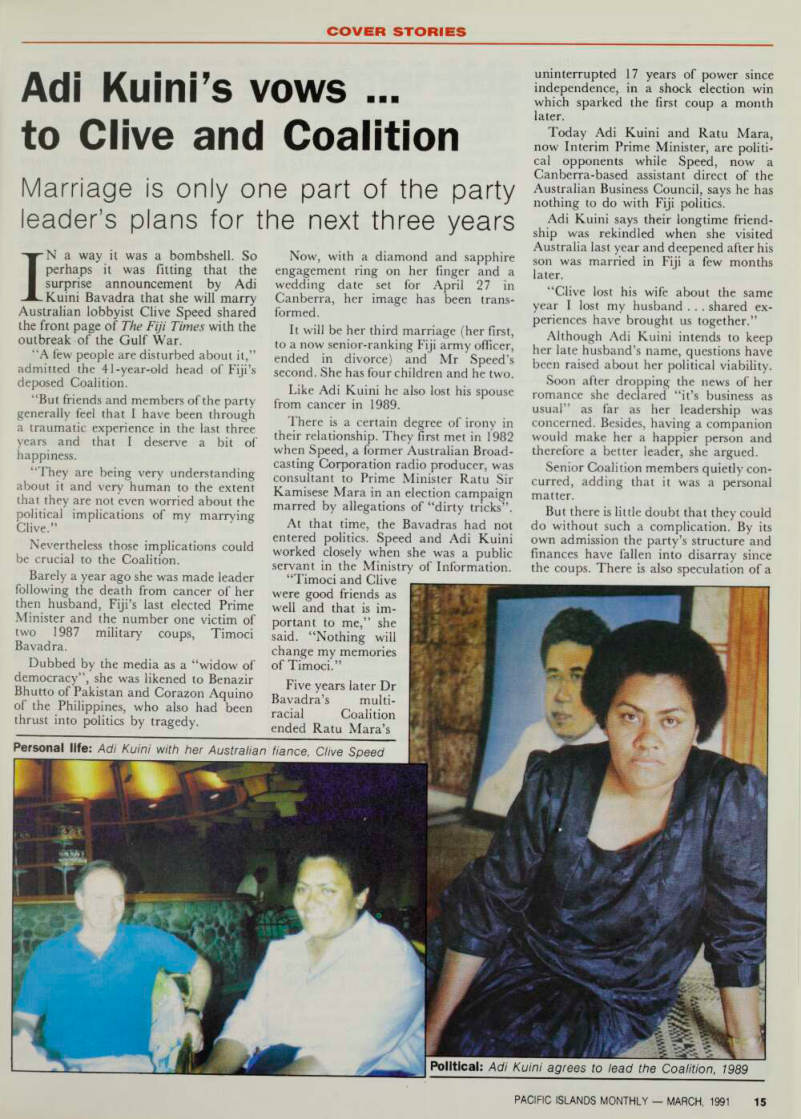
Personal life: Adi Kuini with her Australian fiance, Clive Speed
Political: Adi Kuini agrees to lead the Coalition, 1989
possible split between factions within its two partners, Adi Kuini’s Fiji Labour Party (FLP) and the largely ethnic Indian-backed National Federation Party (NFP), ahead of a crucial debate in July over whether to boycott elections scheduled for the end of the year, (These are more likely to be held in 1992.) The boycott call was made last July by the Coalition executive just before the Interim Government adopted a new constitution favouring indigenous Fijians over others, including Indians.
The document broadly enshrines the
aims of the two coups. As such the Coalition has rejected it as racist and undemocratic, despite an insistence by the Government that it is the best way to bring back parliamentary rule.
Originally, the idea of participation was seen as ideologically unacceptable as it would be seen as giving legitimacy to the constitution.
But in recent months a growing number of rank-and-file FLP members, plus several NFP stalwarts, have warned that staying away could be a one-way ticket to the political wilderness. It could
also result in the forfeiture of 27 seats reserved for Indians, to those who would be more than willing to deal with a pro-
Fijian government.
A final decision on the boycott issue will be made at a Coalition convention probably in July.
“I agree with the boycott stand because it is official and because it is a principled stand,” Adi Kuini said.
“But I certainly would not be one who would not respond to the wishes of the people if it becomes increasingly evident that a big majority of our supporters and delegates support participation.”
Adi Kuini’s main task is to reach consensus on this while rebuilding the
Coalition’s organisation.
Already decisions have been made to reactivate party branches across the country. There is also talk of launching a public “education” programme, ap parently to be based on the aborted “Operation Sunrise” which never really got off the ground after the coups.
But what sort of support can she hope to muster when the basic question of fielding candidates remains unresolved?
On top of this, how can she convince the electorate of her commitment to Fiji when her husband-to-be is to remain in Canberra?
Over the last few weeks Adi Kuini and Speed have both made several trips between Australia and Fiji and say this will continue after the wedding.
“I don’t know how we will manage but we will just have to make the best of things,” said Speed, who has agreed to his future wife remaining in the Fiji spotlight for the present, at least.
But in the long term the Coalition must find a new head. She has no plans to stay on after the start of 1993.
“I feel that three years (as leader) would be reasonable. Because of all the hard times we have been through, and for a widow with young children, and for someone of my age I am only 41 I feel two or three years is reasonable.”
She’s quick to add that she might leave sooner.
“If the party thinks they have a reason to want me to give it up earlier then that will be up to the party. I am a very democratic leader and we are a very
democratic party.”
In any case she never intended to lead the Coalition forever.
In November 1989 tens of thousands of people gathered in Viseisei Village for Dr Bavadra’s funeral. Within days Adi Kuini was asked to assume leadership.
“I was overwhelmed by the emotion of the moment, the feeling the people had at the time of the funeral.
“So when the approach was made I had little choice but to say yes.”
She said it had been an obligation based on her respect for Dr Bavadra.
Now her “assignment” was almost complete. D