Interview
pp. 52-53 · Read in the full issue
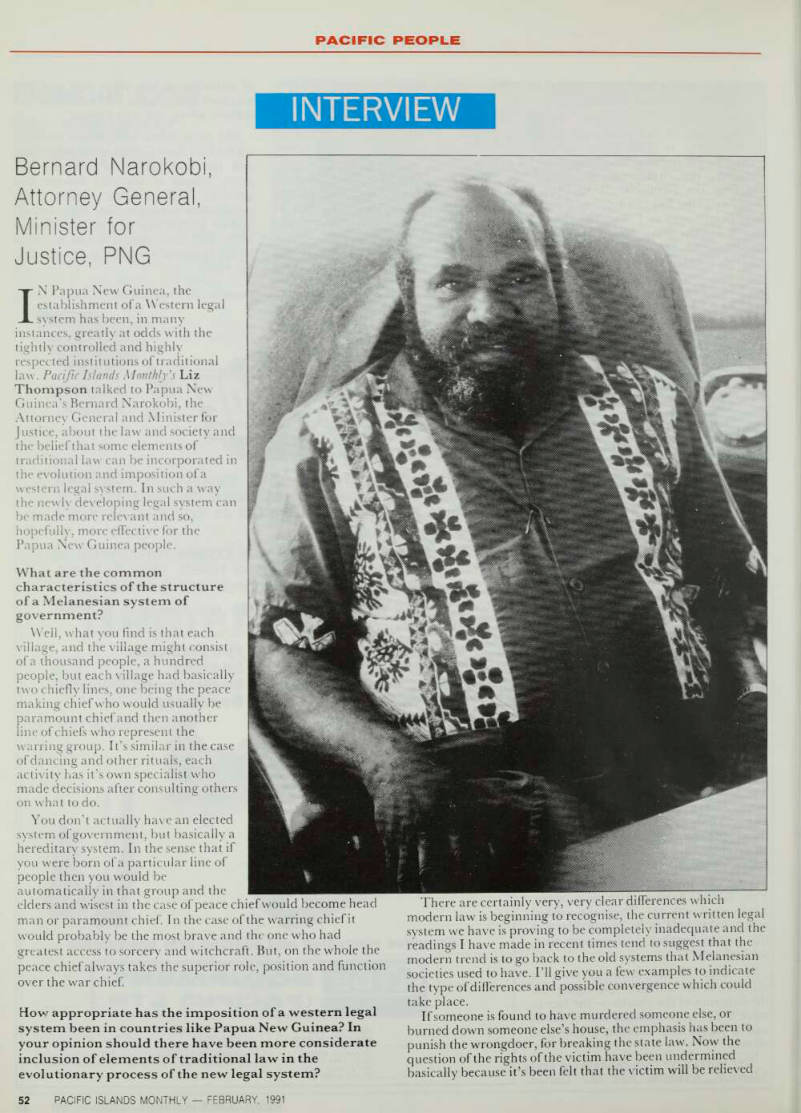
Bernard Narokobi,
Attorney General,
Minister for
Justice, PNG
IN Papua New Guinea, the establishment of a Western legal system has been, in many instances, greatly at odds with the
tightly controlled and highly
respected institutions of traditional law. Pacific Islands Monthly's Liz Thompson talked to Papua New Guinea’s Bernard Narokobi, the Attorney General and Minister for Justice, about the law and society and the belief that some elements of traditional law can be incorporated in the evolution and imposition of a western legal system. In such a way the newly developing legal system can be made more relevant and so, hopefully, more effective for the Papua New Guinea people.
What are the common characteristics of the structure of a Melanesian system of
government?
Well, what you find is that each village, and the village might consist of a thousand people, a hundred people, but each village had basically two chiefly lines, one being the peace making chief who would usually be paramount chief and then another line of chiefs who represent the warring group. It’s similar in the case of dancing and other rituals, each activity has it’s own specialist who made decisions after consulting others on what to do.
You don’t actually have an elected system of government, but basically a hereditary system. In the sense that if you were born of a particular line of people then you would be automatically in that group and the
elders and wisest in the case of peace chief would become head man or paramount chief. In the case of the warring chief it would probably be the most brave and the one who had greatest access to sorcery and witchcraft. But, on the whole the peace chief always takes the superior role, position and function over the war chief.
How appropriate has the imposition of a western legal system been in countries like Papua New Guinea? In your opinion should there have been more considerate inclusion of elements of traditional law in the evolutionary process of the new legal system?
There are certainly very, very clear differences which modern law is beginning to recognise, the current written legal system we have is proving to be completely inadequate and the readings I have made in recent times tend to suggest that the modern trend is to go back to the old systems that Melanesian societies used to have. I’ll give you a few examples to indicate the type of differences and possible convergence which could take place.
If someone is found to have murdered someone else, or burned down someone else’s house, the emphasis has been to punish the wrongdoer, for breaking the state law. Now the question of the rights of the victim have been undermined basically because it’s been felt that the victim will be relieved
when the offender is imprisoned. In this way the victim is not really taken into consideration at all, whereas you find in old traditional law, the victim is the paramount consideration.
In fact, so much so that traditionally the wrong-doing is responded to with murder, or great damage being inflicted on the offender and his line of people. I have often felt that the system we have inherited is wrong because the offender goes to jail, he is well protected, behind bars. His freedom is deprived but in the village he could face death, even for a petty stealing offence. Because he is locked away he cannot do anything to amend and make good what wrong he has done.
Instead the state provides security for him, feeds him, houses him, and in some ways he comes out quite relieved because he’s been protected whilst time’s been given to others to forget the wrong.
How can you use traditional law, based on compensation of the victim, to produce a more appropriate legal system now?
I feel we should now move and we are moving into a system where if an offender is convicted of a
criminal offence, that court, in the overall process of doing justice, takes into account the victim’s plight and situation. For instance, if the state is feeding this person for three meals a day, perhaps one meal could be denied that person and some form of payment made to assist the victim.
Alternatively he could be engaged to produce things which could be sold, money could be raised to pay to assist the victim, or, in a completely safe situation where the prisoner is harmless, he could be supervised, if he committed arson and burnt down someones’ house, he could be supervised in assisting to rebuild the victim’s property.
Obviously with traditional law there were traditional communal methods of enforcement, people took responsibility for their own area, they administered payback or regulated their own people.
What effect has the institutionalisation of the law enforcement bodies had on the community?
The increased professionalisation of police and law
enforcement agencies has effectively disempowered and
disposessed the people of their right, their duty also, to be engaged in law enforcement. Issues like self defence, the right to defend your property have really become subservient, subverted The people have become apathetic, disinterested.
I hey tend to wait for the police to come and protect them and provide security, when in fact, traditionally every man has the right to defend himself against any invasion of his person or his property. I think we should relook at the role and the function of the police force in the community and the powers ot the people, of the citizen in terms of his self defence, ought to be better defined. The power of the police in relation to the general law and order situation, has disempowered the people. \ here 15 of ' c ourse a great need for specialised police but I think the community and the individual ought to have their role re emphasised.
What about the imposition of the idea of a national identity, a nation, obviously very alien to a country
made up of over 700, autonomous clan groups? What kind of effect does this have?
The entire concept of the country, the idea of the nation state, is an act of violence and really an act of hostility against native village independence and village autonomy. You have 700 or 800 language groups with over 2000 villages, each having it’s own autonomous existence, then you have superimposed on it a legal entity called Papua New Guinea.
This is one of the basic factors we have to grapple with. \ ou find today the demands for land compensation, the secessionist movements, they are caught up in this clash. A fundamental clash between village pride, independence, autonomy, on which you have superimposed a nation with legal, political machines and police to actually control and
dispossess and disempower the people.
So this is one of the basic roots we have, one of the basic conflicts. So the struggle, throughout the process of nation building, national development, is a struggle to strike a balance and compromise the social order as a small unit and it’s economic, social, ecological order, against a much wider
national and international
superimposition.
How do you resolve the notion of local landowner ownership and the state in instances in which the state wants to mine what is below the ground, or fish in particular waters. How do you reconcile this ownership with the idea of national development?
Well, for instance, the water the question of water, who actually owns the water which flows through the river or sits in a lake. The traditional attitudes are that the landowners don’t own, but they actually control, the waters. Then you have the state coming down with state legislation, like the Water Resources Act of 1983, declaring that all water is owned by the state. You have minerals, the question of gold, oil, copper, and so on. They might be thousands of
metres down under the ground, but to get there you have to go through the top soil. To extract it you have to destroy very wide and large areas of land and the village or the group that claims that it owns the area has complete dominion over whatever might be under ft. Then the state comes down with it’s mineral legislation, saying the state owns all minerals. The Law Reform Commission has been trying to resolve some of these fundamental conflicts.
I think we have to make a commitment, either we allow the present law to continue and that is to say that traditional landowners are to be dispossessed, that they have no rights other than to be paid just compensation for the destruction of their land and resources, or in the alternative, to make a change to the mining legislations and allow the owners of the land to actually own the minerals. However the state would still have the licensing authorities so that the agreements between the developer and the landowners benefit everyone fairly.
The developer is entitled to fair returns to his investment and his technology, similarly the state representing all the people is also entitled to a fair return and the landowners whose resources are to be exploited, a proper evaluation of that resource ought to be made and be recognised as their equity m the whole process of development. □