for designer
pp. 50-51 · Read in the full issue
Pacific People
Flash of glory for designer of PNG flag
IN 1971, on Papua New Guinea’s National Day, a young Papuan girl in an orange and black dress walked onto the flagpole in front of the grand stand at the Hubert Murray Stadium in Konedobu, Port Moresby. With the help of a policeman she raised and unfurled the new Papua New Guinea flag for the first time.
Thousands of people rushed forward to see her. The event was the highlight of the day’s celebrations.
For 18-year-old Susan Karieke, de signer of the flag, it was a historic moment.“l will never forget. I felt very special, so proud, I had tears in my eyes.”
Since that day the flag has been raised over a thousand, maybe a million times in PNG and all over the world. It’s been
flying atop flagpoles as the country’s
number one symbol ever since. When it is raised people come to attention and salute it.
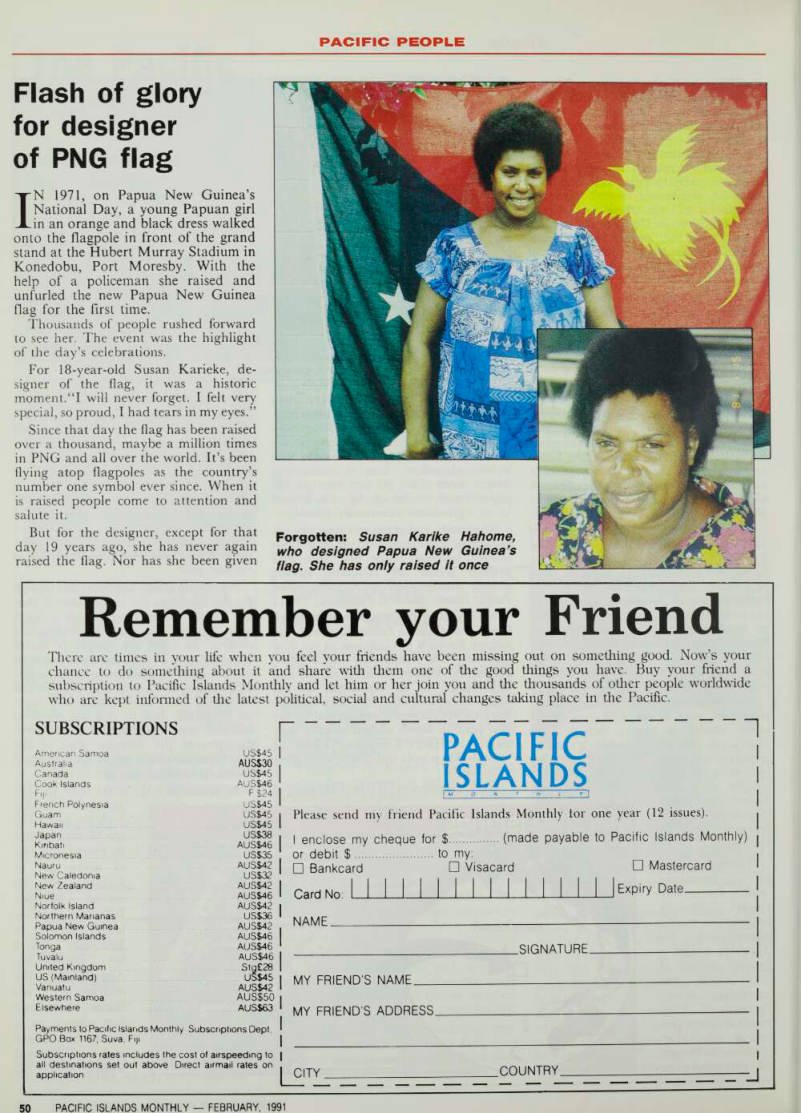
But for the designer, except for that day 19 years ago, she has never again raised the flag. Nor has she been given
Forgotten: Susan Karike Hahome, who designed Papua New Guinea’s flag. She has only raised it once
the respect which has been awarded to the symbol which she dreamed up.
She has never been part of the country’s official independence celebr ations, except in 1985 when she was invited to the flagraising ceremony and awarded the independence medal.
Tearfully she recollects: “I thought I would raise the flag but I did not. I had tears in my eyes as I watched the girl guides and the army marching up with the flag and raising it. I felt really insignificant, left out, forgotten.”
Except for that day, she says: “Every independence day I put my head down and cry.”
But hopefully this may soon change.
The Gordons Catholic Mamas Associ ation of which Susan is a member and the National Council of Women, after hear ing her story, will be submitting her name for this year’s Queen’s honours list.
They will also ask that as long as she is still living and in Port Moresby, she raises the flag at every official indepen dence flagraising ceremony in Port Moresby. And where she cannot do so, her children will take her place.
Susan, now 35, is from Meii village in the Gulf province. Her father was of the Elema people, a people well known for their art, especially the striking carved and painted boards which represent the spirit of clan heroes.
At the age of 12 Susan went to the newly opened school at the Catholic Mission, Araimiri. But she didn’t like it and left after one year.
Then, however, Sr Joseph Mary, a
teaching and nursing Sister, arrived at
Araimiri. She found Susan living aimlessly and started to teach her to cook and sew, and draw and paint. From the beginning Susan showed talent and was encouraged to concentrate on painting.
Her creations were inspired by the memories of the spirit boards of the Gulf.
The boards were kept by a much feared witch doctor. They were held in great awe and only men were permitted to see them. But the aging witchdoctor made an exception in Susan’s case, because her father looked after him.
When Sr Joseph Mary transferred to Yule Island, Bereina, 100 miles away, Susan went with her. There she worked as a nursing aide to Sr Joseph Mary at the mission hospital. In her spare time,
she painted.
In some of her drawings there is evidence of her Catholic upbringing and the influence of the church the face in some of her work becomes that of Christ and a jagged line becomes a crown of thorns.
Her works have been exhibited in Port Moresby, Australia and the United
States. Many have been sold.
So how was the flag born? In 1970 the House of Assembly launched a flag
designing competition. It suggested
paradise, the southern cross, and yellow and green.
When Sr Joseph Mary told Susan to enter the competition Susan refused. She didn’t think she could do it. “But Sr Joseph Mary insisted and told me, you do it and God will help you.”
So Susan streaked a diagonal line across a piece of paper, putting the bird
of paradise on the right side and the southern cross on the left, and chose the colours white, red and yellow, She chose white to represent the lime with which New Guilleai ’ s chew betelnut and red and yellow to represent the many colours of beautiful flowers that grow in PNG’s tropical climate. “We could tell it was a good one right away,” said Sr Joseph Mary in an interview in 1970. And sure enough it was accepted by the House of Assembly as the new flag for PNG. □