contempt charges
p. 44 · Read in the full issue
Media
Samoan editor cleared of contempt charges
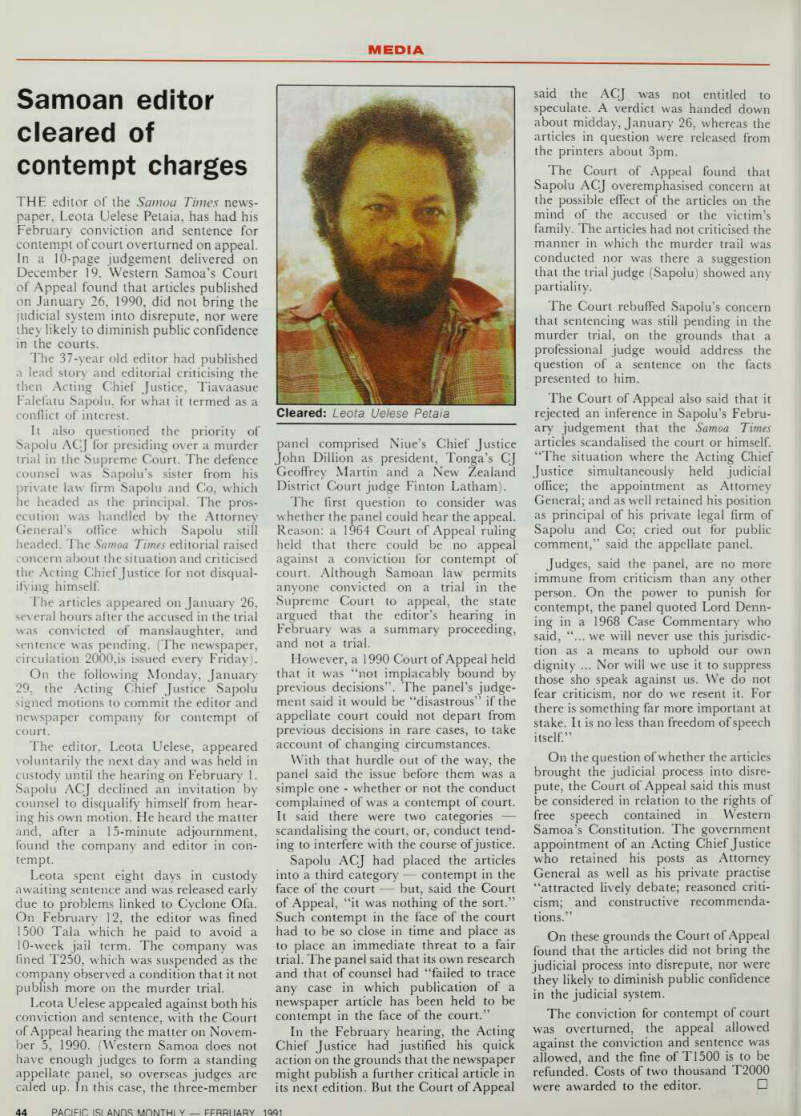
THE editor of the Samoa Times news paper, Leota Uelese Petaia, has had his February conviction and sentence for contempt of court overturned on appeal.
In a 10-page judgement delivered on December 19, Western Samoa’s Court of Appeal found that articles published on January 26, 1990, did not bring the judicial system into disrepute, nor were they likely to diminish public confidence in the courts.
The 37-year old editor had published a lead story and editorial criticising the then Acting Chief Justice, Tiavaasue Falefatu Sapolu, for what it termed as a conflict of interest.
It also questioned the priority of Sapolu ACJ for presiding over a murder trial in the Supreme Court. The defence counsel was Sapolu’s sister from his private law firm Sapolu and Co, which he headed as the principal. The pros ecution was handled by the Attorney General’s office which Sapolu still headed. The Samoa Times editorial raised concern about the situation and criticised the Acting Chief Justice for not disqual
ifying himself.
The articles appeared on January 26, several hours after the accused in the trial was convicted of manslaughter, and sentence was pending. (The newspaper, circulation 2000,is issued every Friday).
On the following Monday, January 29, the Acting Chief Justice Sapolu signed motions to commit the editor and newspaper company for contempt of court.
The editor, Leota Uelese, appeared voluntarily the next day and was held in custody until the hearing on February 1.
Sapolu ACJ declined an invitation by counsel to disqualify himself from hear ing his own motion. He heard the matter and, after a 15-minute adjournment, found the company and editor in con tempt.
Leota spent eight days in custody awaiting sentence and was released early due to problems linked to Cyclone Ofa.
On February 12, the editor was fined 1500 Tala which he paid to avoid a 10-week jail term. The company was fined T 250, which was suspended as the company observed a condition that it not publish more on the murder trial.
Leota Uelese appealed against both his conviction and sentence, with the Court of Appeal hearing the matter on Novem ber 5, 1990. (Western Samoa does not have enough judges to form a standing appellate panel, so overseas judges are caled up. In this case, the three-member
panel comprised Niue’s Chief Justice
John Dillion as president, Tonga’s CJ
Geoffrey Martin and a New Zealand District Court judge Finton Latham).
The first question to consider was whether the panel could hear the appeal.
Reason: a 1964 Court of Appeal ruling held that there could be no appeal against a conviction for contempt of court. Although Samoan law permits anyone convicted on a trial in the Supreme Court to appeal, the state argued that the editor’s hearing in February was a summary proceeding, and not a trial.
However, a 1990 Court of Appeal held that it was “not implacably bound by previous decisions”. The panel’s judge ment said it would be “disastrous” if the appellate court could not depart from previous decisions in rare cases, to take account of changing circumstances.
With that hurdle out of the way, the panel said the issue before them was a simple one - whether or not the conduct complained of was a contempt of court.
It said there were two categories scandalising the court, or, conduct tend ing to interfere with the course of justice.
Sapolu ACJ had placed the articles into a third category contempt in the face of the court but, said the Court of Appeal, “it was nothing of the sort.”
Such contempt in the face of the court had to be so close in time and place as to place an immediate threat to a fair trial. The panel said that its own research and that of counsel had “failed to trace any case in which publication of a newspaper article has been held to be contempt in the face of the court.”
In the February hearing, the Acting Chief Justice had justified his quick action on the grounds that the newspaper might publish a further critical article in its next edition. But the Court of Appeal
said the ACJ was not entitled to speculate. A verdict was handed down about midday, January 26, whereas the articles in question were released from the printers about 3pm.
The Court of Appeal found that Sapolu ACJ overemphasised concern at the possible effect of the articles on the mind of the accused or the victim’s family. The articles had not criticised the manner in which the murder trail was conducted nor was there a suggestion that the trial judge (Sapolu) showed any partiality.
The Court rebuffed Sapolu’s concern that sentencing was still pending in the murder trial, on the grounds that a professional judge would address the question of a sentence on the facts presented to him.
The Court of Appeal also said that it rejected an inference in Sapolu’s Febru ary judgement that the Samoa Times articles scandalised the court or himself.
“The situation where the Acting Chief Justice simultaneously held judicial office; the appointment as Attorney General; and as well retained his position as principal of his private legal firm of Sapolu and Co; cried out for public comment,” said the appellate panel.
Judges, said the panel, are no more immune from criticism than any other person. On the power to punish for contempt, the panel quoted Lord Denn ing in a 1968 Case Commentary who said, “... we will never use this jurisdic tion as a means to uphold our own dignity ... Nor will we use it to suppress those sho speak against us. We do not fear criticism, nor do we resent it. For there is something far more important at stake. It is no less than freedom of speech itself.”
On the question of whether the articles brought the judicial process into disre pute, the Court of Appeal said this must be considered in relation to the rights of free speech contained in Western Samoa’s Constitution. The government appointment of an Acting Chief Justice who retained his posts as Attorney General as well as his private practise “attracted lively debate; reasoned criti cism; and constructive recommenda tions.”
On these grounds the Court of Appeal found that the articles did not bring the judicial process into disrepute, nor were they likely to diminish public confidence in the judicial system.
The conviction for contempt of court was overturned, the appeal allowed against the conviction and sentence was allowed, and the fine of Tl5OO is to be refunded. Costs of two thousand T2OOO were awarded to the editor.
Cleared: Leota Uelese Petaia