Putting Maori into official mouths
p. 43 · Read in the full issue
Culture
By Angela McCarthy
ON Rarotonga, an island con sidered an easy tourist destination because of its standard of Eng lish, politicians and traditional leaders are now worried that their own Maori language is fast becoming a second language.
In May this year a new Maori Language Committee (MLC) was set up,
in conjunction with the Edu cation and Cultural Develop ment Departments, “to maintain and enhance more usage of Cook Island Maori” in the workplace, mass me dia, schools, churches, the arts and homes.
“We want people to write, think and explain in Maori to each other as much as poss ible,” says Committee mem
ber linguist Rangi Moeka’a.
The Chairperson of the com mittee, Tuinariki Short, says that the philosophy behind the setting up of the commit tee is to encourage the nation
to have pride in its language as a functional thing. At the moment he says Maori is becoming more and more the language of ceremony and social niceties
on Rarotonga.
A number of proposals are before the Government at the moment with the first being the symbolic move to make Maori, rather than English, the official language of the Cook Islands. Government De partments will be asked to lead the way in promoting Maori in the workplace under the MLC proposals by running meetings in Maori and writing inter departmental letters and reports in Maori as well as English.
For a lot of us in the Education
Department this means approaching
Maori as a foreign language, especially in written form,” admits Tui Short. “What we would eventually like to see is that criteria for the top jobs be bi-lingualism as well as degrees that way Maori may get the economic status that English at present is seen to have.”
The main thrust of most of the other proposals is to provide role models in targeted areas such as mass media, and to give more status to Maori. Both Rangi Moeka’a and Tui Short feel that better role models are needed in the media.
The CITY Corporation has already floated the idea of having short educa tional language fillers or features shown on television. The Conservation Depart ment has been the only department to do so as yet.
Both the corporation and the editor of the Cook Island Hews highlight the same problem finding Maori speakers who are good journalists, or spending the time and money training their journalists to speak Maori fluently.
The newspaper directors and the Maori Language Committee have dis cussed the problem. One possible sol ution is for the Committees to do some translation work for the Cook Island News
another suggestion was that the
Cultural Development Ministry start
providing information in Maori about the upcoming 1992 Arts Festival and other cultural areas. However Bailey believes the use of Maori shouldn’t be forced onto adults now, but pushed in education in the formative years.
In the primary schools there is a bi lingual language policy. Students learn reading, writing and counting skills in Maori and then slowly move into having English as a medium of instruction by Grade 4. After that Maori becomes a subject as well as a tool to aid under standing in other subjects. The national team which is sat in the third year of highschool has a compulsory Maori language paper, although other subjects are sat in English and the instruction medium in highschools is English.
Such a policy needs bi-lingual primary trained teachers, yet many teachers admit to not feeling totally confident in one or other of the languages. Rango Moeka’a says that while lecturing at Training College he felt it very import ant to emphasise writing Maori correctly not such an easy thing with a
traditionally oral language. One forgot
ten glottal stop can cause a number of mispronounciations, and to him slipping standards in Maori are as much a problem as the lack of Maori spoken
officially.
The other problem is insufficient Maori reading books. The Education
Curriculum Unit are now working on P5/McCarthy/MLC books which are colourful and exciting. But if the children don’t get parental encouragement the books will not be much help. Parents may pay lip service to preserving the Maori language, but English is seen as the economic language or language of status and opportunity.
For Tuinariki Short, the use of English as a instruction medium in higher education is essential despite his belief in the importance of Maori.
“We have a transient population in the Cook Islands. There are now 35,000
Cook Islanders in New Zea land, 9000 in Australia and 19,000 here. The productive age group 15-35 is migrating more and more. Being New Zealand citizens we have opportunities in New Zea land. Because of all this we can’t train people totally and only for here so as a result we have to aim at a regional standard of education.”
Then there is the academic question of what exactly con stitutes Cook Island Maori.
The committee has not yet reached a consensus on how to recognise the 15 island dialects
or on how to approach the introduction of new terminology into the language.
Rangi Moeka’a believes it is better to “Maorify” new words than use the straight English. Moeka’a is involved in the last stage of the compilation of a Cook Island dictionary which was started over 30 years ago by the late Doctor Buse from London University.
When completed, the Cook Island Maori Dictionary will be a major breakthrough in the recording of written and spoken Maori, as it covers all the dialects and indicates usage of the glottal stop and macron, unlike the smailer Savage dic tionary currently in use.
Yet is all this going to be enough to revitalise and raise the standard of Maori? People, aside from the Maori Language Committee, seem divided many feeling that it is more a problem of slipping standards rather than disap pearance of a language.
Back in 1979 a language study by New Zealander Dr Pat Hohepa predicted that the Maori language would start dying out over the next 10 years. Eleven years on and a number of committees later, people are commenting on the inferior level of Maori on Rarotonga. The outer islands which are less westernised do not have the same problem.
“There has been far too much talk for too little action the whole thing needs a bomb put under it,” declares Tim Arnold. “Unless people are made to sit up and take notice of it, the language will just die away.” □
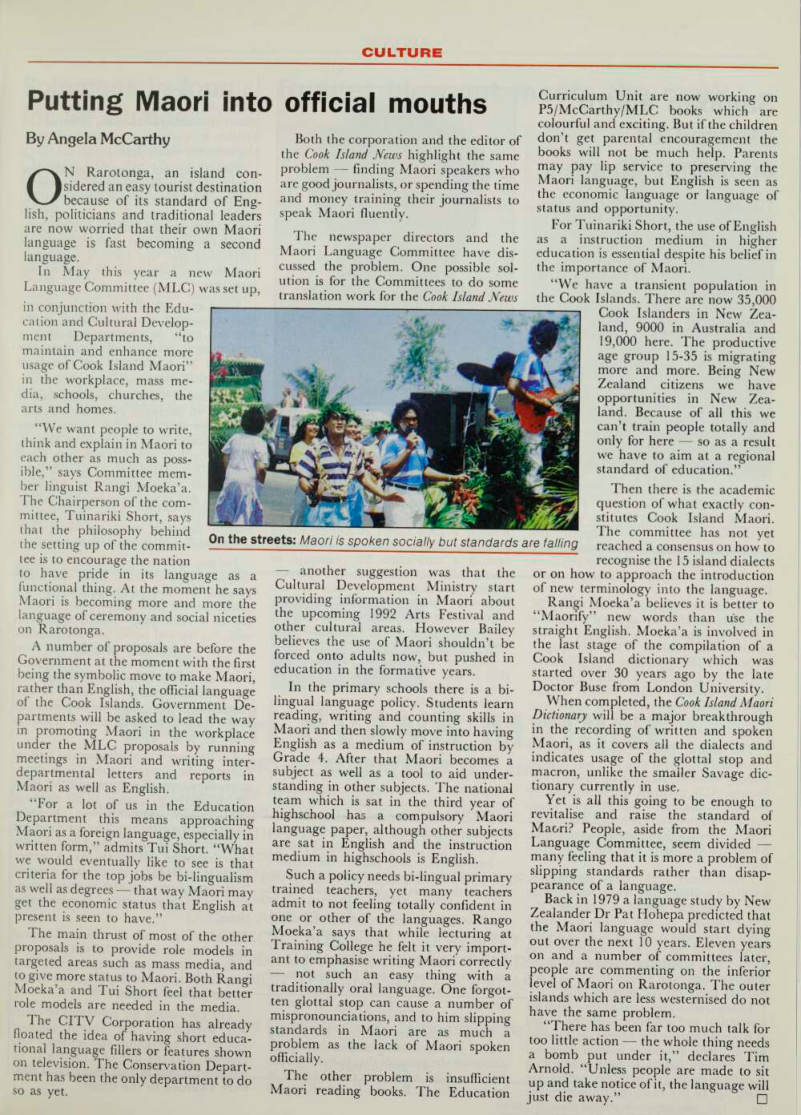
On the streets: Maori is spoken socially but standards are falling