Taxes and tourism on top
pp. 12-18 · Read in the full issue
By David North
IN Guam and Micronesia, the initials “TT” used to stand for the Trust Territory of the Pacific Islands the US administered, United Nations trusteeship of the Northern Marianas, Caroline and Marshall islands.
For business investors and entrepren eurs looking for opportunities in the islands today, “TT” stands for taxes and tourism, the two major sources of revenue and economic development po tential in the region. The flows of tax dollars from the US Federal government and tourist yen from the Japanese private sector also are symbolic of the major policy decision driving the region’s official foreign investment strategy the professed desire of Micronesian leaders to reduce the islands’ heavy dependence on US financial assistance, while fostering private sector growth through foreign investment and creation of industries in which the islands have some relative
advantage.
Japanese-funded tourism development
has shown one viable route, which in Guam and the Northern Marianas has led an unprecedented private sector expansion, spinning off robust construc tion and service sector growth. Commer cial fisheries and other marine resource projects also have generated significant revenue, and show future promise, es pecially in the case of the Federated
States of Micro nesia, whose Ex clusive Economic Zone exceeds 1 million square
miles. Light
manufacturing and specialty agriculture also are attracting considerable in vestment. Import, wholesaling and retailing, which had been the pre vious pillars of the islands’ private sectors, have shown consider able development in response to the tourism-led boom in the Marianas and the Compact funded growth of the Freely Associ ated States.
The flow of US
tax dollars takes several forms, including direct government-to-government oper ational and capital improvement grants, Federal health and welfare programs, as well as defence spending in Guam and the Marshalls (Kwajalein Missile Test Site). Because most of this funding, currently estimated at about Sl2 billion annually for the region Guam, the Northern Marianas, the Federated States of Micronesia, the Marshalls and Palau is funnelled through the island governments, it has come in for consider able criticism.
Meanwhile, many sources inside the US government, such as the Con gressional watchdog agency The General Accounting Office say that island governments (particularly Palau) have squandered Federal dollars through corruption and mismanagement.
Under the Compacts of Free Associ ation with the Marshall Islands and the Federated States of Micronesia, there fore, the aid formula calls for declining US assistance over the 15 years pact. US and Micronesian leaders look to the private sector, and foreign investment looms increasingly important. There are incentives for foreign companies and joint ventures with local investors includ ing some tax holidays, special access to
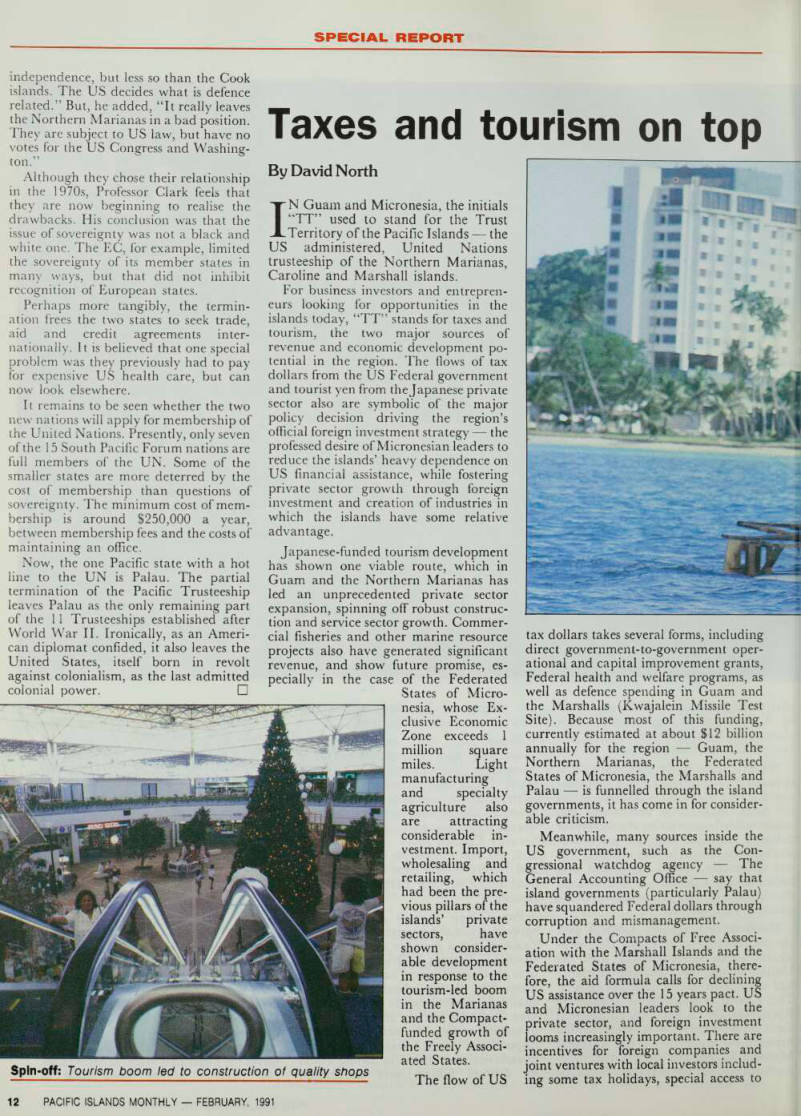
Spin-off: Tourism boom led to construction of quality shops
US, European and South Pacific markets for some island products, local government loans, the lease of government land and buildings as well as expedited application and processing procedures.
Throughout the region, investments are encouraged that create jobs for local citizens, broaden the local tax, base, earn loreign exchanges, use ocal resources as P ° SSlb e ’ S ‘T U is te d T‘ o, ? me J l l I 0 baind addr ess the Blands’ r T h ° tl ; er , adv l an afstn.rnl y H t f include a low at materials’ lot tlte "?P°, rtatlon ° f r.ttf t ki’ j ge - ateS (except for Guam), stable democratic governments, American currency and banking systems, and abundant local labor (except for Guam and the Northern Marianas).
Tourism holds the most immediate opportunities, directly in terms of firms specialising in land development hotel and resort construction, and expansion of transportation facilities, as well as indirectly through the myriad of tourismsupport business, from food, recreation and entertainment activities, to dry
cleaning, laundering, building’ mainten-
ance and security firms On the Guam and in the Northern
Marianas (primarily Saipan) which
together receive more than a million visitors annually (90 per cent from Japan), tourism, growing at 20 per cent plus a year, has poured in more than
$5OO million a year in visitor spending and generated more than 15,000 new jobs since 1985. (The Guam Visitors Bureau has estimated Japanese tourists spent $373 million on Guam in 1988).
Tourism tax and fee revenues now account for more than one-fifth of all direct government revenues in Guam and the Northern Marianas. If tourism related businesses and activities are considered, almost one-half of the islands’ Gross Domestic Product about Jl-5 billion for Guam and the Northern Marianas - is created through 'he tourist industry. 7 f here are more than tv/o dozen first c^ass) high rise hotels on Guam and Saipan, as many smaller family-style uui^ S and mot J ls ’ f nd an estimated $1 • ~n m new hotel construction m the Guam and Saipan have half a d ° ZCn ei ghteen-hole golf courses and x P ect to have 20 by the year 2000.
J a P anese mega-resorts, with condo ™mmms as well as hotels, are planned for Guam ar^ d Saipan. Current local govern ment estimate s indicate Guam and the Northern Marianas could see 2 million vWto ". a yCar by 1966 ' Tourism in Guam and the Northern Marianas has spawned a booming con struction industry, and literally thou of small support businesses. More
Continued on page 16.
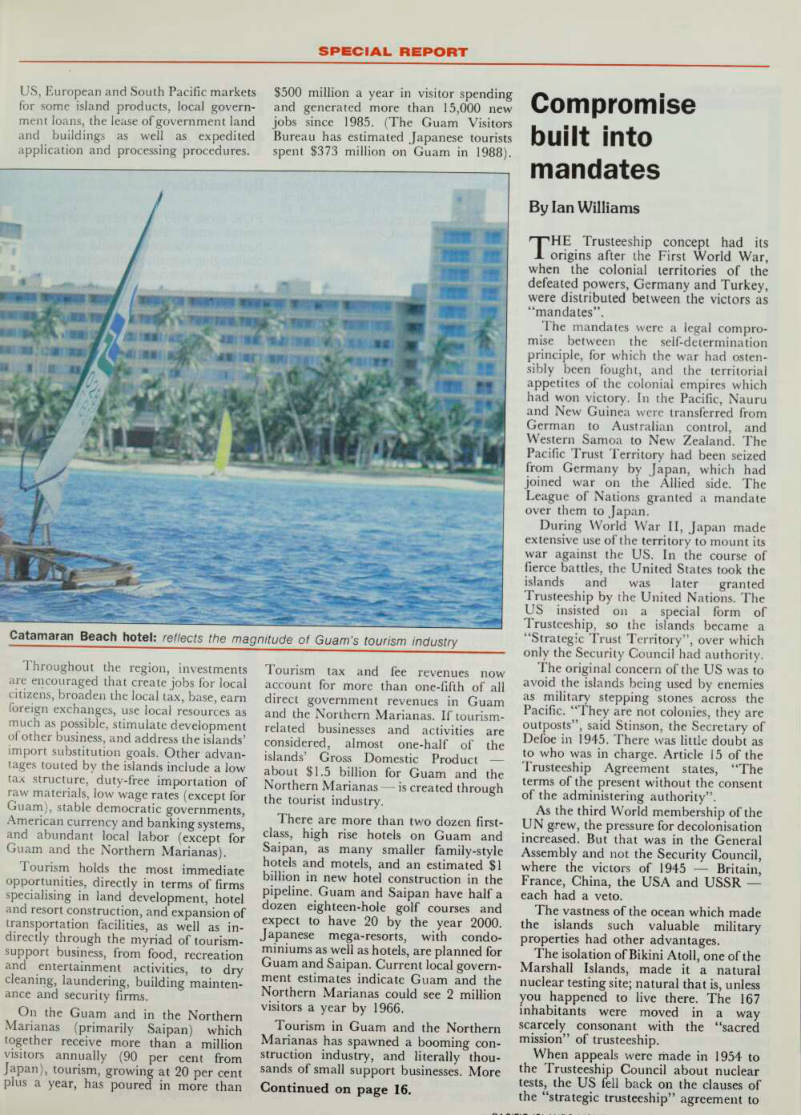
Catamaran Beach hotel: reflects the magnitude of Guam's tourism industry
than a dozen major Japanese, South Korean and US construction companies have established a long-term presence, and some like a Mainland Chinese firm bring in their own laborers.
Roads, water and sewer construction to
keep up with the tourism ex pansion, as well as office build ing, defence-related construc tion and residential develop ment have added to the de mand for all types of construc tion firms and building material
suppliers.
Tourism-led growth is not without its problems. Guam’s labor market is tight (officially 1.2 per cent unemployment), and US immigration regu lations limit importation of alien laborers to “temporary
positions.” This is good for the island’s workers, but tough on employers.
Most of the 3000 new jobs created on Guam this year are permanent, hotel service industry positions. Hence Guam Labor Department leaders and private labor contractors are attempting to recruit US citizens in American Samoa, California, and even along the East Coast, using state labor banks. Citizens of the Freely Associated States, who have
rights under the Compacts to freely
immigrate and work in the United States, also are actively recruited and workers from the Federated States of Micronesia are currently filling most of the service-sector positions being created on Guam. That in-migration has taxed Guam’s social infrastructure, and led to some misunderstandings in inter-island relations.
The Northern Marianas, which con trols its own immigration, has had fewer problems getting alien laborers, but suffers from the other extreme too many foreign workers and muted charges of low wages and sweatshop conditions.
More than half the Northern Mari-
anas total population (currently esti mated at about 45,000) are non-resident aliens, who cannot, under current law, become citizens. Most of those were brought in to work in Saipan’s textile
assembly plants, but expected tourism
growth in the future will exacerbate the labor demand.
Last year the island of Tinian, which has received little of the tourism growth
Saipan has experienced, approved casino
gambling in a controversial referendum.
Japanese land speculators immediately descended on the island creating an additional 31 Chamorro millionaires, almost overnight. Large scale Japanese gaming hotels are now on the drawing boards and could be operating within two years.
This pressure has sent land prices on
Guam and in the Northern Marianas into the stratosphere. Prime beach front property in Turnon Bay Guam’s Waikiki goes for S2OOO a square meter. Middle class Guamanians cannot afford to buy or even build homes.
Moreover, road, power, water and sewer expansion have not kept pace with development and the governments of Guam and the Northern Marianas are
developing voluntary and non-voluntary
means for developers to pay the cost of infrastructure develop ment that benefits them.
These difficulties have spawned some anti development activity but the opposition appears to be frag mented and has not caused any significant movement toward
growth-limiting legislation,
though it has shifted some of the tax holiday incentives toward
joint enterprises with local
businesses.
Tourism growth in the Fed
crated States of Micronesia, the Mar shalls, and Palau has been considerably more modest. Fewer then 100,000 Japan esc visit these three states annually, but the islands are actively encouraging the development of a visitor industry, Though the major islands have enviable natural resources in picturesque sea
beSs ‘world class dSaSrt
““e fne or C
first . c i ass hotels, and the FSM, Mar shalls, and Palau combined include the high cost of air transportation, and the jack of necessary road, power and water mfrastructure to support large-scale ho
tel development.
Construction in the Freely Associated
Sta(es similarly
remains rather small scale. During the late 1970’s and early 1980’s, US-funded infrastructure con
Palau power plant: growth demands such support facilities
struction activities in the FSM, the Marshalls and Palau drew some South Pacific firms such as New Zealand’s Downey-Fletcher — as well as Japanese and Korean companies. But the con tracts have been sporadic and are
winding down.
Tourism in Micronesia offers a unique opportunity for companies wishing to tap into a slice of the Japanese market in a largely favourable overseas venue. But there also are unique obstacles.
Unless foreign companies learn to accept certain business practices, they may find it impossible to reach these affluent Japanese travellers. A minor example on Guam is the unofficial “tourist head tax”. Some local Guam retailers have bitterly complained for years that Japanese tour companies won’t bring visitors to their stores unless the tour operators receive a fee. It usually takes the form of a percentage of whatever amount the tourists spend at the store. While patently illegal in the view of some, it is regarded by many Asians as merely another cost of doing business, like a finder’s fee.
The presence of organised Japanese crime the Yakusa wherever Japanese tourism flourishes, also causes concern. Specialising in prostitution, illegal gambling, narcotics and extortion, the Yakusa pose major problems for law enforcement, religious, government and business leaders.
Beyond tourism, the next most attract ive area for investors appears to be commercial fishing, in-shore marine re sources, aquaculture, ship servicing and transhipment. All the islands have been experiencing moderate increases in the area, but the Federated States of Micro nesia appears to be winning the lion’s share of Exclusive Economic Zone fishing fee revenue. The FSM and Papua New Guinea are receiving most several
million annually from the $lO million a year the US government pays to the South Pacific Forum Fishery Association for American tuna boats to fish in their EEZ’s. East Asian long-line boats and fishing federations also negotiate group and individual licensing, at a few million a year, to fish for yellow fin, big eye, skipjack and bluefin tuna in the FSM’s rich waters.
These revenues are expected to stead ily increase in the next decade as environmentalists’ pressure forces US and Asian boats from the Eastern Pacific, where dolphin swim with tuna, to the southwestern Pacific, where dolphins do not co-migrate with tuna. While Palau and the Marshalls gross less than a million annually in zone licensing fees, (Palau received about $600,000 in Japanese and US fishing boat fees in 1989) their share may increase as the westward push intensifies.
While Guam and the Northern Mari anas, as US jurisdictions, are presently unable to levy licensing fees for the zones around their islands, the regional tuna fishery has created a healthy transhipment industry for the Marianas.
Top quality tuna destined for the sashimi restaurants and bars of metropolitan Japan are offloaded at island ports and air freighted to Tokyo and Osaka. In Guam the business is averaging about 8000 metric tons a year, generating 300 jobs and about $1 million in salaries and purchases. Similar, but smaller oper ations, are working in the FSM and Palau.
US tuna boats unload their catch into freezer ships in the Northern Marianas, from where they are carried to US canneries in American Samoa and Puerto Rico. Some cold storage plant and associated port development has sprung up in the Western Marianas to
Wealthy waters: Beachside hotels and rich fishing waters yield millions of dollars
meet this need and Guam’s Apra Har bour is providing ship chandlering ser vices to the US tuna fleet. The Marshalls is seeking Federal assistance for the construction of a tuna processing plant and the FSM also is undertaking fish
handling and processing projects.
The Compacts of Free Association grant special quotas to the FSM and the Marshalls, allowing duty-free export of processed tuna to the US market.
Aquaculture and mariculture develop ment remains small scale and largely at the experimental and demonstration level. The Micronesian Mariculture Demonstration Center in Palau has domesticated the giant clam and ex ported seed clams throughout the islands.
The low-technology, labor-intensive pro cedure suits the traditional cultures and underutilised coral reefs and flats.
The islands special trade access to markets in the US, Australia and New Zealand provide a key advantage for light manufacturing projects. Under the Headnote 3(a) program certain manu factured articles in Guam, the Northern Marianas and the Freely Associated States can be exported to the US market duty- and quota-free. In Saipan and Guam this has taken the form of garment assembly plants, 26 in the Northern Marianas, two on Guam and one in Yap State of the FSM. These take pre-cut pieces and sew them together, add finishing processes and package the garments. If a minimum percentage (30 per cent for most items, 51 per cent for import-sensitive articles) are “substan tially transformed’’ the goods can qualify for US entry.
The major drawback is that in most of these enterprises except for Guam’s, workers are brought in with the plant and pre-cut pieces, so local labor is not utilised or developed. Moreover, as these industries become competitive with US textile makers, they generate a backlash move to cap island production quotas or deny duty-free status.
The islands also benefit from preferen tial trade Status under the Generalized System of Preferences as well as the South Pacific Regional Trade and Economic Cooperation Agreement. Products ex ported under the latter pact have preferential access to Australia and New Zealand, while the former agreement provides access to European markets.
A major policy goal of the Freely Associated States is to reduce the amount
of imported food, leading to significant
incentive programs that will reduce the annual tonnage of beef, chicken, rice, coffee, and beer that come in primarily from the US and Japan.
Though the islands present formidable challenges, they offer opportunities for companies with a long-term outlook, willing to get in early and develop gradually. □