Freedom
pp. 10-12 · Read in the full issue
Special Report
Freedom at last!
The UN Security Council has cut US colonial ties with three Pacific Trust Territories.
But reactions have been mixed.
By Ian Williams
(United Nations journalist, New York)
THE Saturday afternoon before
Christmas, while the rest of New York was frantically doing its last minute shopping, the United Nations Security Council was locked in debate.
For once, it was not the Middle East which kept them from their families, but the South Pacific.
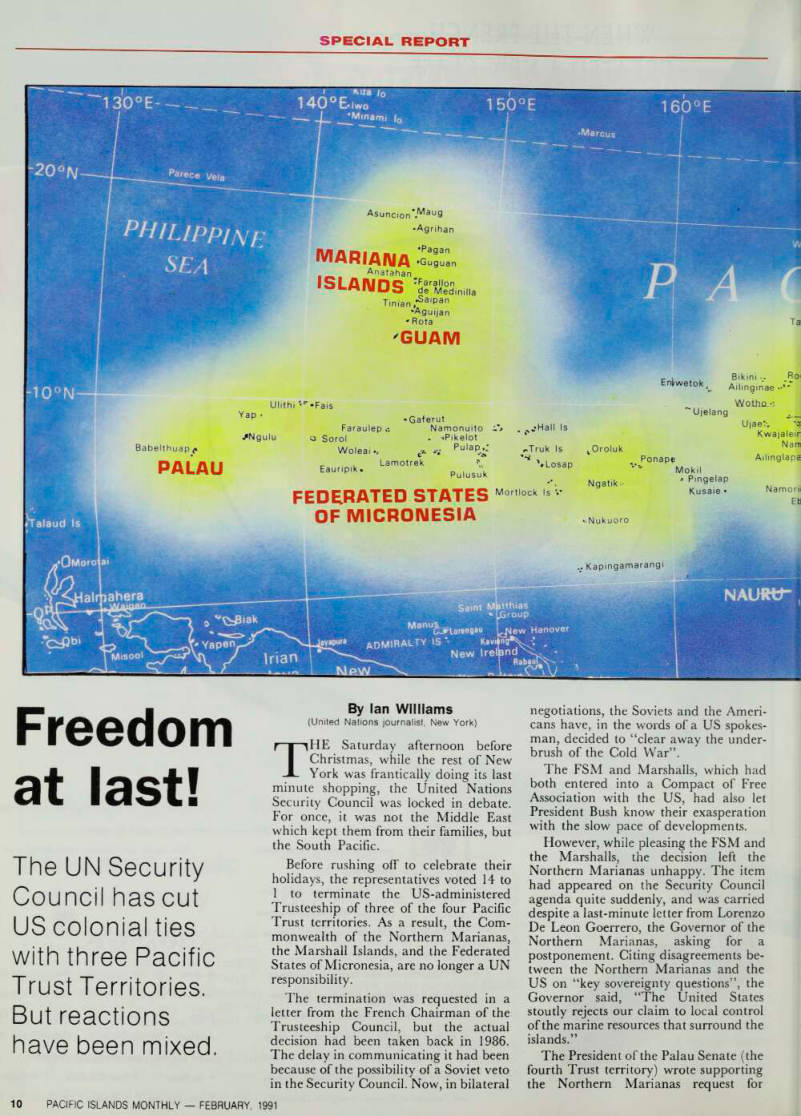
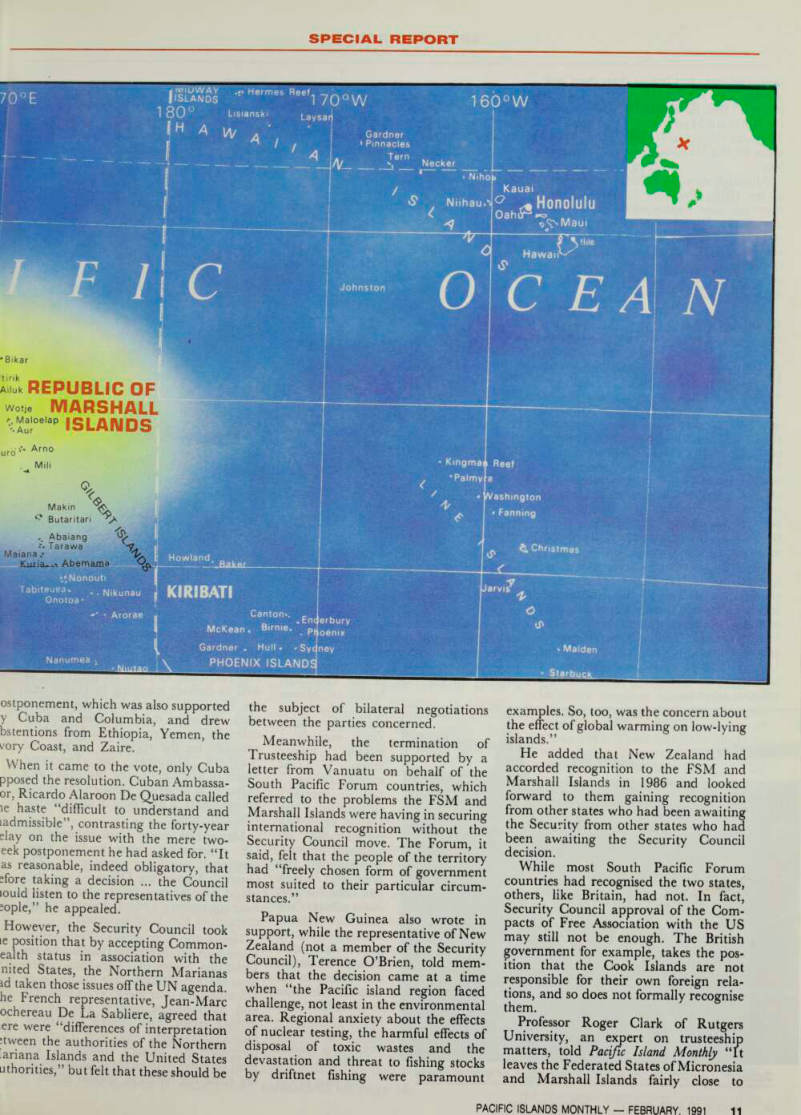
Before rushing off to celebrate their holidays, the representatives voted 14 to 1 to terminate the US-administered Trusteeship of three of the four Pacific Trust territories. As a result, the Com monwealth of the Northern Marianas, the Marshall Islands, and the Federated States of Micronesia, are no longer a UN responsibility.
The termination was requested in a letter from the French Chairman of the Trusteeship Council, but the actual decision had been taken back in 1986.
The delay in communicating it had been because of the possibility of a Soviet veto in the Security Council. Now, in bilateral
negotiations, the Soviets and the Ameri cans have, in the words of a US spokes man, decided to “clear away the under brush of the Cold War”.
The FSM and Marshalls, which had both entered into a Compact of Free Association with the US, had also let President Bush know their exasperation with the slow pace of developments.
However, while pleasing the FSM and the Marshalls, the decision left the Northern Marianas unhappy. The item had appeared on the Security Council agenda quite suddenly, and was carried despite a last-minute letter from Lorenzo De Leon Goerrero, the Governor of the Northern Marianas, asking for a postponement. Citing disagreements be tween the Northern Marianas and the US on “key sovereignty questions”, the Governor said, “The United States stoutly rejects our claim to local control of the marine resources that surround the islands.”
The President of the Palau Senate (the fourth Trust territory) wrote supporting the Northern Marianas request for
ostponement, which was also supported y Cuba and Columbia, and drew bstentions from Ethiopia, Yemen, the yory Coast, and Zaire.
When it came to the vote, only Cuba pposed the resolution. Cuban Ambassa or, Ricardo Alaroon De Quesada called le haste “difficult to understand and
(admissible”, contrasting the forty-year
elay on the issue with the mere two eek postponement he had asked for. “It as reasonable, indeed obligatory, that “fore taking a decision ... the Council lould listen to the representatives of the "ople,” he appealed.
However, the Security Council took ie position that by accepting Common ealth status in association with the nited States, the Northern Marianas id taken those issues off the UN agenda, he French representative, Jean-Marc ochereau De La Sabliere, agreed that ere were “differences of interpretation “tween the authorities of the Northern ariana Islands and the United States uthorities,” but felt that these should be
the subject of bilateral negotiations between the parties concerned.
Meanwhile, the termination of Trusteeship had been supported by a letter from Vanuatu on behalf of the South Pacific Forum countries, which referred to the problems the FSM and Marshall Islands were having in securing international recognition without the Security Council move. The Forum, it said, felt that the people of the territory had “freely chosen form of government most suited to their particular circum stances.”
Papua New Guinea also wrote in support, while the representative of New Zealand (not a member of the Security Council), Terence O’Brien, told mem bers that the decision came at a time when “the Pacific island region faced challenge, not least in the environmental area. Regional anxiety about the effects of nuclear testing, the harmful effects of disposal of toxic wastes and the devastation and threat to fishing stocks by driftnet fishing were paramount
examples. So, too, was the concern about the effect of global warming on low-lying islands.”
He added that New Zealand had accorded recognition to the FSM and Marshall Islands in 1986 and looked forward to them gaining recognition from other states who had been awaiting the Security from other states who had been awaiting the Security Council decision.
While most South Pacific Forum countries had recognised the two states, others, like Britain, had not. In fact, Security Council approval of the Com pacts of Free Association with the US may still not be enough. The British government for example, takes the pos ition that the Cook Islands are not responsible for their own foreign rela tions, and so does not formally recognise them.
Professor Roger Clark of Rutgers University, an expert on trusteeship matters, told Pacific Island Monthly “It leaves the Federated States of Micronesia and Marshall Islands fairly close to
independence, but less so than the Cook islands. The US decides what is defence related.” But, he added, “It really leaves the Northern Marianas in a bad position.
They are subject to US law, but have no votes for the US Congress and Washing ton.”
Although they chose their relationship in the 19705, Professor Clark feels that they are now beginning to realise the drawbacks. His conclusion was that the issue of sovereignty was not a black and white one. The EC, for example, limited the sovereignty of its member states in many ways, but that did not inhibit recognition of European states.
Perhaps more tangibly, the termin ation frees the two states to seek trade, aid and credit agreements inter nationally. It is believed that one special problem was they previously had to pay for expensive US health care, but can now look elsewhere.
It remains to be seen whether the two new nations will apply for membership of the United Nations. Presently, only seven of the 15 South Pacific Forum nations are full members of the UN. Some of the smaller states are more deterred by the cost of membership than questions of sovereignty. The minimum cost of mem bership is around 5250,000 a year, between membership fees and the costs of maintaining an office.
Now, the one Pacific state with a hot line to the UN is Palau. The partial termination of the Pacific Trusteeship leaves Palau as the only remaining part of the 11 Trusteeships established after World War 11. Ironically, as an Ameri can diplomat confided, it also leaves the United States, itself born in revolt against colonialism, as the last admitted colonial power. □