a path
pp. 49-50 · Read in the full issue
Pacific People
Carving a path for art
By Angela McCarthy
IF versatility is the key to success, then Mike Tavioni has got what it takes. The 42-year-old Cook Islander, who is the most established artist on Rarotonga, is a tye-dyer, screen printer, carver, painter and poet.
He is a short, bulky man whose surprisingly hoarse voice rattles off anec dotes at an increasingly fast rate as he warms to our conversation and, like his art, his conversation changes direction
frequently.
“Maybe I’m too lazy, or doing too many things at once when painting coral I can’t keep up supplies of things like handpainted clothes. The fault’s all mine I have a problem - I get excited about something and then I get tired of it, so I try and pass on the ideas to others but it doesn’t always work.
“Fortunately I enjoy working in all mediums. With oils, when things happen I enjoy it, but I get frustrated when things don’t happen. In my situation I can always leave it until later. So I’m never bored when I can’t express myself anymore, I leave it a while.”
This willingness to experiment with new things and to change direction has marked Mike’s work since the beginning.
His interest in art began back in 1975 when he was going to New Zealand on holiday from his agricultural department
job. He wanted to wear a Cook Island printed T-shirt but couldn’t buy one. He noticed the proliferation of printed T-shirts in New Zealand, bought a book on screenprinting and, once back in Rarotonga, began to experiment.
He says that initially he couldn’t really understand the jargon of the book. “The book talked of squeegies I had never heard of them. I couldn’t make a screenprint at first so I used carved pieces of wood.
“Once I even used the top of an old battery top to print a pattern. Then I went on to using a plywood and particle board to develop a better screen.”
In 1979 Mike and his family became involved in three shops, all selling Tavioni tye-dyed or screen-printed T-shirts, dresses and shirts. During the 11 years since his first commercial venture, he has tried many other art mediums and is presently selling from just one shop Tavioni Arts which stocks his carvings and other handcrafts, as well as hand and screen-printed clothing that is now done by his wife Awhitia.
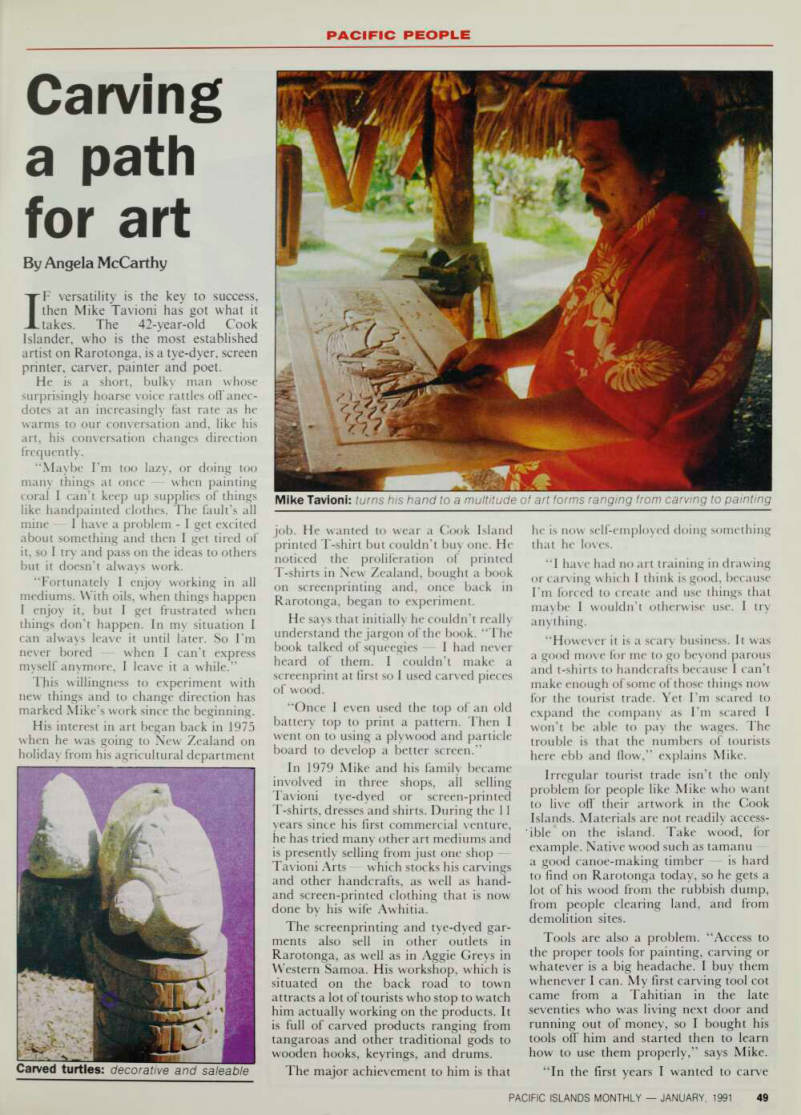
The screenprinting and tye-dyed gar ments also sell in other outlets in Rarotonga, as well as in Aggie Greys in Western Samoa. His workshop, which is situated on the back road to town attracts a lot of tourists who stop to watch him actually working on the products. It is full of carved products ranging from tangaroas and other traditional gods to wooden hooks, keyrings, and drums.
The major achievement to him is that
he is now self-employed doing something
that he loves.
“I have had no art training in drawing or carving which I think is good, because I'm forced to create and use things that maybe I wouldn’t otherwise use. I try
anything.
“However it is a scary business. It was a good move for me to go beyond parous and t-shirts to handcrafts because I can’t make enough of some of those things now for the tourist trade. Yet I'm scared to expand the company as I’m scared I won’t be able to pay the wages. The trouble is that the numbers of tourists here ebb and flow,” explains Mike.
Irregular tourist trade isn’t the only problem for people like Mike who want to live off their artwork in the Cook Islands. Materials are not readily access ible on the island. Take wood, for example. Native wood such as tamanu a good canoe-making timber is hard to find on Rarotonga today, so he gets a lot of his wood from the rubbish dump, from people clearing land, and from demolition sites.
Tools are also a problem. “Access to the proper tools for painting, carving or whatever is a big headache. I buy them whenever I can. My first carving tool cot came from a Tahitian in the late seventies who was living next door and running out of money, so I bought his tools off him and started then to learn how to use them properly,” says Mike.
“In the first years I wanted to carve
Carved turtles: decorative and saleable
Mike Tavioni: turns his hand to a multitude of art forms ranging from carving to painting
coral, having seen it done in Tahiti, but I didn't want to use my only wood carving chisels on the coral because it would ruin them. When I became president of the Canoe Club and trav elled with them, I was able to buy more chisels so now I have been able to experiment with the coral and it’s been quite a success with the tourists.”
To Mike, these and other difficulties, such as financing, restrict not only him but all Cook Islanders involved in art.
“I think we have a lot of creativity in our people look at our dancing. But you see we need no tools to dance. I wish that creativity could move through all mediums to make art here complete. Of all the resources in the Cook Islands what is going to exist and remain in existence after us is our art. Local artists should be prepared to create art in whatever form.
The ancestors created the tangaros for their own time - why do we just keep repeating it? We have to create our own things, keeping traditional flavours but not letting them restrict our creativity,”
The irony with Mike is that, despite such beliefs, he must mass-produce the old traditional figures in various forms for the tourist trade so that he can make a living from his art. He believes that the government should do more for artists.
“Look at traditional canoe making! It is dying; it is already dead in Rarotonga.
Some outer islanders still have tra ditional canoe-makers though. If they were recognised by government as pro fessionals and helped more financially with the work, then the young people learning from them would feel assured of a living, and the art of canoe-making might not disappear.
“The governments run outer island carving workshops but workshops don’t produce experts,” says Mike. “The government needs to buy local art to give it status and prove they value and support artists. The business sector
should follow suit. We get help sometimes from aid donors. I have just received aid money from Germany for a potter’s wheel, bendsaw, etcetera. That sort of thing makes a big difference to what we can produce, but we need more support
locally.”
To increase production by and sup port for local artists, Mike set up an association in the mid-1970s which still holds annual exhibitions to press govern ment to recognise the arts. These display a varied level of artistic ability, because one of the association’s principles is to encourage people trying to create who can’t make a living from it.
“For me, if I stuck to just painting I’d sell maybe six a year - I can’t live on that,” Mike says.
“I live off my art because of t-shirts,
contract jobs, carving, etcetera.”
Mike is well known on Rarotonga for his generosity and willingness to work
with others. Over the years he has run workshops at the University of the South Pacific and at his own workplace, in
everything from tye-dying to
bonecarving. His intention is to pass on the basics to others.
For many locals on the island Mike is seen as a carver above all else, although his carvings can vary immensely in quality and design. Two of his most well-known pieces are with government: the panels on the Prime Minister’s desk and the Tauranga Vananaga (Cultural Development Min istry) sign. The Cultural De velopment Secretary, Jon Jonassen, asked Mike to apply for the new Master Carver position in the Ministry of
Cultural Development department. He
does not want to he feels he is not
experienced enough in canoe making
despite his talents as both a carver and canoeist.
“For such a job you need to be experienced in three areas traditional art such as canoe making, local decorat ive art, and creative contemporary art. It is going to be hard to find someone who can co-ordinate all three areas,” says Mike. “I make accessories for canoes like paddles, but the truly traditional canoe making is done by a priest for canoe
making a traditional professional
not me.”
Jon Jonassen says the position has been vacant since March, and is the first of a number of art-oriented positions they hope to set up. They realise that it will be hard to find someone with the skills, but they’re hoping to employ someone who could at least work towards it.
For Mike there are too many other things he’d prefer to do, and dislikes having to be in a certain place because it is his job to be there. He is happiest working for himself on whatever project appeals at the time, while keeping the basic shop products rolling out.
His latest project has been designing logos for the 1992 Pacific Arts Festival, after he won a competition in partner ship with artist/carver Uango Williams.
At his workshop, Mike shows me the last of his coral carvings which are rough
looking, simply designed faces and
shapes. He then takes me inside and brings out a portfolio of meticulous ink drawings and designs.
The variety is astounding. His subject matter is always Rarotongan and a blend of the old with the new. It is Cook Island art, and he is making a living from it and that for Mike Tavioni is as much as he could ask for. □
The ingenious Tavioni: he experiments with an array of tools to create art from coral.
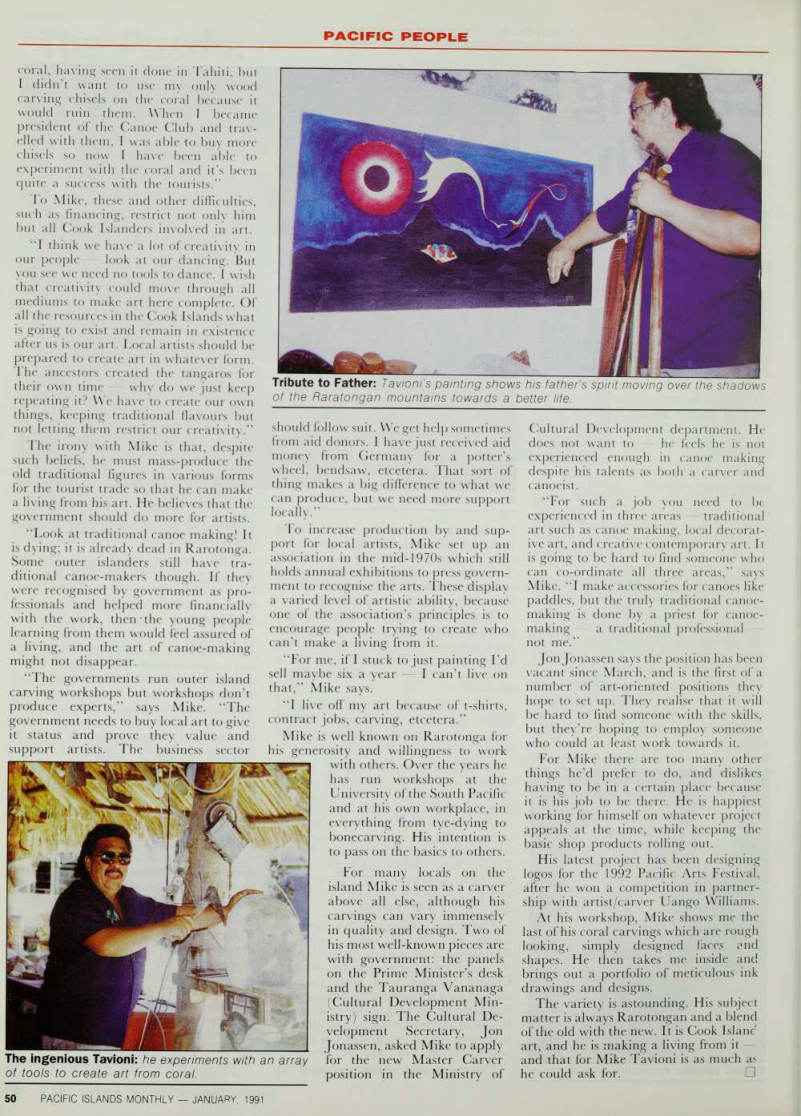
Tribute to Father: Tavioni’s painting shows his father’s spirit moving over the shadows of the Raratongan mountains towards a better life.