Hidden missionaries at work behind the scenes
pp. 47-48 · Read in the full issue
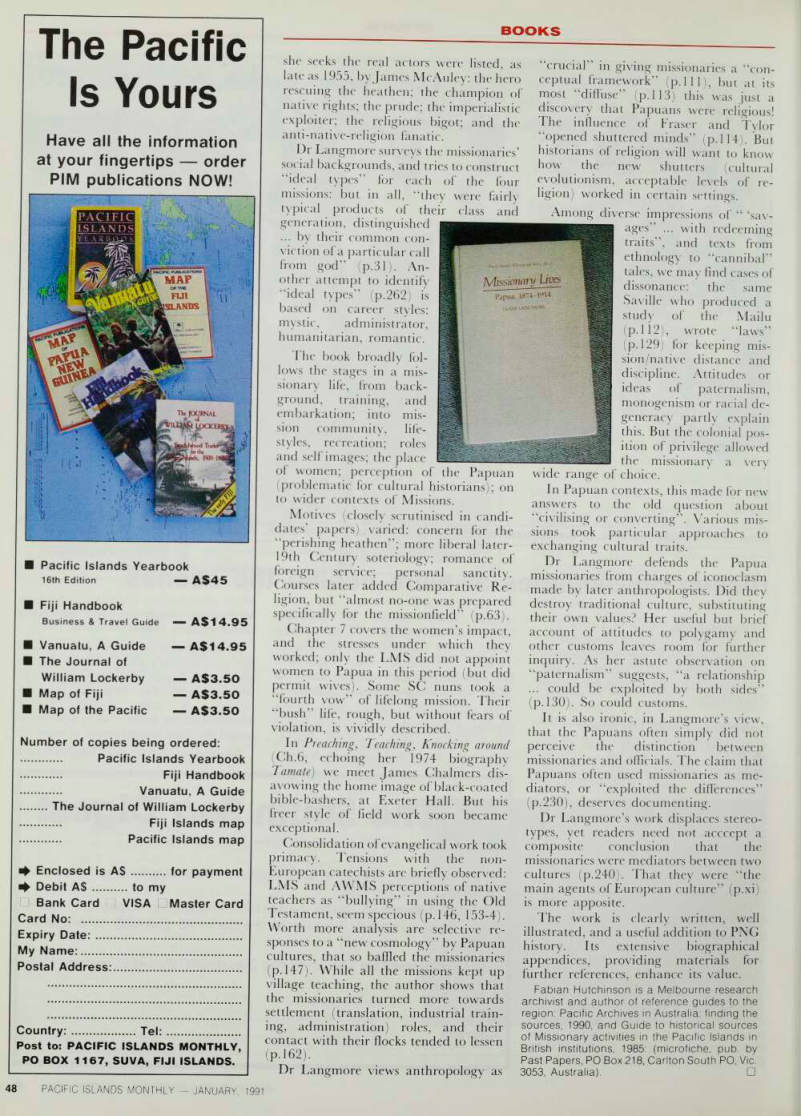
Missionary Lives, Papua 1874-1914: a group portrait. By Dr Diane Langmore.
University of Hawaii Press. Pacific Islands monograph series, no. 6. Honolulu, 1989. 408 pages: illustrated, bibliography, index, maps. US$35.
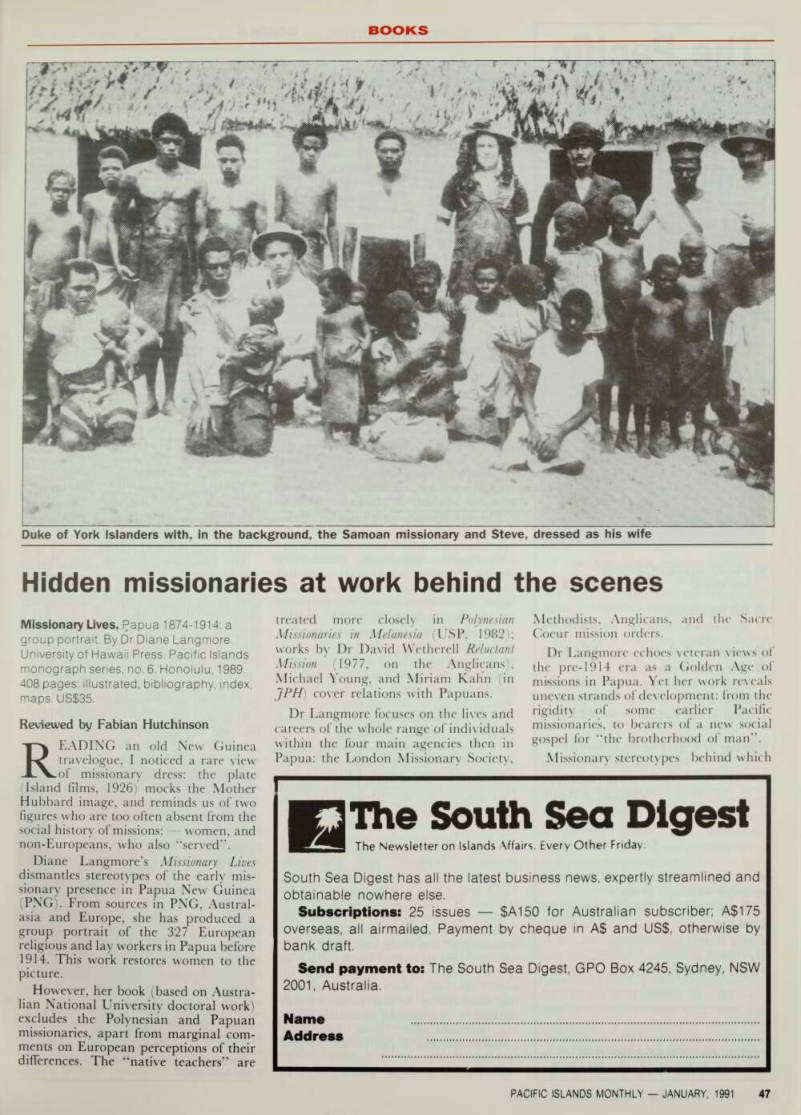
Reviewed by Fabian Hutchinson READING an old New Guinea travelogue, I noticed a rare view of missionary dress: the plate Island films, 1926) mocks the Mother Hubbard image, and reminds us of two figures who are too often absent from the social history of missions: women, and non-Europeans, who also “served”.
Diane Langmore’s Missionary Lives
dismantles stereotypes of the early mis sionary presence in Papua New Guinea (PNG). From sources in PNG, Austral asia and Europe, she has produced a group portrait of the 327 European religious and lay workers in Papua before 1914. This work restores women to the
picture.
However, her book (based on Austra lian National University doctoral work) excludes the Polynesian and Papuan missionaries, apart from marginal com ments on European perceptions of their differences. The “native teachers” are
treated more closely in Polynesian Missionaries in Melanesia (USP, 1982); works by Dr David Wetherell Reluctant Mission (1977, on the Anglicans), Michael Young, and Miriam Kahn (in JPH) cover relations with Papuans, Dr Langmore focuses on the lives and careers of the whole range of individuals within the four main agencies then in Papua: the London Missionary Society,
Methodists, Anglicans, and the Sacre Coeur mission orders.
Dr Langmore echoes veteran views of the pre-1914 era as a Golden Age of missions in Papua. Yet her work reveals uneven strands of development: from the rigidity of some earlier Pacific missionaries, to bearers of a new social gospel for “the brotherhood of man”.
Missionary stereotypes behind which
she seeks the real actors were listed, as late as 1955, by James McAuley: the hero rescuing the heathen; the champion of native rights; the prude; the imperialistic exploiter; the religious bigot; and the
anti-native-religion fanatic.
Dr Langmore surveys the missionaries’ social backgrounds, and tries to construct “ideal types” for each of the four missions: but in all, “they were fairly typical products of their class and
generation, distinguished ... by their common con viction of a particular call from god" (p. 31). An other attempt to identify “ideal types” (p. 262) is based on career styles: mystic, administrator, humanitarian, romantic.
The book broadly fol lows the stages in a mis sionary life, from back ground, training, and embarkation; into mis sion community, life styles, recreation; roles and self images; the place
of women; perception of the Papuan (problematic for cultural historians); on to wider contexts of Missions.
Motives (closely scrutinised in candi dates' papers) varied: concern for the “perishing heathen”; more liberal later 19th Century soteriology; romance of foreign service; personal sanctity.
Courses later added Comparative Re ligion, but “almost no-one was prepared specifically for the missionfield” (p. 63).
Chapter 7 covers the women’s impact, and the stresses under which they worked; only the LMS did not appoint women to Papua in this period (but did permit wives). Some SC nuns took a “fourth vow” of lifelong mission. Their “bush” life, rough, but without fears of violation, is vividly described.
In Preaching, Teaching, Knocking around
(Ch. 6, echoing her 1974 biography Tamale ) we meet James Chalmers dis avowing the home image of black-coated bible-bashers, at Exeter Hall. But his freer style of field work soon became exceptional.
Consolidation of evangelical work took primacy. Tensions with the non- European catechists are briefly observed: LMS and AWMS perceptions of native teachers as “bullying” in using the Old Testament, seem specious (p. 146, 153-4).
Worth more analysis are selective re sponses to a “new cosmology” by Papuan cultures, that so baffled the missionaries (p. 147). While all the missions kept up village teaching, the author shows that the missionaries turned more towards settlement (translation, industrial train ing, administration) roles, and their contact with their flocks tended to lessen (p. 162).
Dr Langmore views anthropology as
‘crucial’ in giving missionaries a “con ceptual framework” (p. Ill), but at its most “diffuse” (p. 113) this was just a discovery that Papuans were religious!
The influence of Fraser and Tylor “opened shuttered minds” (p. 114). But historians of religion will want to know how the new shutters (cultural evolutionism, acceptable levels of re ligion) worked in certain settings.
Among diverse impressions of “ ‘sav
ages” ... with redeeming traits”, and texts from ethnology to “cannibal” tales, we may find cases of dissonance: the same Saville who produced a study of the Mailu (p. 112), wrote “laws” (p. 129) for keeping mis sion/native distance and discipline. Attitudes or ideas of paternalism, monogenism or racial de generacy partly explain this. But the colonial pos ition of privilege allowed the missionary a very
wide range of choice.
In Papuan contexts, this made for new answers to the old question about “civilising or converting”. Various mis sions took particular approaches to exchanging cultural traits.
Dr Langmore defends the Papua missionaries from charges of iconoclasm
made by later anthropologists. Did they
destroy traditional culture, substituting
their own values? Her useful but brief account of attitudes to polygamy and other customs leaves room for further inquiry. As her astute observation on “paternalism” suggests, “a relationship ... could be exploited by both sides” (p. 130). So could customs.
It is also ironic, in Langmore’s view, that the Papuans often simply did not perceive the distinction between missionaries and officials. The claim that Papuans often used missionaries as me diators, or “exploited the differences”
(p. 230), deserves documenting.
Dr Langmore’s work displaces stereo types, yet readers need not acccept a composite conclusion that the missionaries were mediators between two cultures (p. 240). That they were “the main agents of European culture” (p.xi) is more apposite.
The work is clearly written, well illustrated, and a useful addition to PNG
history. Its extensive biographical
appendices, providing materials for further references, enhance its value.
Fabian Hutchinson is a Melbourne research archivist and author of reference guides to the region: Pacific Archives in Australia: finding the sources, 1990, and Guide to historical sources of Missionary activities in the Pacific Islands in British institutions, 1985: (microfiche, pub. by Past Papers, PO Box 218, Carlton South PO, Vic. 3053, Australia). □