Troubled times
pp. 45-46 · Read in the full issue
Movies
Troubled times reflected in Samoans’ inner search
A new film portrays the painful struggle against colonialism
By David Robie
IT COULD have been a creative disaster a palagi filmmaker explor ing the theme of the conflicts created by the impact of colonialism on a South Pacific society. But no, the screen version of Samoan novelist Albert Wendt’s Flying Fox in a Freedom Tree is a perceptive and
moving, yet powerful interpretation.
It has been acclaimed by critics and has featured in the Tokyo, Cannes, Hawaii and Auckland international film festivals. The Tokyo jury awarded the film one of its top awards best screenplay. It was the first New Zealand film to be selected for the Tokyo competition.
However, Flying Fox has not drawn the expected big Samoan audiences in New Zealand. The film may be too real; a graphic documentary of pain and suffer
ing.
“The complication,” says Samoan critic Samson Samasoni, “is that for people of Pacific Island origin (and perhaps other colonised people through out the world) the exercise becomes a disturbing historical mirror for them to look at instead of being the academic and artistic challenge that it is for non-Pacific Island people.”
Although this is director Martyn Sanderson’s debut as a feature filmmaker, he has had acting roles in many features, including Beyond Reason-
able Doubt , Never Say Die and Bad Blood , (In Flying Fox , he actually appears as an actor as a crusty, expatriate police interrogator).
Sanderson, 52, has also worked pro fessionally in film, television and theatre for 25 years and has produced, directed and edited several short films. He was founding director of Downstage Theatre in Wellington. His documentary Keskidee Aroha about a black African theatre group’s tour of New Zealand, was highly praised.
In Flying Fox , Sanderson captures much of the nuances and subtlety of Wendt’s story. “It was a challenge,” he admits, “The whole process of filmmak ing involves deadlines and money versus the spirit and sensitivity of the film.
“It’s hard working on a location in a small Samoan village and not tramping on people’s sensibilities. But that’s very much the kind of conflict which this story
is about.”
Even though Sanderson’s sincerity and qualifications he has a long-standing friendship with Wendt are impeccable there have been some unpublished criti cisms ofhis “right” to make this film. The creative environment in New Zealand is frequently hostile to the notion of a pakeha or palagi interpreting “indigenous” cul ture in film and print.
But this argument doesn’t impress Samasoni and many other critics. “Such distractions are not constructive and, in fact, impact negatively on the fruitful development of Pacific arts,” he says.
Samasoni points out that if Wendt’s writing had only been exposed to Samoans, it would not have gained the international attention and praise it deserved. ‘The lobby that advocates only the
Revenge: Tagata (Richard Von Sturmer), left, steals a wallet
Frustration: Pepe and Tagata fire a home-made cannon
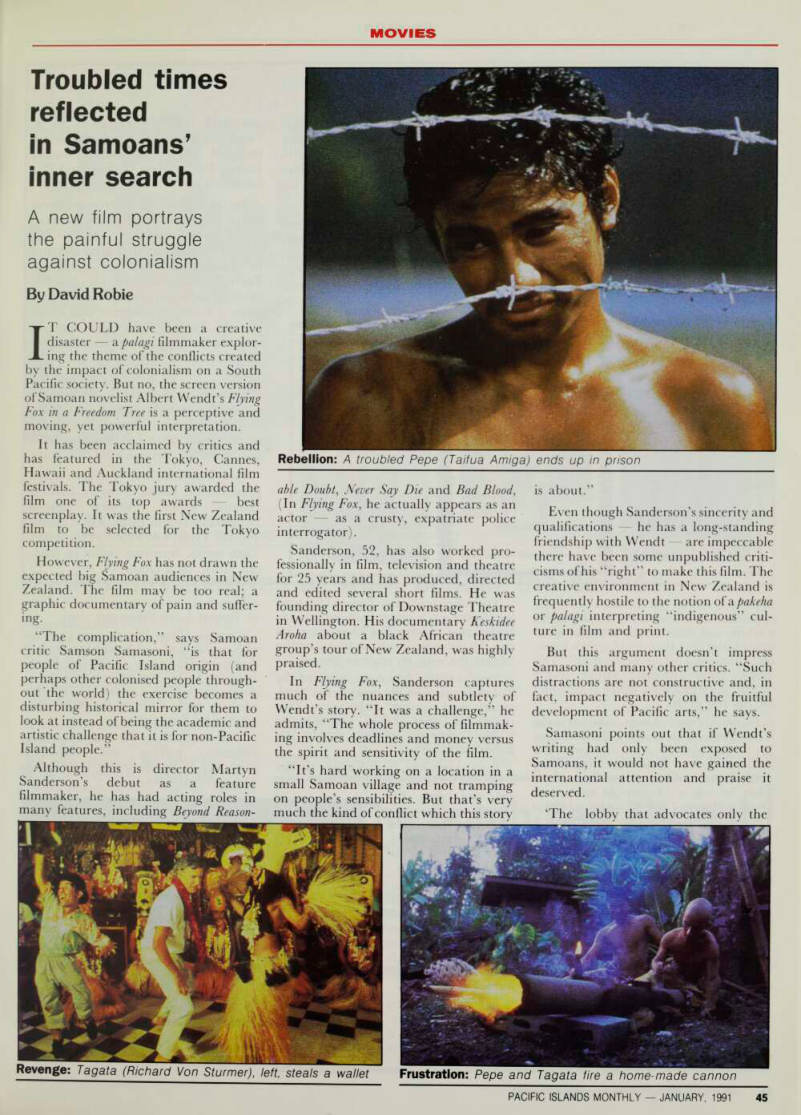
Rebellion: A troubled Pepe (Taifua Amiga) ends up in prison
oppressed should tell the sad tales of the oppressed does keep some employed for a while, and diverts their attention from other issues that they could wreak havoc on,” Samasoni wrote in Illusions. “This lobby’s most attractive feature is the ‘purist’ entertainment which it provides for the rest of us.”
Faifua “Junior” Amiga, who plays the leading role, is an unlikely film star. Just 20, he has already acted in three New Zealand feature films, including Flying Fox. He embarked on his film career when he was a 14-year-old student at
Otara’s Hillary College, auditioning for
The Silent One so that he could skip a science class. He didn’t win that role, but a year later he scored a part in Kingpin.
He later had a role in Mark II and has gained several television parts.
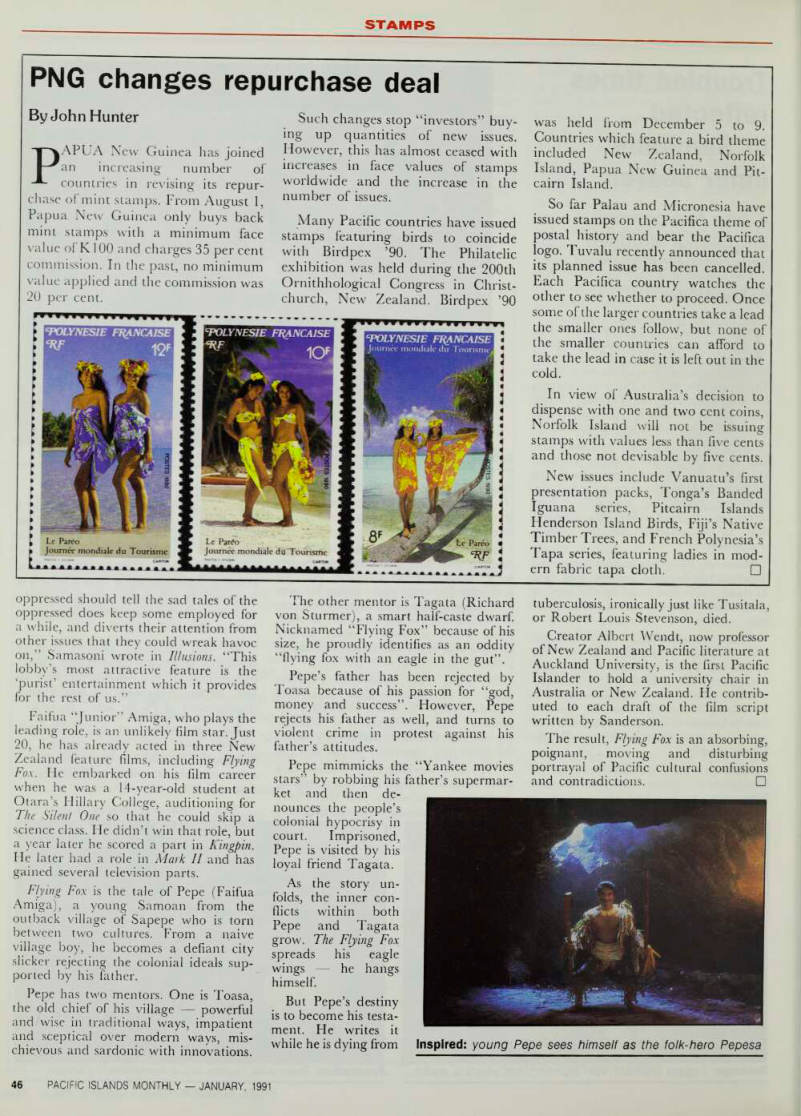
Flying Fox is the tale of Pepe (Faifua Amiga), a young Samoan from the outback village of Sapepe who is torn between two cultures. From a naive village boy, he becomes a defiant city slicker rejecting the colonial ideals sup ported by his father.
Pepe has two mentors. One is Toasa, the old chief of his village powerful and wise in traditional ways, impatient and sceptical over modern ways, mis chievous and sardonic with innovations.
The other mentor is Tagata (Richard von Sturmer), a smart half-caste dwarf.
Nicknamed “Flying Fox” because of his size, he proudly identifies as an oddity “flying fox with an eagle in the gut”.
Pepe’s father has been rejected by Toasa because of his passion for “god, money and success”. However, Pepe rejects his father as well, and turns to violent crime in protest against his father’s attitudes.
Pepe mimmicks the “Yankee movies stars” by robbing his father’s supermar
ket and then de nounces the people’s colonial hypocrisy in
court. Imprisoned,
Pepe is visited by his
loyal friend Tagata.
As the story un folds, the inner con flicts within both Pepe and Tagata grow. The Flying Fox
spreads his eagle
wings he hangs himself.
But Pepe’s destiny is to become his testa ment. He writes it while he is dying from
tuberculosis, ironically just like Tusitala, or Robert Louis Stevenson, died.
Creator Albert Wendt, now professor of New Zealand and Pacific literature at Auckland University, is the first Pacific Islander to hold a university chair in Australia or New Zealand. He contrib uted to each draft of the film script written by Sanderson.
The result, Flying Fox is an absorbing,
poignant, moving and disturbing
portrayal of Pacific cultural confusions and contradictions. □
Inspired: young Pepe sees himself as the folk-hero Pepesa