state of
pp. 43-44 · Read in the full issue
The Arts
Vanuatu: state of the arts
By Ngaire Douglas
THE strength of Vanuatu’s indigen ous culture and the introduction of a variety of outside elements have made the country one of the most artistically rich in the Pacific.
This is evident in the fact that Port Vila, though relatively small in size, boasts an impressive number of show places for both indigenous and exotic art.
The most important of these, in terms of native tradition, is the museum of the Cultural Centre. It is located in premises built by the condominium government but, because of the size and quality of its collection, it is fast outgrowing the centre. Development plans for Port Vila include the construction of a larger building near the Bamboo Royal restaur ant to house the priceless artifacts and archives of the Cultural Centre. Depend ing on foreign aid, something may be achieved in the near future.
The museum’s exhibits combine natu ral history there are extensive displays of local shells, butterflies and birds with products of human skill such as ritual objects, artefacts and weapons.
The exhibit also includes historical and contemporary photographs, and video and audio tape collections of custom
celebrations and social behaviour.
The rarest piece in the collection is a
piece of 3000-year-old Lapita pottery
found on the island of Malo near Espiritu San-to. It is said to be the largest single piece so far collected.
Other outstanding exhibits include huge slit drums and tree fern figures from Ambrym, funerary objects from Mal akula, and an assortment of clubs and spears for use against both man and beast. Next door to the museum, at Handikraf Blong Vanuatu, one can buy versions of the artefacts made specifically for sale to tourists. If purists find this disturbing, they might consider that the
“authentic” pieces are not for sale at any price and, in any event, most people would be hard put to explain with precision the difference between the construction of a tree-fern figure for village use, and one for sale.
The dominant colours in the museum are brown, black and orange, the original dyes used by the people of Southwest Malakula. But a recent revival of traditional arts among the people of Southeast Malakula has seen the introduction of bright blues, yellows and reds into their work. Ac cording to Acting Cu rator, Jack Keitadi, many ni-Vanuatu did not un derstand the role of the museum when it was es tablished in the 19605.
Slow-ly, through small scale education pro
grammes and as a result of increasing familiarity with the Cen-tre, people are donating for preservation artefacts which at one time would have been destroyed after they had served their specific purpose. Every piece in the collection has a special significance: there is also material which members of the opposite sex are forbidden to see. Jack Keitadi is working on the classification and preser vation of male ritual objects, while a female expert is to be engaged to work with material from female rites.
In late 1989, the museum staff com pleted the first major cataloguing of the collection. They are also involved in actions to get the government to make large-scale archaeological surveys of land earmarked for development, in the hope that this may avoid destruction of valuable sites and artefacts.
Vanuatu’s best-known practitioners of contemporary art are the prolific and justly acclaimed Nicolai Micoutouchkine and Aloi Pilioko (who were profiled in Pacific Islands Monthly in February, 1990). But in a small, bright, unpreten tious gallery in Port Vila, other splendid examples of work by locals and expatri ates are to be found.
This is Gallerie L’Atelier, located in a charming old wooden building on Rue Bougainville. The operators, ni-Vanuatu Hardy Leo and his wife, and Frenchwoman Suzanne Bastien, pride themselves on their collection of works by local artists. However, cream of the collection is work by Robert Tatin d’Avesnieres, a French artist and friend of Madame Bastien, who lived and painted in Vanuatu in the 19605.
Much of Tatin’s work depicts village life, but in the semi-urbanised communi ties which were growing even in his day.
Although Tatin was not strictly speak ing a realist, these have a gritty accuracy
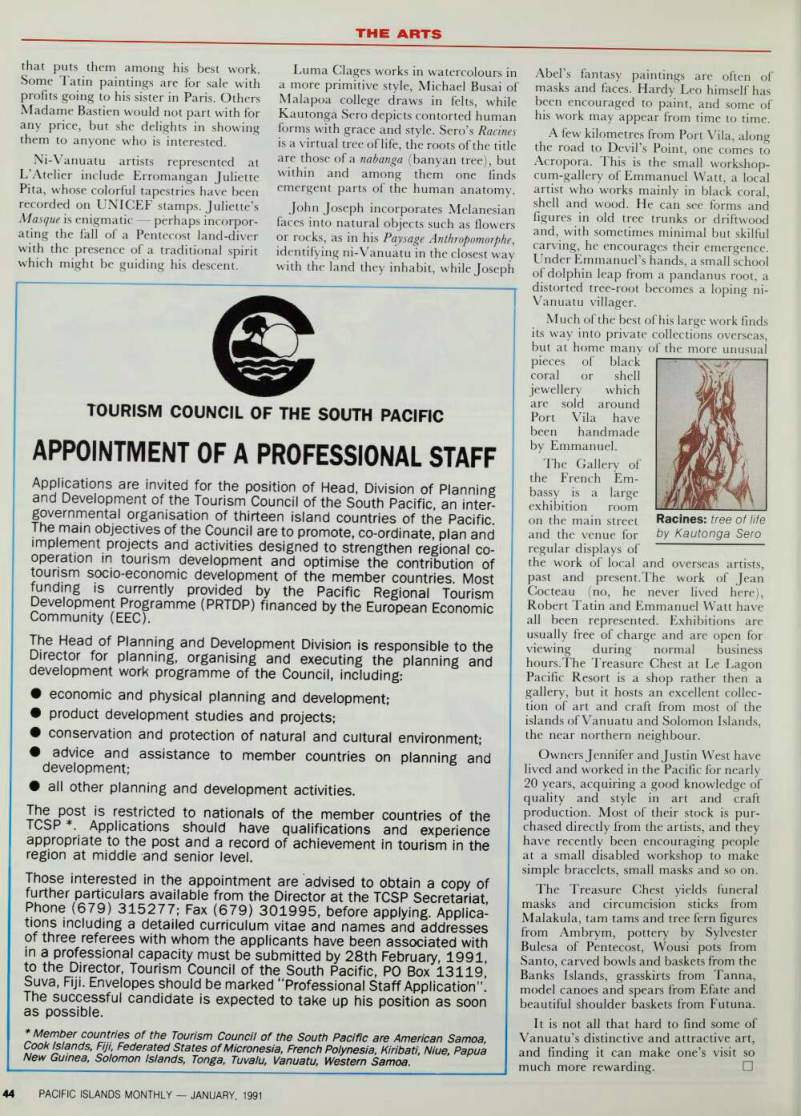
Masque: by Juliette Pita
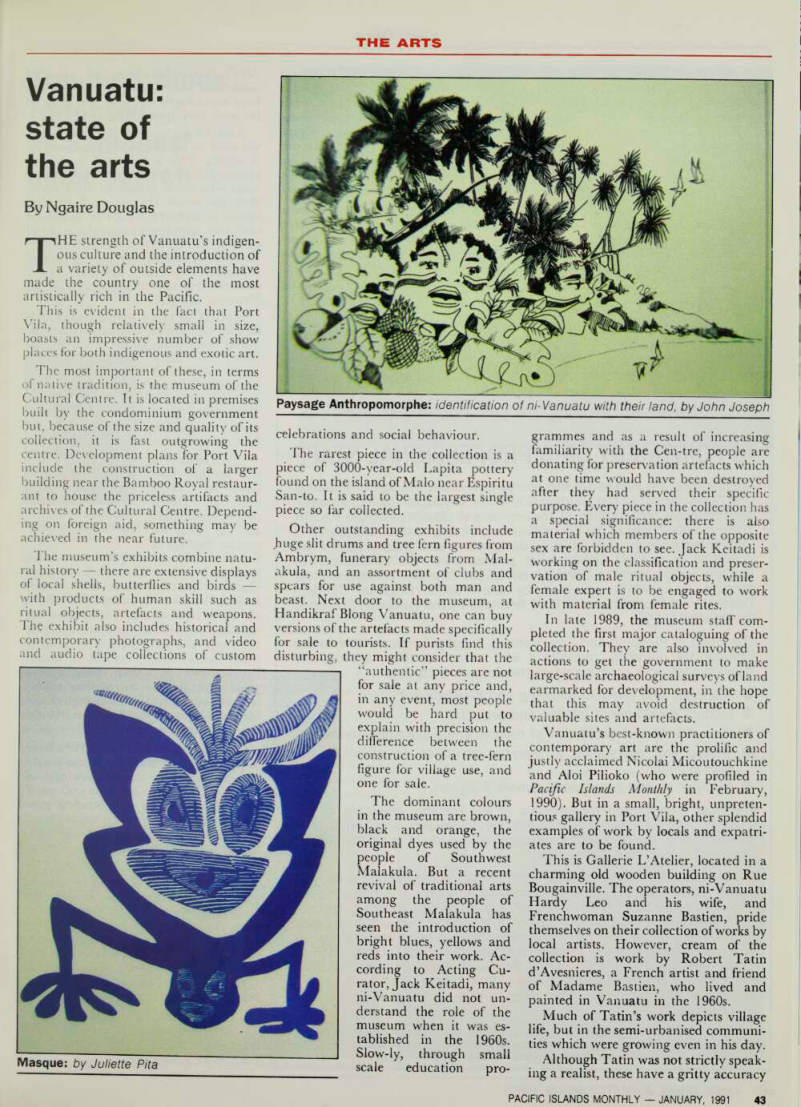
Paysage Anthropomorphe: identification of ni-Vanuatu with their land, by John Joseph
that puts them among his best work.
Some Tatin paintings are for sale with profits going to his sister in Paris. Others Madame Bastien would not part with for any price, but she delights in showing them to anyone who is interested.
Ni-Vanuatu artists represented at L’Atelier include Erromangan Juliette Pita, whose colorful tapestries have been recorded on UNICEF stamps. Juliette’s Masque is enigmatic perhaps incorpor ating the fall of a Pentecost land-diver with the presence of a traditional spirit which might be guiding his descent.
Luma Clages works in watercolours in a more primitive style, Michael Busai of Malapoa college draws in felts, while Kautonga Sero depicts contorted human forms with grace and style. Sero’s Racines is a virtual tree of life, the roots of the title are those of a nabanga (banyan tree), but within and among them one finds emergent parts of the human anatomy.
John Joseph incorporates Melanesian faces into natural objects such as flowers or rocks, as in his Paysage Anthropomorphe, identifying ni-Vanuatu in the closest way with the land they inhabit, while Joseph
Abel’s fantasy paintings are often of masks and faces. Hardy Leo himself has been encouraged to paint, and some of his work may appear from time to time.
A few kilometres from Port Vila, along the road to Devil’s Point, one comes to Acropora. This is the small workshop cum-gallery of Emmanuel Watt, a local artist who works mainly in black coral, shell and wood. He can see forms and figures in old tree trunks or driftwood and, with sometimes minimal but skilful carving, he encourages their emergence.
Under Emmanuel’s hands, a small school of dolphin leap from a pandanus root, a distorted tree-root becomes a loping ni- Vanuatu villager.
Much of the best of his large work finds its way into private collections overseas, but at home many of the more unusual
pieces of black coral or shell
jewellery which
are sold around Port Vila have been handmade by Emmanuel.
The Gallery of the French Em bassy is a large exhibition room on the main street and the venue for
regular displays of the work of local and overseas artists, past and present. The work of Jean Cocteau (no, he never lived here), Robert Tatin and Emmanuel Watt have all been represented. Exhibitions are usually free of charge and are open for viewing during normal business hours. The Treasure Chest at Le Lagon Pacific Resort is a shop rather then a gallery, but it hosts an excellent collec tion of art and craft from most of the islands of Vanuatu and Solomon Islands, the near northern neighbour.
Owners Jennifer and Justin West have lived and worked in the Pacific for nearly 20 years, acquiring a good knowledge of quality and style in art and craft production. Most of their stock is pur chased directly from the artists, and they have recently been encouraging people at a small disabled workshop to make simple bracelets, small masks and so on.
The Treasure Chest yields funeral masks and circumcision sticks from Malakula, tarn tarns and tree fern figures from Ambrym, pottery by Sylvester Bulesa of Pentecost, Wousi pots from Santo, carved bowls and baskets from the Banks Islands, grasskirts from Tanna, model canoes and spears from Efate and beautiful shoulder baskets from Futuna.
It is not all that hard to find some of Vanuatu’s distinctive and attractive art, and finding it can make one’s visit so much more rewarding. □
Racines: tree of life by Kautonga Sero