The Evans blast
LAST month Australia’s Foreign Minister, Senator Gareth Evans, made his fourth tour of the Pacific but did not visit Fiji. Fiji’s Prime Minister, Ratu Sir Kamisese Mara, had told him he was not welcome.
At issue was one sentence in Evans’ speech to the United Nations General As sembly in October and com ments he made during a visit to India four months ago.
Evans had told the United
Nations Fiji’s racially
weighted post-coup consti tution would build “new and
far-reaching racially dis
criminatory principles into
the Fijian political system”.
It was a strong statement
to a distinguished audience of world leaders. Ratu Sir Kamisese, who left a cordial meeting with Australia’s Prime Minister at the South Pacific Forum in Vanuatu satisfied a softening of Australia’s policy was in the wind, was angered.
In an interview shortly afterwards, Ratu Sir Kamisese accused Evans of opposing improved relations between Australia and Fiji and highlighted the differences made by Hawke and Evans, saying their views on Fiji “appeared quite divergent”.
The differences arose over comments made by Hawke after his Forum meeting with Ratu Sir Kamisese. The Australian Prime Minister had, for the first time, publicly urged the ousted Coalition party in Fiji to abandon their boycott of elections. He also made it clear Australia’s relations with Fiji would be reviewed in the light of the continuing progress back to constitutional rule and the extent to which the military forces exercised influence over the government.
Hawke’s statements were the most conciliatry since the 1987 coups and appeared to mark a subtle, but significant, change in Australia’s stand. In particular, they appeared to abandon Australia’s oft repeated position that it would not normalise relations until Fiji had a constitution “broadly acceptable to all communities”. Now the new constitution has been promulgated, Ratu Sir Kamisese wants to see the issue removed from the international stage.
Within Australia, however, there is still strong pressure on the government not to modify its stand. Only recently, Justice Michael Kirby, one of Australia’s most senior and respected judges, condemned the post-coup constitution, saying the government would not be answerable to the governed (ethnic- Indian or Fijian) and that the document provided a means by which Fiji could be ruled in perpetuity by a small group of chiefs and their associates.
Judge Kirby’s comments were not prompted by opposition to indigenous rights. On the contrary, he is a man who has spoken out in favour of special measures to assist indigenous people. Rather his comments were based on a desire to see harmony in Fiji and on the belief that once the rights of one,
or a number of groups, are severely curtailed, the seeds for future unrest and instability will have been sown.
Even though the Australian media may have tired of reporting the twists and turns of Fiji politics, interest and concern continue to be registered by groups representing ‘middle Australia’, such as Amnesty International. Amnesty was particularly distressed by the charges of sedition layed against seven ethnic Indians alleged to have been involved in a symbolic burning of the new consstitution, and has said if the protestors or the three journalists, charged in a related incident with malicious publication, are convited, they will be regarded as prisoners of conscience.
Many Australians find it simply absurd that people taking part in a peaceful protest could face such severe charges. That the five soldiers resposibsle for kidnapping and torturing one of the protestors can be let off with a fine confirm the view in many minds that there are serious problems with the Fiji
justice system.
Within Evans’ ruling Labor Party, feeling is also strong.
Just last month a nationwide appeal to Labor Party branches and trade unions, for Fiji’s ousted Coalition, saw some unions give contributions six times more than what they had been asked. Despite Hawke’s comments in Port Vila, the accommodation hoped for by Ratu Sir Kamisese has not eventuated. Evans and the Foreign Affairs Department insist there have never been any inconsistencies between comments made by Hawke and his Foreign Minister, merely that there has been a slightly different emphasis on the same unchanged seven-point policy statement. If anything, Ratu Sir Kamisese’s reaction, coming as it did at the same time as the kidnapping and sedition charges is only likely to harden the Australian government’s resolve at least in the short term.
Evans has made it clear he believes Fiji cannot expect to be immune from criticism. In New Zealand late last month, he went further and stressed Australia’s duty to take a stand in favour ofhuman rights. “You can’t go around making pronouncements about South Africa and China ... and then sit on your hands ... when you have a very difficult human rights situation in your own region,” he said.
But despite his tough response, Evans is also facing pressure
to take the pragmatic road and, if not restore normal relations, at least ease back on his criticism.
That pressure is coming, not just from businesspeople and some diplomats, but increasingly from the Liberal-National Party Opposition which is now edging ahead of the government in opinion polls for the first time in years. Whatever the political
complexion ot me government in Canberra, however, it will face a dilemma over its stand over Fiji. No politicall party has yet backed the restoration of full relations and all agree that the constitution severly discriminates against Indo-Fijians and against indigenous Fijians living in the urban areas.
Essentially, the difference between the parties is still one of style rather than content. □
Sydney
Jemima
Garrett
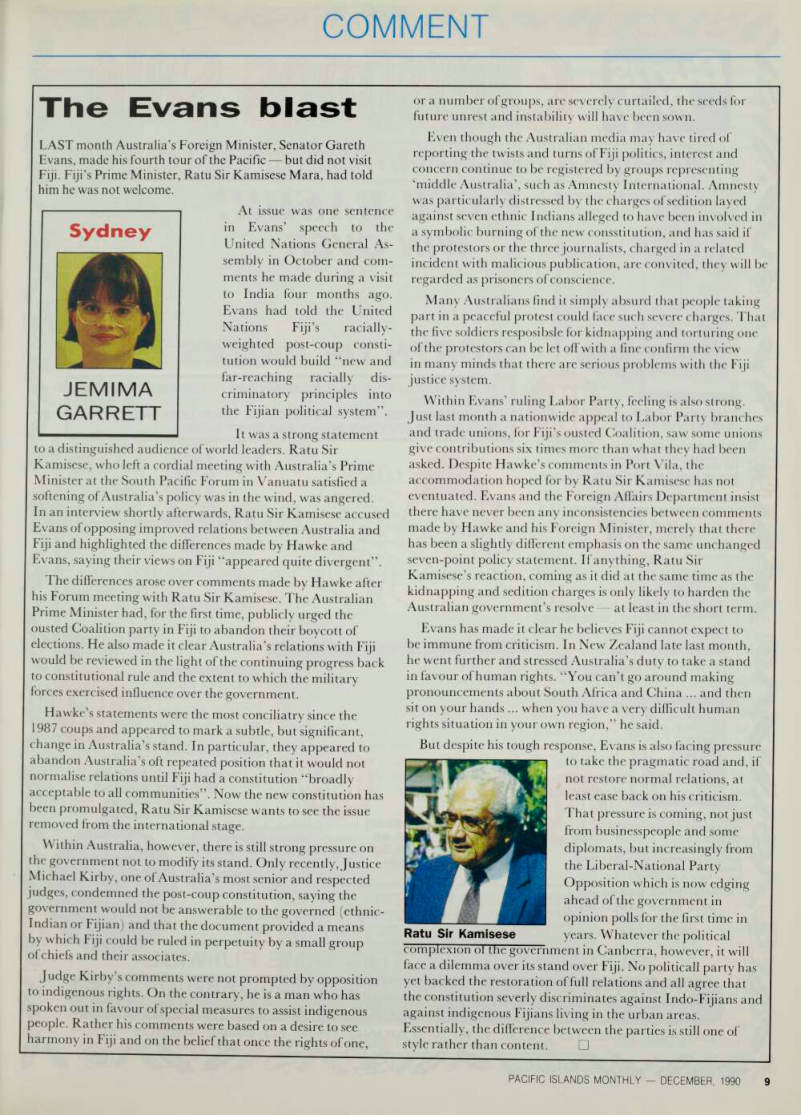
Ratu Sir Kamisese