Alien question
NEW Zealand was founded by immigrants, starting with the Maori who came here in their long canoes from fabled Hawaiki more than a thousand years ago. European migrants poured in over the last century and a half to enlarge the cultural and ethnic base of the country.
The pace of immigration stepped up after the Second World War with waves of British and Dutch settlers, and in recent years there has been a steady trickle of other newcomers, many like the Maori from Polynesia and others from Asia. In Auckland and Wellington now, Thai, Malaysian and Cambodian restaurants vie for business with Italian trattoria, Greek tavernas and the rash of Chinese eating houses founded by earlier arrivals.
But New Zealand’s population remains small, at under 3.4 million, and despite persistent suggestions over the years that it should be greater in the interests of expanding the economy, successive governments have maintained a cautious approach.
A positive and dynamic immigration policy, like that Australia has exercised for many years, is a nettle New Zealand politicians have refused to grasp. Although they have spawned a constant stream of reviews and White Papers on the subject, immigration has remained at conservative levels. This has worried many business people, particularly in the face ofa dramatic outflow of New Zealanders in recent years.
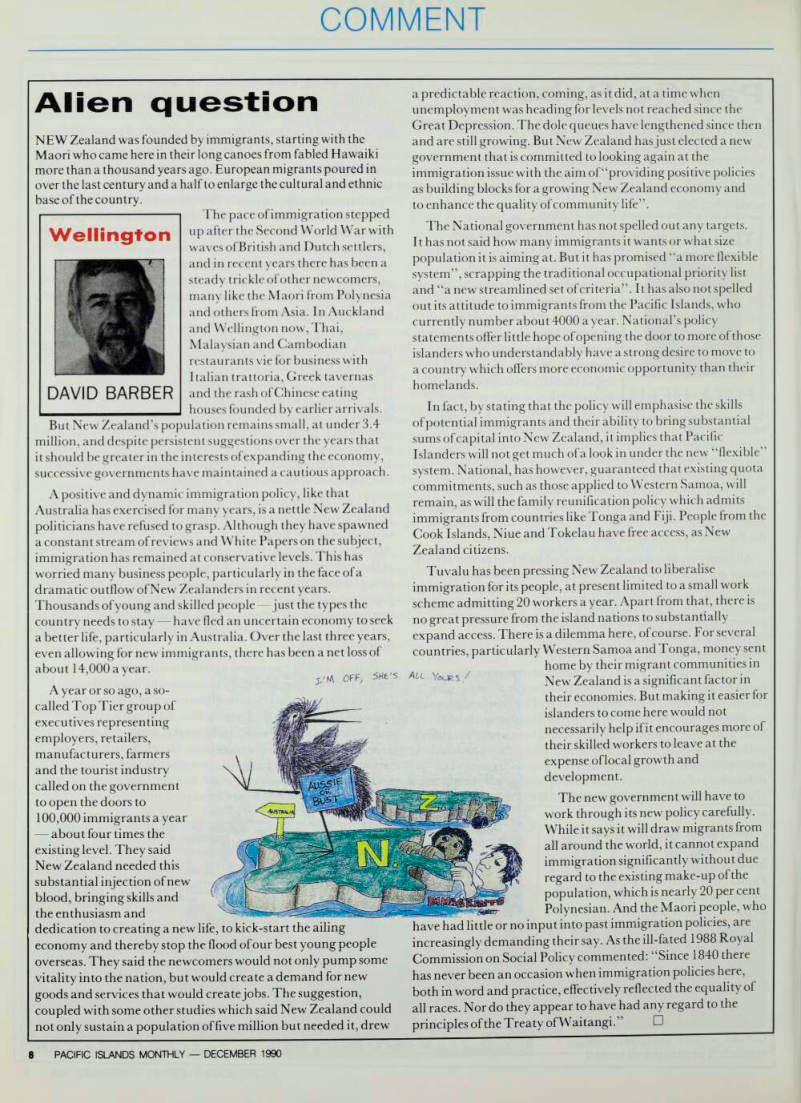
Thousands of young and skilled people —just the types the country needs to stay have fled an uncertain economy to seek a better life, particularly in Australia. Over the last three years, even allowing for new immigrants, there has been a net loss of
about 14,000 a year.
A year or so ago, a so called Top Tier group of
executives representing
employers, retailers,
manufacturers, farmers and the tourist industry called on the government to open the doors to 100,000 immigrants a year about four times the existing level. They said New Zealand needed this substantial injection of new blood, bringing skills and the enthusiasm and
dedication to creating a new life, to kick-start the ailing economy and thereby stop the flood of our best young people overseas. They said the newcomers would not only pump some vitality into the nation, but would create a demand for new goods and services that would create jobs. The suggestion, coupled with some other studies which said New Zealand could not only sustain a population offive million but needed it, drew
a predictable reaction, coming, as it did, at a time when unemployment was heading for levels not reached since the Great Depression. The dole queues have lengthened since then and are still growing. But New Zealand has just elected a new government that is committed to looking again at the immigration issue with the aim of“providing positive policies as building blocks for a growing New Zealand economy and to enhance the quality of community life”.
The National government has not spelled out any targets. 11 has not said how many immigrants it wants or what size population it is aiming at. But it has promised “a more flexible system”, scrapping the traditional occupational priority list and “a new streamlined set ofcriteria”. It has also not spelled out its attitude to immigrants from the Pacific Islands, who currently number about 4000 a year. National’s policy statements offer little hope of opening the door to more of those islanders who understandably have a strong desire to move to a country which offers more economic opportunity than their homelands.
In fact, by stating that the policy will emphasise the skills of potential immigrants and their ability to bring substantial sums of capital into New Zealand, it implies that Pacific Islanders will not get much ofa look in under the new “flexible” system. National, has however, guaranteed that existing quota commitments, such as those applied to Western Samoa, will remain, as will the family reunification policy which admits immigrants from countries like Tonga and Fiji. People from the Cook Islands, Niue and Tokelau have free access, as New Zealand citizens.
Tuvalu has been pressing New Zealand to liberalise immigration for its people, at present limited to a small work scheme admitting 20 workers a year. Apart from that, there is no great pressure from the island nations to substantially expand access. There is a dilemma here, of course. For several countries, particularly Western Samoa and Tonga, money sent
home by their migrant communities in New Zealand is a significant factor in their economies. But making it easier for islanders to come here would not necessarily help if it encourages more of their skilled workers to leave at the expense oflocal growth and development.
The new government will have to work through its new policy carefully.
While it says it will draw migrants from all around the world, it cannot expand
immigration significantly without due
regard to the existing make-up of the population, which is nearly 20 per cent Polynesian. And the Maori people, who
have had little or no input into past immigration policies, are increasingly demanding their say. As the ill-fated 1988 Royal Commission on Social Policy commented: “Since 1840 there has never been an occasion when immigration policies here, both in word and practice, effectively reflected the equality of all races. Nor do they appear to have had any regard to the principles of the T reaty ofWaitangi.” □
Wellington