Spanish wreck reveals Marianas link
pp. 37-38 · Read in the full issue
By David North
A three-year excavation of a Manila Galleon wreck site in the Northern Mariana islands has recovered thousands of historic artifacts which have been purchased by a Japanese collector for $4.94 million and will eventually be turned over to the island government.
The collection of items from the 1638 wreck of the Nuestra Senora de la Conception , including more than a thousand pieces of Spanish gold jewellery, will be perma nently exhibited in the Northern Marianas and either sold or donated to the islands, according to a government announcement. The Northern Marianas also receives $ 1.2 million as its share of the sale and a cross-section of the artifacts for its public museum, APEX International, which is building a marina-condominium complex on the capital island of Saipan, will construct a privately operated museum in its resort to display the collection, according to com pany spokesman Hajime Mori. He also offered to sell the collection to the government after 25 years. If the collec
tion had not been bought in 40 years, Mori said it is the firm’s intention to donate it to the local government.
Northern Marianas Governor Larry I.
De Leon Guerrero, who signed the sale document July 28 in London, said he was pleased the collection will be returned to the islands permanently and commended the parties to the agreement for negotiat
ing in good faith.
The recovery group, Pacific Sea Re sources Inc., which provided the up-front
capital, equipment, personnel and con
ducted the excavation, receives 75 per cent of the collection’s sale price, accord ing to its agreement with the Northern Marianas government. Pacific Sea Re sources President William Mathers, call ing the APEX announcement “the best possible conclusion to this project,” be lieves the project is the first scientific, i.e., archeological, excavation even done on a Manila Galleon, some 30 of which were lost in the Pacific during the 250 years of
the Spanish trading line.
The huge armed vessels, the largest ocean-going ships of their era, piled the mid-Pacific route between Acapulco and
Manila on their three-month westward crossing, stopping at Guam for food and water. On the Manila to Acapulco leg, the heavily-laden transports steered northeast to the Japan Current, which carried them across the top of the Pacific to the California coast. The eastward
crossing was a harrowing, typhoon-tossed
journey from tropical to freezing climes
and could take as long as seven months.
Mortality was high, usually claiming a
third of the crew and passengers.
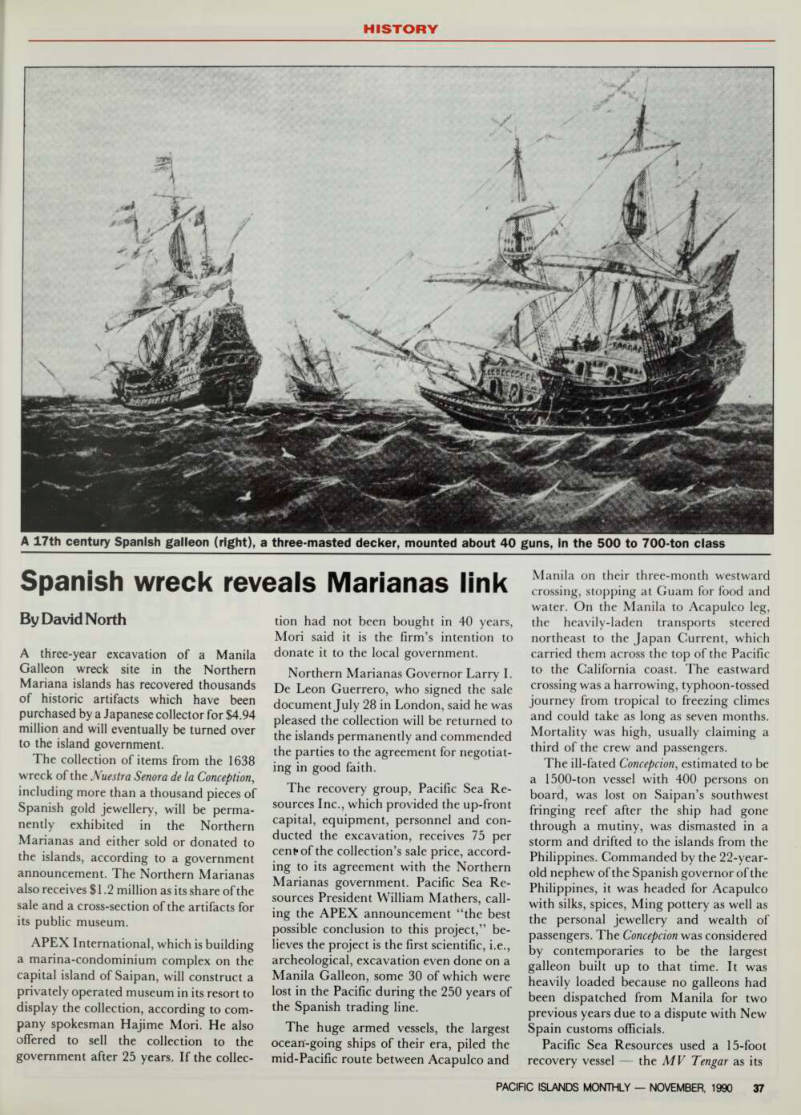
The ill-fated Concepcion , estimated to be a 1500-ton vessel with 400 persons on board, was lost on Saipan’s southwest fringing reef after the ship had gone through a mutiny, was dismasted in a storm and drifted to the islands from the Philippines. Commanded by the 22-year old nephew of the Spanish governor of the Philippines, it was headed for Acapulco with silks, spices, Ming pottery as well as the personal jewellery and wealth of passengers. The Concepcion was considered
by contemporaries to be the largest
galleon built up to that time. It was heavily loaded because no galleons had been dispatched from Manila for two previous years due to a dispute with New Spain customs officials.
Pacific Sea Resources used a 15-foot recovery vessel the MV Tengar as its
A 17th century Spanish galleon (right), a three-masted decker, mounted about 40 guns, In the 500 to 700-ton class
base during the excavation, living on the vessel and conducting all survey, exca vation and recovery operations from the ship, which was anchored over the wreck site. The Tengar also contained a fully
equipped conservation laboratory where
initial restoration work was conducted on the artifacts. After being photographed and recorded on the ship’s computer data system, the artificacts were sent to the British Museum and the Institute for Archaeology for further restorations and research.
At a 1988 Northern Marianas exhibit of some of the collection, Mathers described the Tengar’s self-contained approach to marine archaeological recovery as a way of bringing the sophisticated acoustic survey and state of the art locating and recovery equipment to the remote lo cations in the Asia-Pacific region where historic shipwrecks are located. The Concepcion project is the first for the company, which specialised in the archaeological recovery of historic wrecks.
The 28-member team of divers, composed of Asians, Europeans and Americans, worked in depths ranging from 20 to 200 feet, and explored even deeper areas with the aid of a diving bell and remotely
operated vehicle equipped with a video camera. Over two seasons, in 1987 and 1988, the team spent 10 months on site.
The results of the survey and excavation indicate that the Concepcion had struck the reef several times, and continued to disgorge its cargo as it was blown south along the boulder-strewn coral platform.
Some large sections of the ship sank in 50 feet of water while other parts drifted into deeper water before going down.
The recovery work also found that most of the pieces of jewellery and other loose cargo had accumulated in cracks and crevices in the reef and under large coral heads. The project used large suction tubes to draw off up 10 feet of sand from these fissures. The 22.5 karat gold items in the collection include gem-studded broaches, pendants, rings and crucifixes, as well as gold neck chains, filigreed buttons, sections of plate and coins. One of the most stunning items in the collec tion is a small gold perfume decanter inlaid with 44 diamonds.
Other items in the collection include hundreds of 17th century storage jars, ship fittings, a 12-foot anchor, cannon shot, and Ming porcelain. All of the ship’s cannon, and probably some of its other cargo, had been salvaged by Spanish
recovery expeditions in the late 17th century. The islanders recovered much of the cargo following the initial sinking.
The project’s three years of archival research, overseen by renown marine exploration historian Sir John Hale, of the University of London, has brought to light a greater degree of cultural interac tion between the Chammoro population of the Marianas and galleon traders than previously realised. The extent of the interaction, motivated largely by an iron for-food-and-water trade between the islanders and the Spanish resulted in some early alliances between Chamorro chiefs and galleon castaways. Some survivors of the Concepcion , for example, were well treated and taken back to the Philippines a 1500 mile two-week sail by Chamorro seamen in open island canoes.
Though the islands were not colonised until 1668, the Spanish had used the islands regularly from 1565 on as a reprovisioning stop on the westward crossing and refuge from storms on the eastward passage. Unfortunately the abundance of reefs throughout the archi pelago and the lack of sheltered harbours led to numerous mishaps and several galleons are believed to have gone down on Marianas’ waters. □