That sinking feeling again
pp. 34-36 · Read in the full issue
The Environment
By Jeremy Leggett
LOW-LYING Pacific islands are in grave peril from global warming and the increase in sea levels and storm intensities which it will cause in the years to come. This much is now clear from a recent UN-commissioned consultation by hundreds of the world’s climate scien tists. If such a future is to be avoided, much will hinge on events on the diplomatic stage over the next few months. In advance of the all-important World Climate Con ference in Geneva last month, the first salvoes were fired by the representatives of Pacific Islanders.
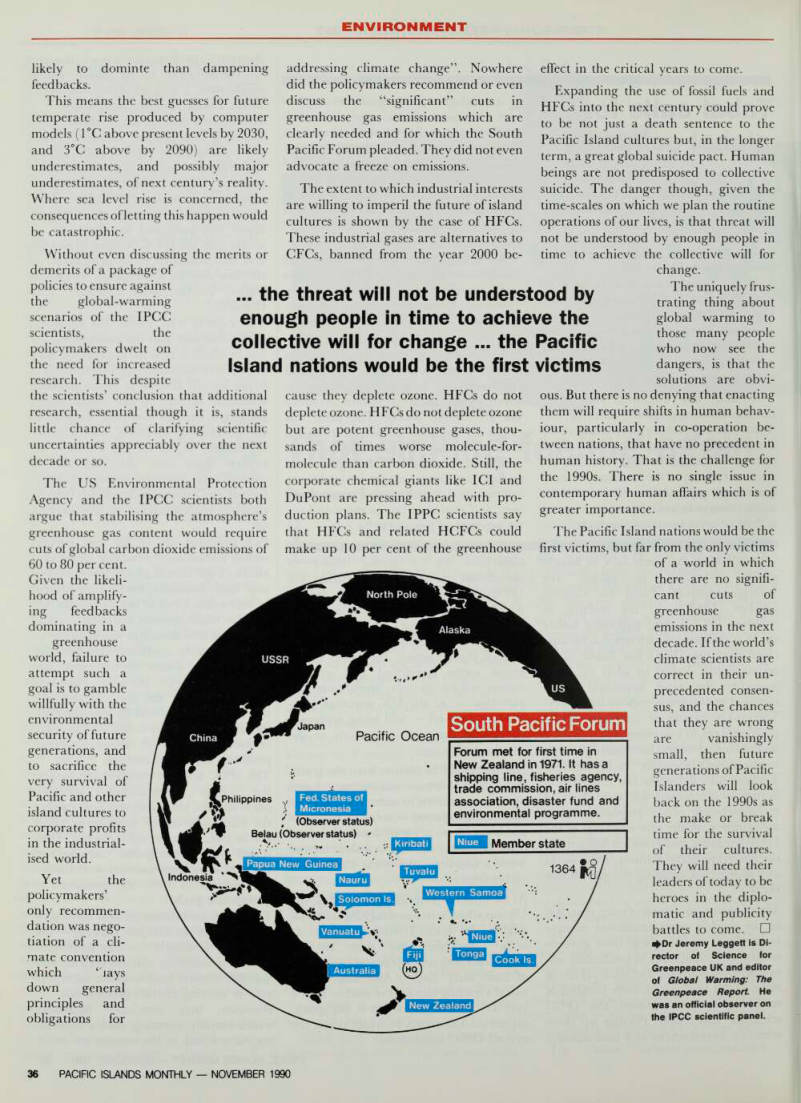
In early August, the South Pacific Forum in Vanuatu produced a hard hitting statement about the threat of global warming and a plea for action.
Kiribati’s Foreign Secretary, Peter Timeon, carried that message to a vital United Nation’s meeting in Sweden at the end of August. His passionate state ment to the plenary on the first day brought an unprecedented round of sympathetic applause from many of the
300-plus delegates.
This moving occasion amounted to an announcement that the race is on to persuade the world to cut significantly its emissions of greenhouse gases. At stake for many Pacific Island nations maybe within a generation is the very future of their cultures.
Allied with the Pacific Islanders at present on the world stage are countries
like West Germany, Austria, Italy and Denmark, all of which recognises the enormity of the global warming problem and are committed to cuts in greenhouse gas emissions. It was the hands of diplomats from such countries which clapped at the end of Timeon’s speech.
But blocking progress is a formidable group of nations, especially those with economies locked into the production and use of fossil fuels coal, oil and gas from which the majority of greenhouse gases drive.
The final South Pacific Forum com munique at Port Vila read: “The Forum noted the continued threat to the cul tural and physical survival of Pacific nations from climate change and sea level rise. The Forum recalled that the gases which cause the greenhouse effect, notable carbon dioxide, are emitted mainly from industrialised countries.
The Forum therefore strongly urged industrialised countries to enact signifi cant cuts in the emission of greenhouse gases into the atmosphere, including the establishment of oglibatory emission re duction standards.”
The communique was a consensus statement and therefore supported by New Zealand and Australia, which both subsequently announced their intention like a growing number of European countries to cut their carbon dioxide emissions by 20 per cent by the year 2005.
The United Nations panel charged
with adivising the world how to handle global warming is called the Intergovernmental Panel on Climate Change (IPCC). At the meeting in Sweden, IPCC’s final gathering before the World Climate Conference, it became clear that the IPCC has failed in its responsibility. Failed in what has been arguably the most important international consultation process in history.
The main reason is that the IPCC policymakers, in a working group chaired by the United States, have failed to listen to the panel s scientists. In his address, imeon told delegates the final IPCC ummary document fell well short of
recommending policy responses ‘com-
mensurate with the dire warnings of the IPCC scientists, and as such it fails to offer the low-lying island nations of the world any prospect of escaping the greenhouse threat 55 The scientists, consisting of more than 300 of the world’s most emininent climate researchers, most of them from governments, are unanimous in predicting unprecedented warming and sea-level rise in the decades to come. A mere handful of scientific doubters contest the IPCC scientists conclusion. Playing up these scientific uncertainties and undoubtedly
influenced by a strong lobby of greenhouse-gas-emitting inudstries, the IPCC policymakers effectively recom mended handing out bandaids in the face of an authoritative plague warning.
Taking their cue from White House chief of staff John Sununu, the IPCC policy group seems convinced that making serious efforts to cut greenhouse gas pollution as the UN scientists’ con clusions demand will bring economic chaos and dramatic reductions in the standard of living.
Nothing could be further from the truth.
But even if this view was correct and not a genuflection to auto, oil, coal and chemical companies we could still have no choice but to cut greenhouse emissions if we genuinely wanted to guarantee the world’s children, and their children, a viable future.
At the final IPCC meeting in Sweden, the US was allied in its foot dragging by Saudi Arabia, the Soviet Union and China. It is no coincidence that these are the world’s leading producers and consumers of fossil fuels. Sadly, Australia the world’s leading exporter of coal kept a very low profile and when it did speak, supported US efforts to water down the overall IPCC conclusions.
Australia’s performance was a betrayal of its commitment to its South Pacific neighbours, a cynical abrogation of the South Pacific Forum communique.
Determined that the truth about global warming and possible solutions should not be eclipsed by the UN policy group, Greenpeace asked 20 of the world’s pre eminent climate scientists and energy exports to compile a “shadow IPCC report”. Global Warming: the Greenpeace Report was published worldwide to co incide with the IPCC meeting in Sweden and was presented to all delegations on the first day by Greenpeace delegation leader, ex-Australian diplomat Paul Hohnen.
The experts who wrote The Greenpeace Report conclude that the anti-greenhouse future which is now an imperative, need not involve dramatic cuts in standards of living for all. Instead it could maintain economic activity in the industrialised countries, expand economic activity in the developing countries, and improve the quality of life for all. Further, the experts show how the industrialised countries can dramatically cut their fossil fuel use and reap a significant side benefit; eliminating dependence on Middle East oil.
Full practical use of the best energy saving technologies available could save about 75 per cent of all electricity and oil now used. Similarly, massive investment in renewable forms of energy production solar, wind, biomass and so on could within the next decade or so displace most or even all of the world’s current fossil fuel
dependence. These technologies are
available today, through massively
under-used, and are cost effective. All they require is the will by governments, industries and people to face the challenge of change, to rearrange the world’s energy priorities and infrastructure.
The IPCC scientists believe that despite the huge remaining scientific uncertainties, the question is not whether the human-enhanced greenhouse effect will be bad, but how bad and when. They stated clearly that global warning will occur in a business-as-usual world with out policies to stem the emissions of
greenhouse gases.
The only uncertainties are over the degree which amplify or dampen warning the so-called “feedbacks” can come into play in a warming climate system, and that few of these feedbacks are incorpor ated in existing climate predictions.
However, they concluded feedbacks which amplify warming, such a decreas ing carbon sink in the oceans, are more
likely to dominte than dampening feedbacks.
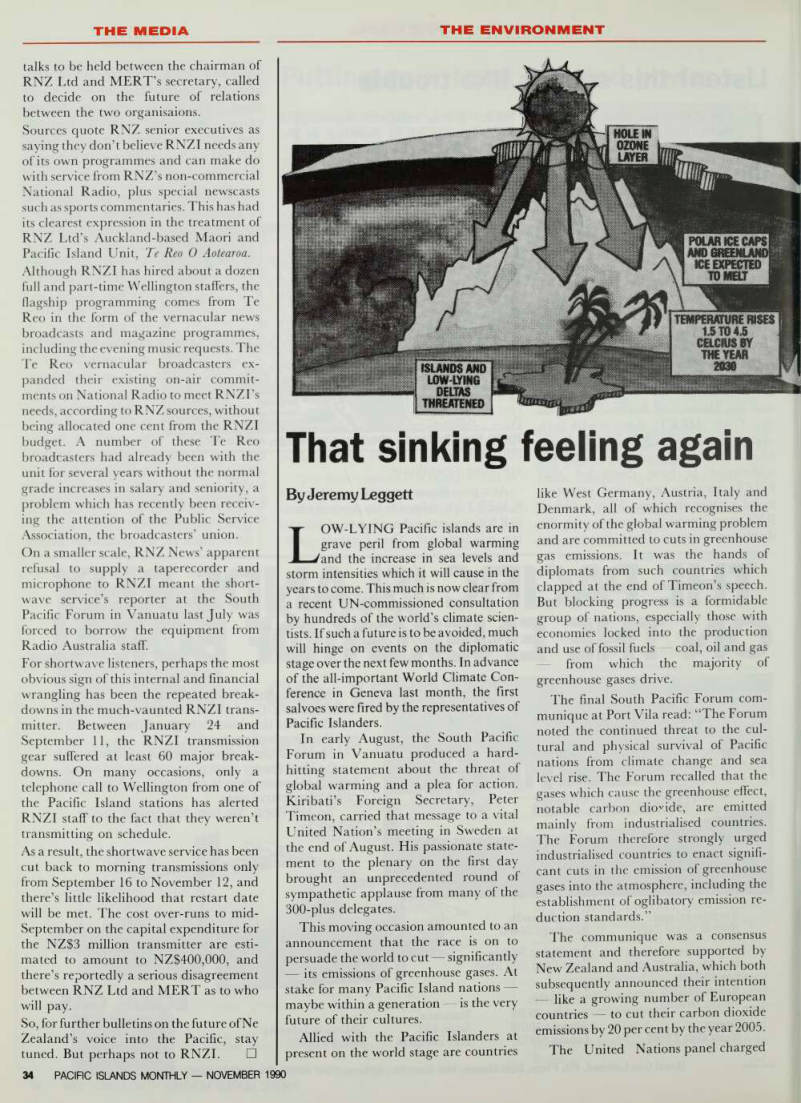
This means the best guesses for future temperate rise produced by computer models (1 °C above present levels by 2030, and 3°C above by 2090) are likely underestimates, and possibly major underestimates, of next century’s reality.
Where sea level rise is concerned, the consequences ofletting this happen would be catastrophic.
Without even discussing the merits or
demerits of a package of
policies to ensure against
the global-warming scenarios of the IPCC scientists, the policymakers dwelt on the need for increased research. This despite
the scientists’ conclusion that additional research, essential though it is, stands little chance of clarifying scientific uncertainties appreciably over the next decade or so.
The US Environmental Protection Agency and the IPCC scientists both argue that stabilising the atmosphere’s greenhouse gas content would require cuts of global carbon dioxide emissions of
60 to 80 per cent.
Given the likeli hood of amplify
ing feedbacks
dominating in a greenhouse world, failure to attempt such a goal is to gamble willfully with the environmental security of future generations, and to sacrifice the very survival of Pacific and other island cultures to corporate profits in the industrial ised world.
Yet the
policymakers’
only recommen dation was nego tiation of a cli mate convention which ‘hays down general principles and
obligations for
addressing climate change”. Nowhere
did the policymakers recommend or even discuss the “significant” cuts in greenhouse gas emissions which are clearly needed and for which the South Pacific Forum pleaded. They did not even advocate a freeze on emissions.
The extent to which industrial interests are willing to imperil the future of island cultures is shown by the case of HFCs.
These industrial gases are alternatives to CFCs, banned from the year 2000 be
... the threat will not be understood by enough people in time to achieve the collective will for change ... the Pacific Island nations would be the first victims
cause they deplete ozone. HFCs do not deplete ozone. HFCs do not deplete ozone but are potent greenhouse gases, thou sands of times worse molecule-for molecule than carbon dioxide. Still, the corporate chemical giants like ICI and DuPont are pressing ahead with pro duction plans. The I PPG scientists say that HFCs and related HCFCs could make up 10 per cent of the greenhouse
effect in the critical years to come.
Expanding the use of fossil fuels and HFCs into the next century could prove to be not just a death sentence to the Pacific Island cultures but, in the longer term, a great global suicide pact. Human beings are not predisposed to collective suicide. The danger though, given the time-scales on which we plan the routine operations of our lives, is that threat will not be understood by enough people in time to achieve the collective will for
change.
The uniquely frus
trating thing about
global warming to those many people who now see the dangers, is that the solutions are obvi
ous. But there is no denying that enacting them will require shifts in human behav iour, particularly in co-operation be tween nations, that have no precedent in human history. That is the challenge for the 19905. There is no single issue in contemporary human affairs which is of greater importance.
The Pacific Island nations would be the first victims, but far from the only victims
of a world in which there are no signifi cant cuts of greenhouse gas emissions in the next decade. If the world’s climate scientists are correct in their un
precedented consen
sus, and the chances that they are wrong
are vanishingly
small, then future generations of Pacific Islanders will look back on the 1990 s as the make or break time for the survival of their cultures.
They will need their leaders of today to be heroes in the diplo matic and publicity battles to come. □
Dr Jeremy Leggett is Di rector of Science for Greenpeace UK and editor of Global Warming: The Greenpeace Report. He was an official observer on the IPCC scientific panel.