Listen! this sounds like trouble
pp. 33-34 · Read in the full issue
The Media
LESS than a year after its rebirth, Radio New Zealand’s shortwave service to the Pacific is on the rocks.
The shortwave service, formally known as Radio New Zealand International, went to air on January 24 this year with a new IOOkW transmitter and high hopes of providing Island vernacular-based compe tition for Rim broadcasters like Radio Australia.
The shortwave service was one of the few recent New Zealand initiative praised in the South Pacific Task Force report, Towards a Pacific Island Community. The report called for the shortwave service to be “enhanced” with more extensive new broadcasts. However, RNZTs future is now in doubt after a serious falling out between Radio New Zealand Limited and the Ministry of External Relations and Trade (MERT). Sources with both organisations say MERT is highly dissat isfied with RNZ’s performance. MERT is understood to have demanded that RNZ’s chairman and chief executive make a clear statement as to whether RNZ even intends continuing with the shortwave service. These sources say
MERT is now extremely distrustful of RNZ because of its handling of the Ministry’s NZ$l.l million annual contri bution to RNZTs NZ$2 million yearly operating budget. MERT was reportedly outraged to discover RNZ has been double-charging for some services and has
also been taking a protit from KN/.I s operating expenditure.
At a joint finance meeting on October 8, MERT felt obliged to lay down the law to RNZ executives about financial report ing requirements. These include such
basis as keeping a separate RNZI bank account, crediting this account rather than RNZ Ltd with any interest earned, presenting standard accounts with, at the very least, a separate listing of RNZTs debtors and creditors, if not a completely separate balance sheet.
RNZI manager lan Johnstone has been instructed to break down last year’s
actual expenditure in the same detail as the
1990/91 budget
“with a view to re ducing budget ex penditure to within the MERT grant.” A meeting has been set down with MERT as soon as possible to
pinpoint budget cuts
and the consequences for RNZI’s services.
According to reports
irom the October 8 meeting, MERT officials made it clear the Ministry views RNZI as a joint venture and has asked RNZ Ltd for a formal statement putting a value on its own contribution.
All of this is on the agenda for special
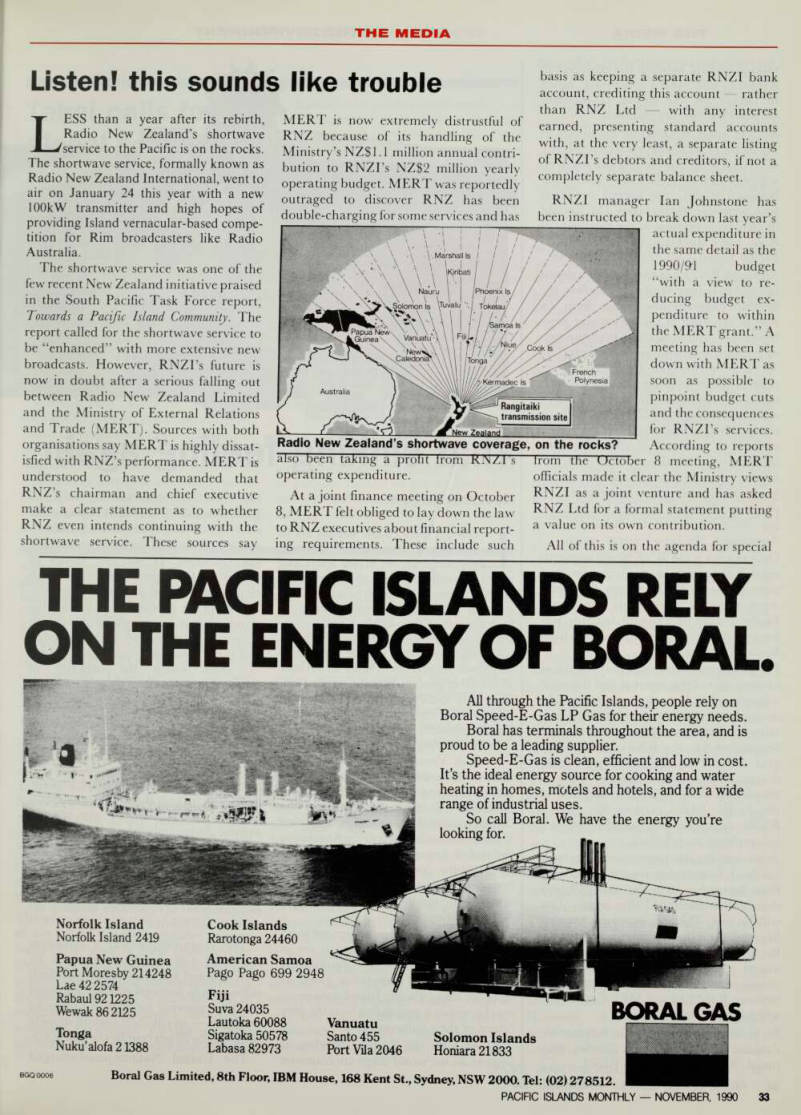
Radio New Zealand’s shortwave coverage, on the rocks?
talks to be held between the chairman of RNZ Ltd and MERT’s secretary, called to decide on the future of relations between the two organisaions.
Sources quote RNZ senior executives as saying they don’t believe RNZI needs any of its own programmes and can make do with service from RNZ’s non-commercial National Radio, plus special newscasts such as sports commentaries. This has had its clearest expression in the treatment of RNZ Ltd’s Auckland-based Maori and Pacific Island Unit, Te Reo 0 Aotearoa.
Although RNZI has hired about a dozen full and part-time Wellington staffers, the flagship programming comes from Te Reo in the form of the vernacular news broadcasts and magazine programmes, including the evening music requests. The Te Reo vernacular broadcasters ex panded their existing on-air commit ments on National Radio to meet RNZI’s needs, according to RNZ sources, without being allocated one cent from the RNZI budget. A number of these Te Reo broadcasters had already been with the unit for several years without the normal grade increases in salary and seniority, a problem which has recently been receiv ing the attention of the Public Service Association, the broadcasters’ union.
On a smaller scale, RNZ News’ apparent refusal to supply a taperecorder and microphone to RNZI meant the short wave service’s reporter at the South Pacific Forum in Vanuatu last July was forced to borrow the equipment from Radio Australia staff.
For shortwave listeners, perhaps the most obvious sign of this internal and financial wrangling has been the repeated break downs in the much-vaunted RNZI trans mitter. Between January 24 and September 11, the RNZI transmission gear suffered at least 60 major break downs. On many occasions, only a telephone call to Wellington from one of the Pacific Island stations has alerted RNZI staff to the fact that they weren’t transmitting on schedule.
As a result, the shortwave service has been cut back to morning transmissions only from September 16 to November 12, and there’s little likelihood that restart date will be met. The cost over-runs to mid- September on the capital expenditure for the NZ$3 million transmitter are esti mated to amount to NZ$4OO,OOO, and there’s reportedly a serious disagreement between RNZ Ltd and MERT as to who will pay.
So, for further bulletins on the future of Ne Zealand’s voice into the Pacific, stay tuned. But perhaps not to RNZI. □