independence
pp. 17-18 · Read in the full issue
Temaru calls for Maohi independence
By Ulafala Aiavao
SOUTH Pacific nations are being drawn into another faceoff with France over the question of de-
colonisation this time
involving French
Polynesia.
The issue has been around for some time, but always
low on political agenda.
The focus in recent years has been on New
Caledonia which has more active inde pendence movements, enjoys the sym pathy and support of the Pacific Forum nations and possesses higher profile. And, while it can be said that many Kanaks are pursuing self-determination, the region’s perception of French Polynesia is that the majority of the population there enjoy a high standard of living they will not sacrifice for the sake of a new political status.
That mind-set was recently challenged at
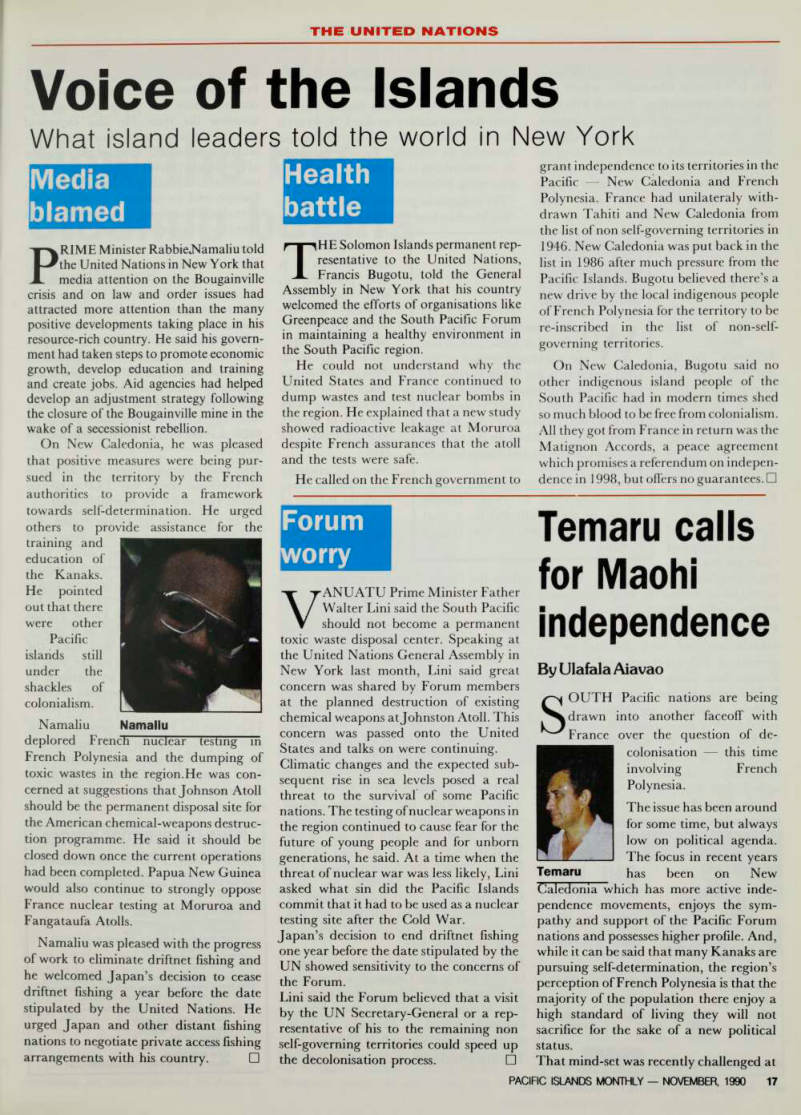
Temaru
at the United Nations in New York before the UN Fourth Committee, which con siders de-colonisation. French Polynesia is not on the Fourth Committee’s agenda, but New Caledonia is. That allowed Tahiti nationalist, Oscar Temaru, of the pro-independence Front de Liberation de Polynesie, to present a petition on the New Caledonian issue and draw similarities with Tahiti.
Temaru did not mention Tahiti or % French Polynesia by name, prefer ring to use “Maohi” for the people and “Maohi Polynesia” for the territory. He did identify some of the islands by name and soundly con demned nuclear testing at Moruroa Atoll. The French delegation at the Fourth Committee
interrupted
Temaru several times on points of order for not stick
ing to the New Caledonia issue. (Temaru would pause during the interruption and then continue without a retraction).
French Polynesia as a candidate for de colonisation had been referred to in directly at UN meetings until recently.
Papua New Guinea’s Prime Minister, Rabbie Namaliu, in his address to the UN General Assembly on September 24, noted positive measures being pursued by the French in New Caledonia towards a framework for self determination and,
ultimately, independence. Namaliu
added that there were “other Pacific islands under the shackles of colonialism”
PNG officials later confirmed that he referred to French Polynesia On October 8, Solomon Islands Perma nent Representative to the UN, Francis Bugotu, called on the 159-nation General Assembly to “favour” French Polynesia by re-inscribing it on the list of non-self
governing territories.
“The indigenous peoples ofTahiti, the Te Aho Maohi whose land has been occupied
by France since 1842, testing nu clear bombs in it and polluting its seas, have been waiting in the wings patiently to be re-inscribed into the United Nations
Special Committee
(on de colonisation) with the aim of getting
independence,” he
said.
New Caledonia and Tahiti were both on the list of non-self governing territories and
withdrawn by
France. Pressure
from the Pacific Islands resulted in New Caledonia being put back in the list in 1986.
The French Polynesia issue attracted mixed reactions from the Pacific members of the United Nations. One prevailing view was that while the French Polynesia issue would be raised eventually, Pacific delegates believed it was best to keep international attention on New Caledonia. Events in New Caledonia can be confusing for diplomats from outside the region and their support may be crucial when sought by the Forum.
Temaru said the Kanaks found similarities in the fight of all nations against oppression, and the fate of the Kanaks corresponded to that of the Maohi (French Polynesian) people. The 1988 Matignon Accords in New Caledonia meant that Kanaks might be eight years away from independence. But he warned the Accords might just be a truce or a cruel lure.
Kanaks had been stripped of their nickel, he said, just as the Compagnie Francaise des Phosphates de I’Oceanie had stripped the Maohi people on the French Polynesia island of Makatea of their phosphate over a period of 60 years.
Temaru attacked French nuclear tests at
Moruroa which he said were imposed by France without consultation. France did not recognise his country’s right to question the tests. He also expressed concern at the upcoming European econ omic union in 1992. He said the creation of that single market will result in the free circulation of goods, people and capital in Europe and its colonies. This will turn French Polynesia and New Caledonia into new European colonies.
Temaru managed to state his piece on French Polynesia through several inter ruptions by the French delegation on points of order. What will be harder is to drum up is international support to get a resolution passed in the General As sembly which will place the territory on the Fourth Committee. The first question potential supporters will ask is, how many Tahitians want independence. A refer endum might find out, but, such a move was suggested by indigenous groups in 1986, and the French government has not responded.
Who does Temaru’s Front de Liberation de Polynesie speak for? FLP presently claims two of the 41 Assembly seats.
To be considered for re-inscription, the UN member states need to be convinced that the FLP, or any other pro independence group, represents a signifi cant proportion of the indigenous popu lation. The most obvious support the FLP could pursue is the South Pacific Forum which was not approached as a group.
Pacific delegations say that since the Solomon Islands brought up the issue at the UN, it will be left to Honiara to introduce it at a subsequent Forum meeting, perhaps as early as next year.
That gives the FLP some time to coordi nate their campaign at the regional level.
Melanesian diplomats are confident that if or when New Caledonia becomes independent, French Polynesia will be the next item. □