Voice of the Islands
p. 17 · Read in the full issue
What island leaders told the world in New York
Media blamed
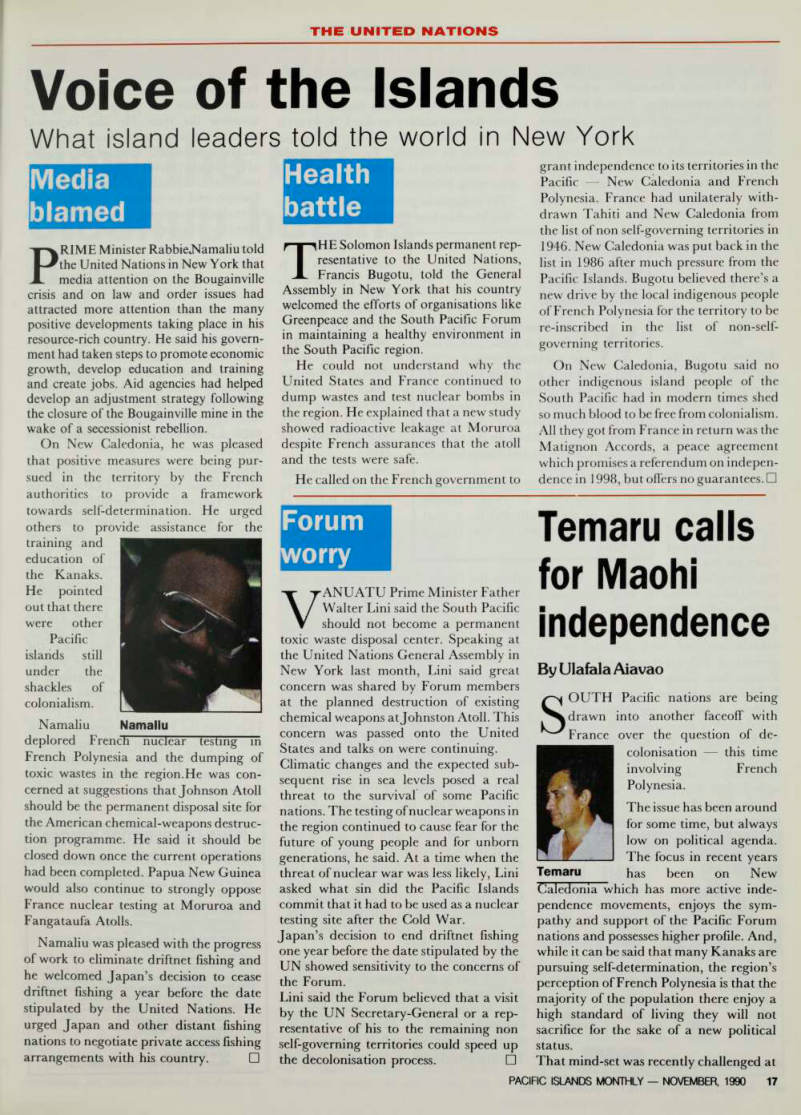
PRIME Minister RabbieJ'Jamaliu told the United Nations in New York that media attention on the Bougainville crisis and on law and order issues had attracted more attention than the many positive developments taking place in his resource-rich country. He said his govern ment had taken steps to promote economic growth, develop education and training and create jobs. Aid agencies had helped develop an adjustment strategy following the closure of the Bougainville mine in the wake of a secessionist rebellion.
On New Caledonia, he was pleased that positive measures were being pur sued in the territory by the French authorities to provide a framework towards self-determination. He urged others to provide assistance for the
training and education of the Kanaks.
He pointed out that there were other Pacific islands still under the shackles of colonialism.
Namaliu
deplored French nuclear testing m French Polynesia and the dumping of toxic wastes in the region.He was con cerned at suggestions that Johnson Atoll should be the permanent disposal site for the American chemical-weapons destruc tion programme. He said it should be closed down once the current operations had been completed. Papua New Guinea would also continue to strongly oppose France nuclear testing at Moruroa and
Fangataufa Atolls.
Namaliu was pleased with the progress of work to eliminate driftnet fishing and he welcomed Japan’s decision to cease driftnet fishing a year before the date stipulated by the United Nations. He urged Japan and other distant fishing nations to negotiate private access fishing arrangements with his country. □
Health battle
THE Solomon Islands permanent rep resentative to the United Nations, Francis Bugotu, told the General Assembly in New York that his country welcomed the efforts of organisations like Greenpeace and the South Pacific Forum in maintaining a healthy environment in the South Pacific region.
He could not understand why the United States and France continued to dump wastes and test nuclear bombs in the region. He explained that a new study showed radioactive leakage at Moruroa despite French assurances that the atoll and the tests were safe.
He called on the French government to
grant independence to its territories in the Pacific New Caledonia and French Polynesia. France had unilateraly with drawn Tahiti and New Caledonia from the list of non self-governing territories in 1946. New Caledonia was put back in the list in 1986 after much pressure from the Pacific Islands. Bugotu believed there’s a new drive by the local indigenous people of French Polynesia for the territory to be re-inscribed in the list of non-self governing territories.
On New Caledonia, Bugotu said no other indigenous island people of the South Pacific had in modern times shed so much blood to be free from colonialism.
All they got from France in return was the Matignon Accords, a peace agreement which promises a referendum on indepen dence in 1998, but offers no guarantees. □
Forum worry
VANUATU Prime Minister Father Walter Lini said the South Pacific should not become a permanent toxic waste disposal center. Speaking at the United Nations General Assembly in New York last month, Lini said great concern was shared by Forum members at the planned destruction of existing chemical weapons at Johnston Atoll. This concern was passed onto the United States and talks on were continuing.
Climatic changes and the expected sub sequent rise in sea levels posed a real threat to the survival of some Pacific nations. The testing of nuclear weapons in the region continued to cause fear for the future of young people and for unborn generations, he said. At a time when the threat of nuclear war was less likely, Lini asked what sin did the Pacific Islands commit that it had to be used as a nuclear testing site after the Cold War.
Japan’s decision to end driftnet fishing one year before the date stipulated by the UN showed sensitivity to the concerns of the Forum.
Lini said the Forum believed that a visit by the UN Secretary-General or a rep resentative of his to the remaining non self-governing territories could speed up the decolonisation process. □
Namaliu