Interview
pp. 51-53 · Read in the full issue
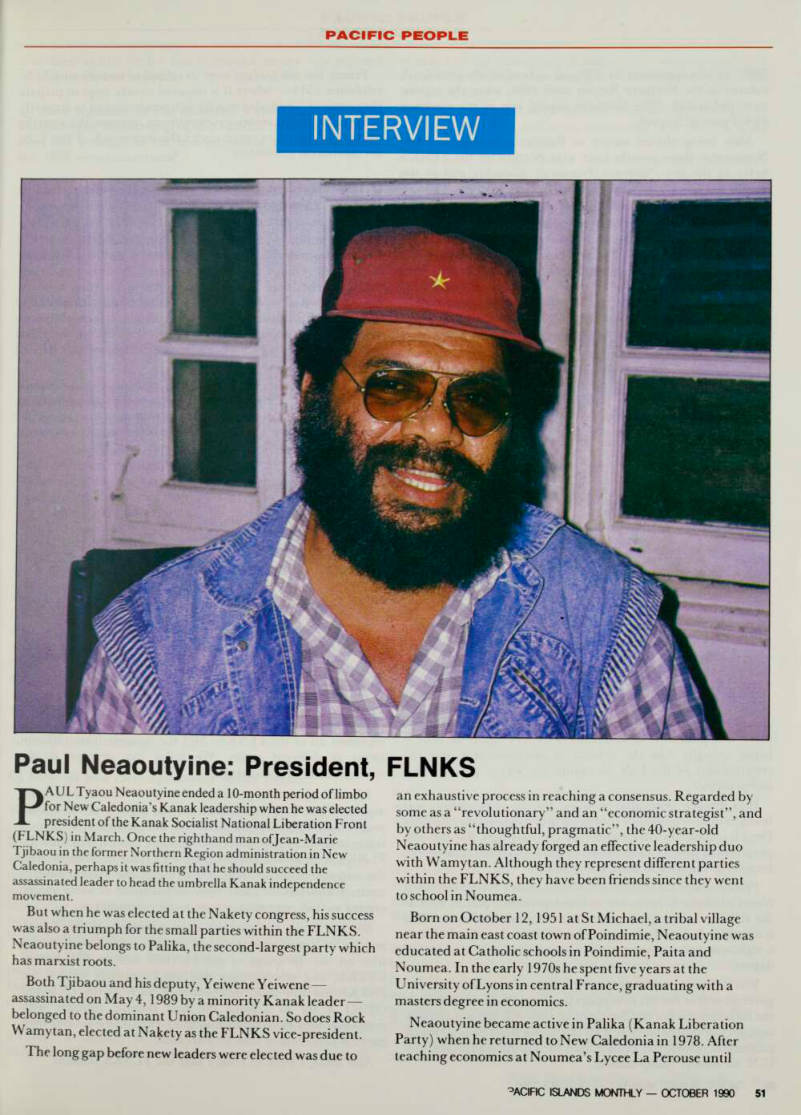
Paul Neaoutyine: President, FLNKS
PAUL Tyaou Neaoutyine ended a 10-month period of limbo for New Caledonia’s Kanak leadership when he was elected president of the Kanak Socialist National Liberation Front (FLNKS) in March. Once the righthand man ofJean-Marie Tjibaou in the former Northern Region administration in New Caledonia, perhaps it was fitting that he should succeed the assassinated leader to head the umbrella Kanak independence movement.
But when he was elected at the Nakety congress, his success was also a triumph for the small parties within the FLNKS.
Neaoutyine belongs to Palika, the second-largest party which has marxist roots.
Both Tjibaou and his deputy, Yeiwene Yeiwene — assassinated on May 4,1989 by a minority Kanak leader — belonged to the dominant Union Caledonian. So does Rock Wamytan, elected at Nakety as the FLNKS vice-president.
The long gap before new leaders were elected was due to
an exhaustive process in reaching a consensus. Regarded by some as a “revolutionary” and an “economic strategist”, and by others as “thoughtful, pragmatic”, the 40-year-old Neaoutyine has already forged an effective leadership duo with Wamytan. Although they represent different parties within the FLNKS, they have been friends since they went to school in Noumea.
Born on October 12,1951 at St Michael, a tribal village near the main east coast town of Poindimie, Neaoutyine was educated at Catholic schools in Poindimie, Paita and Noumea. In the early 1970 s he spent five years at the University of Lyons in central France, graduating with a masters degree in economics.
Neaoutyine became active in Palika (Kanak Liberation Party) when he returned to New Caledonia in 1978. After teaching economics at Noumea’s Lycee La Perouse until
1985, he was appointed by Tjibaou as head of the president’s cabinet in the Northern Region until 1988, when the regions were disbanded, (The Northern capital was in the rundown nickel port of Nepoui).
After being elected mayor of Poindimie in March 1989, Neaoutyine three months later won election on the FLNKS ticket to the new Northern Province’s Assembly and to the Territorial Congress. By the end of 1989 he was being widely touted as the likely consensus leader of the FLNKS.
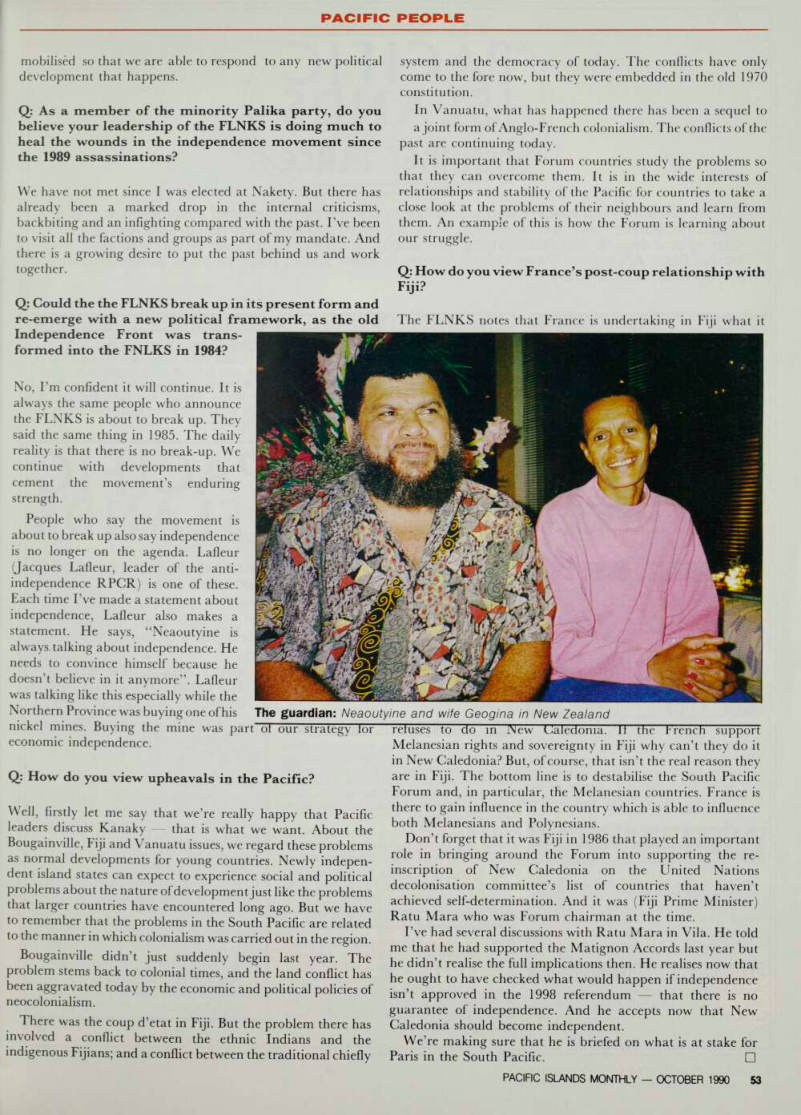
Neaoutyine has travelled widely. He visited New York twice in 1987 for United Nations debates on New Caledonia. He attended the 1986 South Pacific Forum in Suva and the 1980 Forum in Port Vila. He has recently been on a three-country tour which has taken him to France, New Zealand and Papua New Guinea. He was joined by his wife, Georgina, also a Kanak militant, and Wamytan in New Zealand where he spoke to Pacific Islands Monthly's David Robie.
Q: Although the FLNKS lost its case for observer status at the South Pacific Forum, it made gains with a resolution bringing the issue of independence back into the context of the United Nations decolonisation com mittee. How do you view the progress?
We are happy with how things are going. In Vila we were able to meet informally with Pacific leaders and to brief them over reality with the Matignon Accords. The de cision to create a Forum com mittee Fiji, Nauru and the Solomon Islands which will visit New Caledonia to di rectly monitor developments will be a big help to us. That is if France accents such visits.
Once that principle is established, then it is isn’t such a big step to have a U.N. mission.
Previously, at Tarawa, the Forum nations were prepared to accept the Matignon Accords at face value. Now they realise there is no guarantee of independence. Once again the issue is being brought into the context of decolonisation and the responsibility of the U.N. to ensure the way is prepared for
independence.
Had France been sincere when the loi cadre statute was brought in we would have continued into independence as other French colonies in Africa and Asia did long ago. But the self government process was reversed by Paris and the Kanak people became a minority in their homeland.
France under the socialists now maintains a role of referee in New Caledonia between the anti-independence parties such as the RPCR and the pro-independence Kanaks. Its bottom line is to remain in New Caledonia. The difference in policy between a right-wing government in France and the left is a matter of degree.
You’d expect governments of the right to oppose us and the governments of the left to support us. But they don’t. Although the socialists are not confrontational, they will still not actively support our independence. This is why we must have as much pressure as possible on France from the Forum leaders and the U.N. to achieve independence.
France has not budged over its refusal to comply with U.N. resolution 1514 where it is required to take steps to prepare the people of New Caledonia for independence and to regularly report to the decolonisation committee on progress. We want the Matigon Accords to come under the framework of the U.N. decolonisation committee.
Q: How confident are you of winning the referendum in
1998 and gaining independence?
I’m not entirely confident. But I am very confident about the task that we in the FLNKS have set ourselves, such as convincing other ethnic groups, like Wallis islanders, Tahitians, and even the Caldoche, that New Caledonia has a vocation towards independence. We are trying to work with young Wallis islanders and Tahitians in the Oceanic Union. It is our duty and our role to organise their population. We will not let them continue to be held as hostages by the French and the RPCR
against us!
The FLNKS aspirations are deeply embedded in the Kanak culture and the Kanak people. These are our springboards in seeking national independence. In opposition to this the people with economic power have sought to mobilise groups against us
The struggle takes different forms at different stages. We tailor our strategy to the circumstances’
through fear.
Within the context of inde pendent economic develop ment and redistribution, there is no reason to be afraid of us.
We are succeeding in convinc ing them that independence is viable. That success is being demonstrated through the ef forts of Jacques Lafleur and the RPCR in trying to break up the Oceanic Union.
Q: How do you see yourself and your role?
I know some see me as a revolutionary. I’m not renouncing my convictions, nor my militant past. But today I am obliged to represent all of the FLNKS. And the struggle takes different forms at different stages. We tailor our strategy to the circumstances of the struggle.
My difficult task as president of the FLNKS has three main aspects. First, I am spokesman for the dignity of the Kanak people and their determination for independence. I have to relate to all other groups abroad and here, and explain what the FLNKS is all about. I represent the FLNKS in dialogue with the anti-independence RPCR party and the French govern ment. I also talk to other New Caledonians of other ethnic origins so that our message goes to all communities.
Second, I am the guarantor, or guardian, of the Kanak people. So I must maintain close relations with Kanak groups who are on the fringe of the FLNKS, such as FULK and USTKE, and other groups that are completely outside the FNLKS but still want independence, such as the LKS and OPAO. I try to achieve the best possible contacts with everybody and to establish dialogue. Then there are our own internal problems to take into account, And third, I have to ensure that the FLNKS remains
mobilised so that we are able to respond to any new political
development that happens.
Q: As a member of the minority Palika party, do you believe your leadership of the FLNKS is doing much to heal the wounds in the independence movement since the 1989 assassinations?
We have not met since I was elected at Nakety. But there has already been a marked drop in the internal criticisms, backbiting and an infighting compared with the past. I’ve been to visit all the factions and groups as part of my mandate. And there is a growing desire to put the past behind us and work
together.
Q: Could the the FLNKS break up in its present form and re-emerge with a new political framework, as the old
Independence Front was trans formed into the FNLKS in 1984?
No, I’m confident it will continue. It is always the same people who announce the FLNKS is about to break up. They said the same thing in 1985. The daily reality is that there is no break-up. We continue with developments that cement the movement’s enduring strength.
People who say the movement is about to break up also say independence is no longer on the agenda. Lafleur (Jacques Lafleur, leader of the anti independence RPCR) is one of these.
Each time I’ve made a statement about independence, Lafleur also makes a statement. He says, “Neaoutyine is
always, talking about independence. He
needs to convince himself because he doesn’t believe in it anymore”. Lafleur was talking like this especially while the Northern Province was buying one of his
nickel mines. Buying the mine was part ol our strategy lor
economic independence.
Q: How do you view upheavals in the Pacific?
Well, firstly let me say that we’re really happy that Pacific leaders discuss Kanaky that is what we want. About the Bougainville, Fiji and Vanuatu issues, we regard these problems as normal developments for young countries. Newly indepen dent island states can expect to experience social and political problems about the nature ofdevelopment just like the problems that larger countries have encountered long ago. But we have to remember that the problems in the South Pacific are related to the manner in which colonialism was carried out in the region.
Bougainville didn’t just suddenly begin last year. The problem stems back to colonial times, and the land conflict has been aggravated today by the economic and political policies of neocolonialism.
There was the coup d’etat in Fiji. But the problem there has involved a conflict between the ethnic Indians and the indigenous Fijians; and a conflict between the traditional chiefly
system and the democracy of today. The conflicts have only come to the fore now, but they were embedded in the old 1970 constitution.
In Vanuatu, what has happened there has been a sequel to a joint form of Anglo-French colonialism. The conflicts of the past are continuing today.
It is important that Forum countries study the problems so that they can overcome them. It is in the wide interests of relationships and stability of the Pacific for countries to take a close look at the problems of their neighbours and learn from them. An example of this is how the Forum is learning about our struggle.
Q: How do you view France’s post-coup relationship with Fiji?
The FLNKS notes that France is undertaking in Fiji what it
reluses to do m i\ew Caledonia. T 1 the trench support Melanesian rights and sovereignty in Fiji why can’t they do it in New Caledonia? But, of course, that isn’t the real reason they are in Fiji. The bottom line is to destabilise the South Pacific Forum and, in particular, the Melanesian countries. France is there to gain influence in the country which is able to influence both Melanesians and Polynesians.
Don’t forget that it was Fiji in 1986 that played an important role in bringing around the Forum into supporting the re inscription of New Caledonia on the United Nations decolonisation committee’s list of countries that haven’t achieved self-determination. And it was (Fiji Prime Minister) Ratu Mara who was Forum chairman at the time.
I’ve had several discussions with Ratu Mara in Vila. He told me that he had supported the Matignon Accords last year but he didn’t realise the full implications then. He realises now that he ought to have checked what would happen if independence isn’t approved in the 1998 referendum that there is no guarantee of independence. And he accepts now that New Caledonia should become independent.
We’re making sure that he is briefed on what is at stake for Paris in the South Pacific. □
The guardian: Neaoutyine and wife Geogina in New Zealand