Striving to be free
pp. 49-50 · Read in the full issue
sdfdsfdsfsdsfdsfds
Solomon leads Vanuatu’s women into an era of new discoveries and a struggle for greater participation in a country dominated by men
By Nicholas Rothwell
THE sweet smell of baking cakes wafts through the tidy offices of Vanuatu’s National Council of Women. Kathy Solomon, the untiring executive director of the organisation, is busy preparing for a fund-raising party. Earlier this year, the NCW held a memorable National Women’s Festival in Port Vila to mark its 10th birthday, bringing together thousands of ni- Vanuatu women from all the country’s islands.
This festival part celebration, part review has given new impetus to the NCW, a quietly determined institution that has been endeavouring ever since Vanuatu’s independence to improve the lot of the country’s female population.
Something of the NCW’s spirit, em battled, but calm, can be gauged from a brief dedication contained in its sub mission to the Vanuatu Government in 1985 for a family law bill: “ to Vanuatu Woman, workers, suppressed, oppressed,
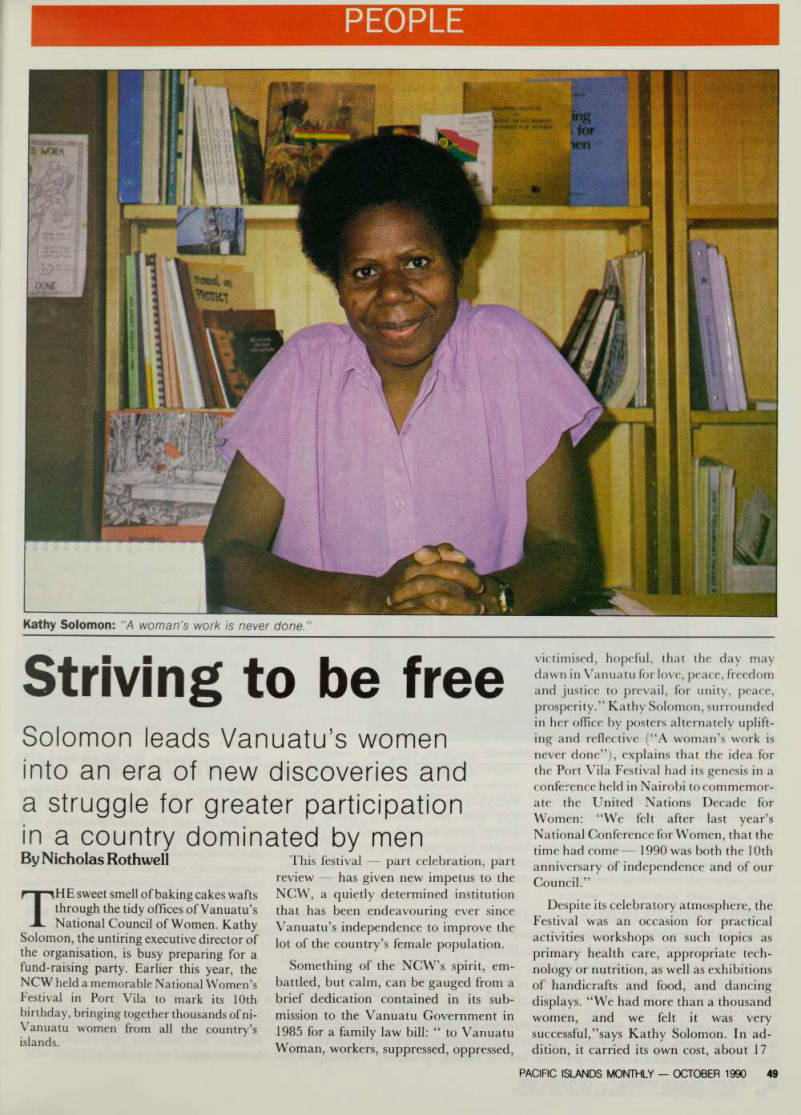
victimised, hopeful, that the day may dawn in Vanuatu for love, peace, freedom and justice to prevail, for unity, peace, prosperity.” Kathy Solomon, surrounded in her office by posters alternately uplift ing and reflective (“A woman’s work is never done”), explains that the idea for the Port Vila Festival had its genesis in a conference held in Nairobi to commemor ate the United Nations Decade for Women: “We felt after last year’s National Conference for Women, that the time had come 1990 was both the 10th anniversary of independence and of our Council.”
Despite its celebratory atmosphere, the Festival was an occasion for practical activities workshops on such topics as primary health care, appropriate tech nology or nutrition, as well as exhibitions of handicrafts and food, and dancing displays. “We had more than a thousand women, and we felt it was very successful,’’says Kathy Solomon, In ad dition, it carried its own cost, about 17
Kathy Solomon: “A woman’s work is never done.”
Pacific People
million vatu. But whatever the Festi val’s success, the situation of women in Vanuatu remains less than ideal. Foreign observers are often struck by the influence and self-confidence of the ni-Vanuatu
women in positions of political and ad ministrative power, while few see the life of ordi nary women in vil
lages and remoter islands.
In the customary organisation of Vanuatu society, women often occupy a somewhat subordinate role. Statistics portray a rather depressing picture of wife-beatings and desertion of families. In
‘We are not here to fight men ... we are here to assist... we have talent’
the country’s evolution after inde pendence, strong em
phasis has
been placed
on improv
ing the lot of women, but Kathy Solomon still sees
plenty of
room for improve ment: “I
personally
would like the place of women in society to be
changed
more. We would be
happier if equal opportunities would be given to us, with recognition and respect.
We are just gradually moving towards it, maybe we have taken only one half-step upwards. Our Festival this year opened the eyes of blindness, not only for men but women also. A lot of women don’t really know what we are doing, and some of them not only uneducated women thought our work was rubbish.”
Like many ni-Vanuatu women, Kathy Solomon is reluctant to condemn custom, which has played such a crucial part in maintaining traditional identity, and has formed much of the basis for the construc tion of the country’s independent charac ter. Custom varies widely from island to island, even from region to region, but some of its principles scarcely ennoble
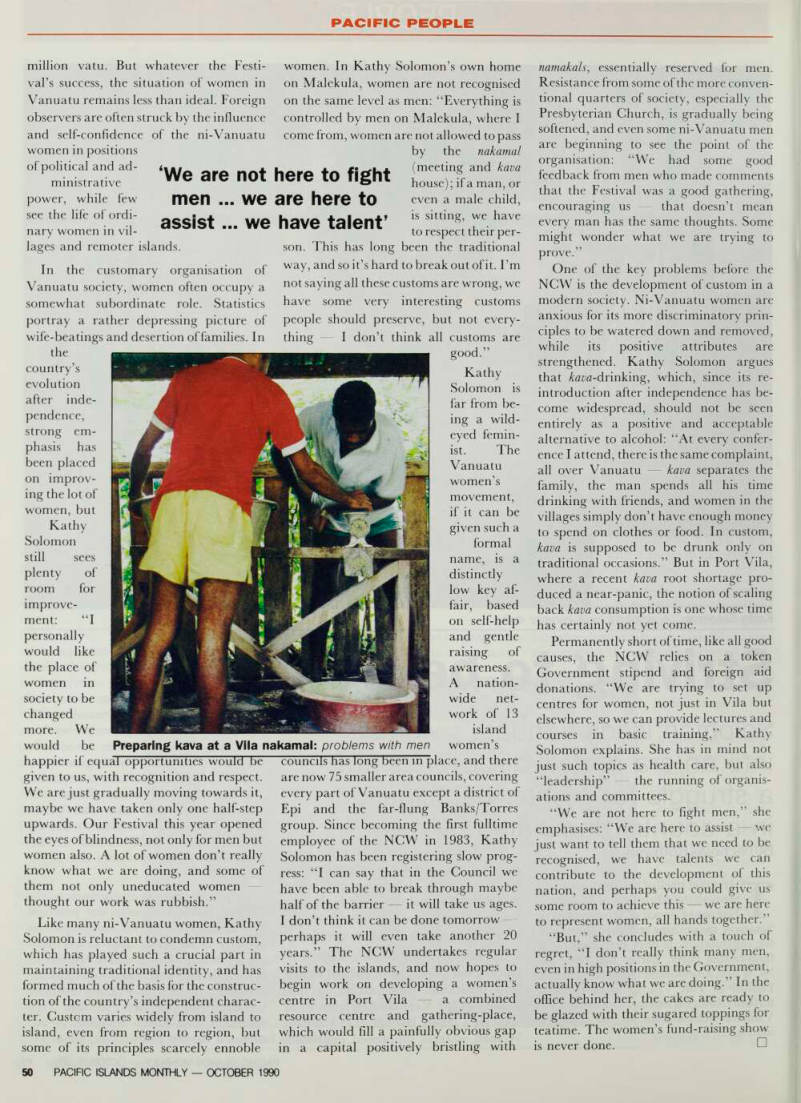
women. In Kathy Solomon’s own home on Malekula, women are not recognised on the same level as men: “Everything is controlled by men on Malekula, where I come from, women are not allowed to pass
by the nakamal (meeting and kava house); if a man, or even a male child, is sitting, we have to respect their per
son. This has long been the traditional way, and so it’s hard to break out ofit. I’m not saying all these customs are wrong, we have some very interesting customs people should preserve, but not every thing I don’t think all customs are
good,”
Kathy
Solomon is far from be ing a wild eyed femin ist. The Vanuatu women’s movement, if it can be given such a formal name, is a distinctly low key af fair, based on self-help and gentle raising of awareness.
A nation wide net work of 13 island women’s
councils has long been m place, and there are now 75 smaller area councils, covering every part of Vanuatu except a district of Epi and the far-flung Banks/Torres group. Since becoming the first fulltime employee of the NCW in 1983, Kathy Solomon has been registering slow prog ress: “I can say that in the Council we have been able to break through maybe half of the barrier it will take us ages.
I don’t think it can be done tomorrow perhaps it will even take another 20 years.” The NCW undertakes regular visits to the islands, and now hopes to begin work on developing a women’s centre in Port Vila a combined resource centre and gathering-place, which would fill a painfully obvious gap in a capital positively bristling with
namakals, essentially reserved for men.
Resistance from some of the more conven tional quarters of society, especially the
Presbyterian Church, is gradually being
softened, and even some ni-Vanuatu men are beginning to see the point of the organisation: “We had some good feedback from men who made comments that the Festival was a good gathering, encouraging us that doesn’t mean every man has the same thoughts. Some might wonder what we are trying to
prove.”
One of the key problems before the NCW is the development of custom in a modern society. Ni-Vanuatu women are anxious for its more discriminatory prin ciples to be watered down and removed, while its positive attributes are
strengthened. Kathy Solomon argues
that fozpfl-drinking, which, since its re introduction after independence has be come widespread, should not be seen
entirely as a positive and acceptable
alternative to alcohol: “At every confer ence I attend, there is the same complaint, all over Vanuatu kava separates the family, the man spends all his time drinking with friends, and women in the
villages simply don’t have enough money
to spend on clothes or food. In custom, kava is supposed to be drunk only on traditional occasions.” But in Port Vila, where a recent kava root shortage pro duced a near-panic, the notion of scaling back kava consumption is one whose time has certainly not yet come.
Permanently short of time, like all good causes, the NCW relies on a token Government stipend and foreign aid donations. “We are trying to set up centres for women, not just in Vila but elsewhere, so we can provide lectures and courses in basic training,” Kathy Solomon explains. She has in mind not just such topics as health care, but also
“leadership” the running of organis
ations and committees.
“We are not here to fight men,” she emphasises: “We are here to assist we just want to tell them that we need to be recognised, we have talents we can contribute to the development of this nation, and perhaps you could give us some room to achieve this we are here to represent women, all hands together.’
“But,” she concludes with a touch of regret, “I don’t really think many men, even in high positions in the Government, actually know what we are doing.” In the office behind her, the cakes are ready to be glazed with their sugared toppings for teatime. The women’s fund-raising show is never done.
Preparing kava at a Vila nakamal: problems with men