Christmas remembers the old days
p. 47 · Read in the full issue
Stamps
ON April 18, Christmas Island re leased the first part of a new definitive series tracing the various modes of transport used since the island was first settled in 1888.
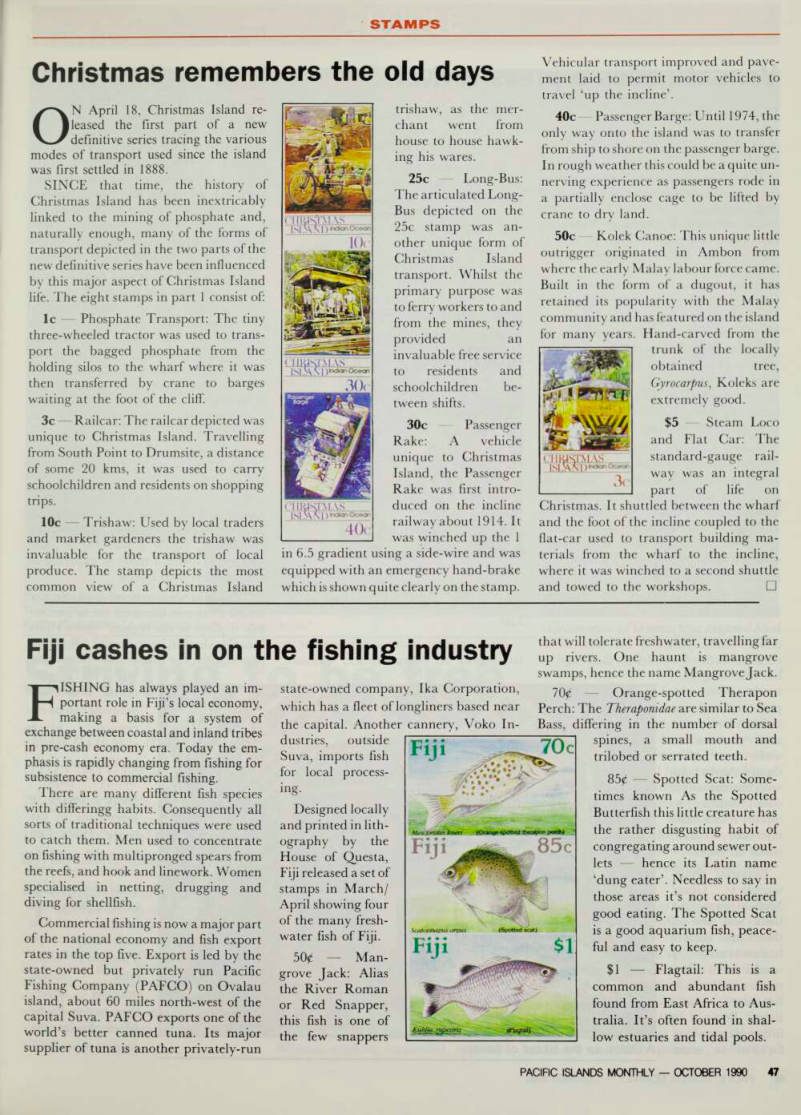
SINCE that time, the history of Christmas Island has been inextricably linked to the mining of phosphate and, naturally enough, many of the forms of transport depicted in the two parts of the new definitive series have been influenced by this major aspect of Christmas Island life. The eight stamps in part 1 consist of: 1c Phosphate Transport: The tiny three-wheeled tractor was used to trans port the bagged phosphate from the holding silos to the wharf where it was then transferred by crane to barges waiting at the foot of the cliff. 3c Railcar: The railcar depicted was unique to Christmas Island. Travelling from South Point to Drumsite, a distance of some 20 kms, it was used to carry schoolchildren and residents on shopping trips. 10c Trishaw: Used by local traders and market gardeners the trishaw was invaluable for the transport of local produce. The stamp depicts the most common view of a Christmas Island
trishaw, as the mer chant went from house to house hawk ing his wares.
25c Long-Bus:
The articulated Long- Bus depicted on the 25c stamp was an other unique form of Christmas Island transport. Whilst the primary purpose was to ferry workers to and from the mines, they
provided an
invaluable free service to residents and schoolchildren be tween shifts.
30c Passenger
Rake: A vehicle unique to Christmas Island, the Passenger Rake was first intro duced on the incline railway about 1914. It was winched up the 1
in 6.5 gradient using a side-wire and was equipped with an emergency hand-brake which is shown quite clearly on the stamp.
Vehicular transport improved and pave ment laid to permit motor vehicles to travel ‘up the incline’. 40c Passenger Barge: Until 1974, the only way onto the island was to transfer from ship to shore on the passenger barge.
In rough weather this could be a quite un nerving experience as passengers rode in a partially enclose cage to be lifted by crane to dry land. 50c Kolek Canoe: This unique little outrigger originated in Ambon from where the early Malay labour force came.
Built in the form of a dugout, it has retained its popularity with the Malay community and has featured on the island for many years. Hand-carved from the
trunk of the locally obtained tree, Gyrocarpus, Koleks are extremely good. $5 Steam Loco and Flat Car: The standard-gauge rail way was an integral part of life on
Christmas. It shuttled between the wharf and the foot of the incline coupled to the flat-car used to transport building ma terials from the wharf to the incline, where it was winched to a second shuttle and towed to the workshops. □