Rocks of Ages
pp. 43-46 · Read in the full issue

Culture
By Nicholas Roth well
NOT for nothing, is Vanuatu’s cur rency, the vatu, named after stone.
From the top to the bottom of the archipelago, the islands of Vanuatu are dotted with precious archaeological sites and stone megaliths, hardly any of them well known, studied or recorded.
“From the point of view of stones and the way stones are used, Vanuatu is the most important place in the Pacific,” explains the ever-enthusiastic Kirk Huffman, former curator of the Vanuatu Cultural Centre: “Stones are spirits, stones are alive, stones have power stones are ancestors”.
Now, all Vanuatu’s priceless archaeological patrimony not only its standing stones and dolmens, but also its intricate networks of sacred sites and its ancient settlements will be mapped and registered, thanks to the largest cultural grant ever provided to a Pacific nation by the European Community (EC).
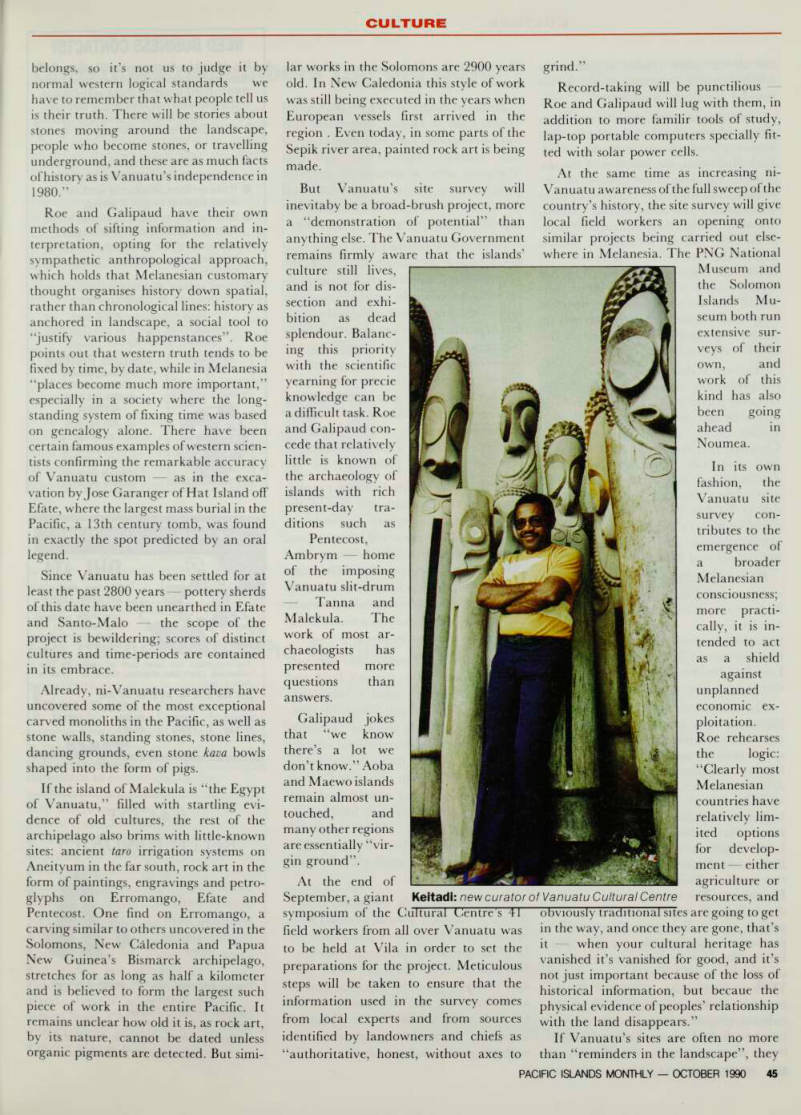
This survey, to be carried out by the Vanuatu Cultural Centre under its new curator, Jack Keitadi, over a two-year period, will not only help fill one of the most gaping holes in our knowledge of Pacific history; it is also painstakingly designed by the Vanuatu Government to record and protect ni-Vanuatu under standing of traditional culture, which is under threat there as is throughout the Pacific region. The project, jointly backed by the EC’s European Development Fund and France’s scientific agency ORSTOM, has funding of 300,000 European currency units (about half a million Australian dollars), and is a model ofits kind. The archaeologists, David Roe
and Jean-Christopher Galipaud, will
train ni-Vanuatu workers to continue their project, and will co-operate closely with the Port Vila-based Cultural Centre’s nationwide network of field workers. Both men have extensive experi ence in similar projects elsewhere in Melanesia Roe in the Solomon Islands, Galipaud in New Caledonia, where he is one of the staff of ORSTOM, which has made him available for this survey.
In a society like Vanuatu’s, critically based on land, such a venture can stir deep sensitivities. The more potent re
ligious sites will be excluded, as will be sites that play crucial parts in local land ownership systems. Excavation, which ni- Vanuatu opposed because it disturbs ancestral spirits, is also ruled out, and only certain sections of the final survey may be published. “We are not coming in as individuals but on behalf of the ni- Vanuatu, providing a service, ensuring their patrimony is respected in develop ment planning,” says Roe. But after completion, the site survey will provide a thorough record, a “mental and physical map,” of one of the Pacific’s richest and least-known treasures. In adddition, the team may also prepare proposals for legislation to protect Vanuatu’s regis tered sites.
Koe explains the scale ot the project: “We plan 200 field days a year, and we need to cover as much ground as possible.
It will be a very long process, for some of the islands have seen only very little work.” Galipaud considers that of all the islands of Melanesia, “the sites of Vanuatu are the least known.”
One constant problem before the sur vey team will be the difference between the conventional interests of Western science and the concerns of the ni- Vanuatu. Prehistorians andarchaeologists from all over the world have been descending on the West Pacific in recent years, as standard models of human settlement have been explored, and it has become increasingly evident that Australia and Melanesia were in habited some 20 to 30,000 years ago.
“Recent trends in archaeology in Melanesia are earth-shattering, and in ternational attention is being focused more and more on Australia and the Pacific as places where the early achieve ments of man were extraordinary,” Roe says. The survey, then, will inevitably reveal Vanuatu as part of a much larger
cultural identity being pieced together in
the rest of the Pacific region. But for ni- Vanutu villagers, the key sites may often be “markers” of recent history, stones and boundaries, or simple place-names re cording crucial events. Further, in an oral society, many of the most resonant places in the landscapes may not be “sites” at all in the western sense of the word.
Roe points out that in islands such as Malekula, there may be visually spec tacular monuments, which are not “archaeologically vital”, lying close to
"such things as the roads ot the dead, which have no physical manifestation but are more vital than all the physical evidence put together.” Hence his insist ence that “we need not only to record the sites but also what local landowners feel about the sites” as well as to encourage them to become interested in sites that may not presently be important to them.
It is a marriage of extraordinary delicacy between scientific method and traditional values. As Roe explains it, “we will have to put aside some of our empirical standards when recording in formation. There will be stories and histories it will be difficult to accept as fact but we have to avoid making value judgments as to the information we are given, for we are recording it not for ourselves but for the people to whom it
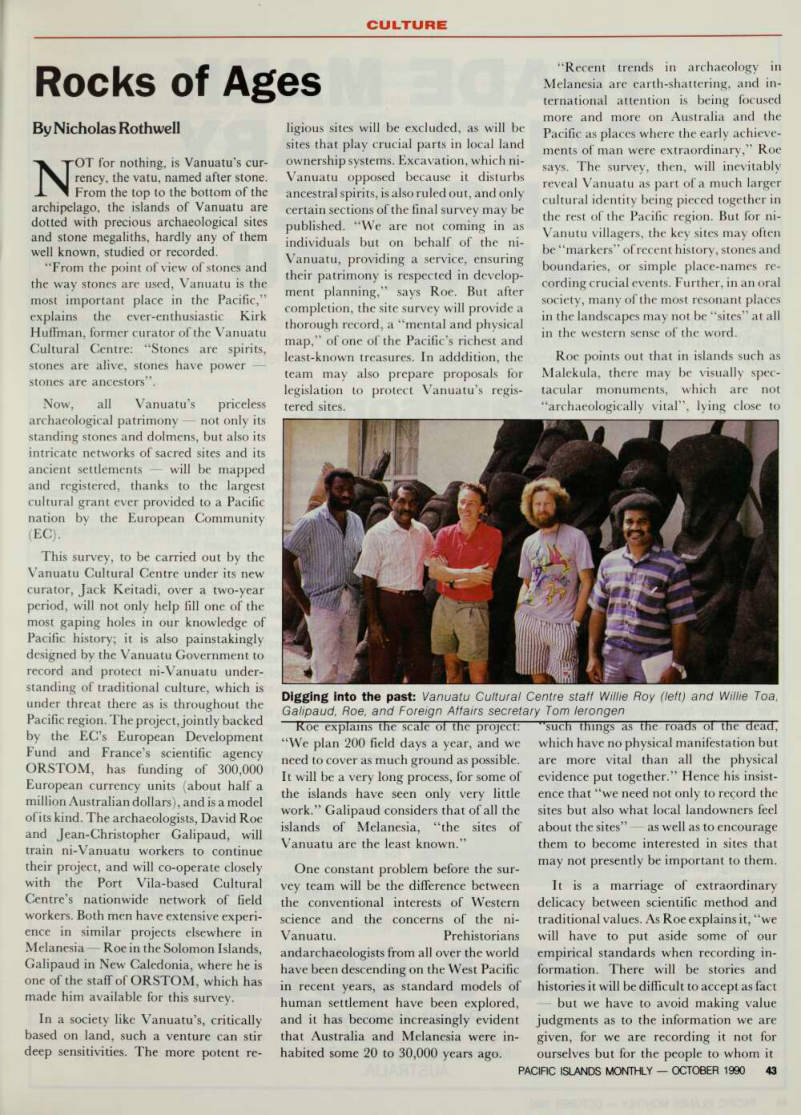
Digging into the past: Vanuatu Cultural Centre staff Willie Roy (left) and Willie Toa, Galipaud, Roe, and Foreign Affairs secretary Tom lerongen
belongs, so it’s not us to judge it by normal western logical standards we have to remember that what people tell us is their truth. There will be stories about stones moving around the landscape, people who become stones, or travelling underground, and these are as much facts ofhistory as is Vanuatu’s independence in 1980.”
Roe and Galipaud have their own methods of sifting information and in terpretation, opting for the relatively sympathetic anthropological approach, which holds that Melanesian customary thought organises history down spatial, rather than chronological lines: history as anchored in landscape, a social tool to “justify various happenstances”. Roe points out that western truth tends to be fixed by time, by date, while in Melanesia “places become much more important,” especially in a society where the long standing system of fixing time was based on genealogy alone. There have been certain famous examples of western scien tists confirming the remarkable accuracy of Vanuatu custom as in the exca vation by Jose Garanger of Hat Island off Efate, where the largest mass burial in the Pacific, a 13th century tomb, was found in exactly the spot predicted by an oral legend.
Since Vanuatu has been settled for at least the past 2800 years pottery sherds of this date have been unearthed in Efate and Santo-Malo the scope of the project is bewildering; scores of distinct cultures and time-periods are contained in its embrace.
Already, ni-Vanuatu researchers have uncovered some of the most exceptional carved monoliths in the Pacific, as well as stone walls, standing stones, stone lines, dancing grounds, even stone kava bowls shaped into the form of pigs.
If the island of Malekula is “the Egypt of Vanuatu,” filled with startling evi dence of old cultures, the rest of the archipelago also brims with little-known sites: ancient taro irrigation systems on Aneityum in the far south, rock art in the form of paintings, engravings and petro glyphs on Erromango, Efate and Pentecost. One find on Erromango, a carving similar to others uncovered in the Solomons, New Caledonia and Papua New Guinea’s Bismarck archipelago, stretches for as long as half a kilometer and is believed to form the largest such piece of work in the entire Pacific. It remains unclear how old it is, as rock art, by its nature, cannot be dated unless organic pigments are detected. But simi
lar works in the Solomons are 2900 years old. In New Caledonia this style of work was still being executed in the years when European vessels first arrived in the region . Even today, in some parts of the Sepik river area, painted rock art is being made.
But Vanuatu’s site survey will inevitaby be a broad-brush project, more a “demonstration of potential” than anything else. The Vanuatu Government remains firmly aware that the islands’
culture still lives, and is not for dis section and exhi bition as dead splendour. Balanc ing this priority with the scientific yearning for precie knowledge can be a difficult task. Roe and Galipaud con cede that relatively little is known of the archaeology of islands with rich
present-day tra
ditions such as Pentecost, Ambrym home of the imposing Vanuatu slit-drum Tanna and Malekula. The work of most ar chaeologists has presented more
questions than
answers.
Galipaud jokes
that “we know there’s a lot we don’t know.” Aoba and Maewo islands remain almost un touched, and many other regions are essentially “vir gin ground”.
At the end of September, a giant
symposium of the Cultural Centre s field workers from all over Vanuatu was to be held at Vila in order to set the preparations for the project. Meticulous steps will be taken to ensure that the information used in the survey comes from local experts and from sources identified by landowners and chiefs as “authoritative, honest, without axes to
grind.”
Record-taking will be punctilious Roe and Galipaud will lug with them, in addition to more familir tools of study, lap-top portable computers specially fit ted with solar power cells.
At the same time as increasing ni- V anuatu awareness of the full sweep of the country’s history, the site survey will give local field workers an opening onto similar projects being carried out else where in Melanesia. The PNG National
Museum and the Solomon Islands Mu seum both run extensive sur veys of their own, and work of this kind has also
been going
ahead in Noumea.
In its own fashion, the Vanuatu site survey con tributes to the emergence of a broader Melanesian consciousness;
more practi
cally, it is in tended to act as a shield
against
unplanned economic ex
ploitation.
Roe rehearses the logic: “Clearly most Melanesian countries have relatively lim ited options for develop ment either
agriculture or
resources, and
obviously traditional sites are going to get in the way, and once they are gone, that’s it when your cultural heritage has vanished it’s vanished for good, and it’s not just important because of the loss of historical information, but becaue the
physical evidence of peoples’ relationship
with the land disappears.”
If Vanuatu’s sites are often no more than “reminders in the landscape”, they
Keitadi: new curator of Vanuatu Cultural Centre
are all the more crucial as pointers to a hidden world, “teaching devices for the transfer of cultural knowledge.”
The sites and stones also offer irreplace able evidence of cultural patterns that have vanished elsewhere in the world.
Kirk Huffmkan, the initiator of the site survey, has long been aware of the international importance of the megaliths of Malekuka and other islands. Indeed, one of the world’s foremost authorities on prehistoric stone monuments, Goran Burenhult, of the University of Stockholm’s Institute of archaeology, is a regular visitor to Vanuatu. He is con vinced that the role of standing stones in long-dead European societies can only be properly grasped with reference to the still-surviving cultures there.
Huffman’s desire to set in place a comprehensive site survey before his recent departure from Vanuatu has been fuelled by two somewhat implausible new threats to the ancient monuments Christian fundamentalist sects and log ging companies. One religious group desecrated a much-prized customary centre, the south-west Malekulan sacred site of Melpmes, last May, breaking centuries-old cylindrical pottery and elongated skulls, and busily praying over holy stones and dolmens.
Post-independence Vanuatu has until now been exceptional in\the South Pacific for its quality of religious tolerance, for the coexistence of Christian spirit and traditinal memory, promoted under the Government of Prime Minister Walter Lini. But this climate may be under some threat from newer religious formations.
The dangers of development are per haps even more pressing. Dr Huffman is one of the few anthropologists prepared to speak on the record about the activities of logging companies in the Pacific. He delivered a lecture in Vila last year warning that certain South-East Asian
logging companies, recently excluded
from other regional countries, might begin seeking to exploit Vanuatu’s lim ited stands of forests among them such rare woods as Kaori pine, which grows on Erromango. This was the chief factor that drove him to suggest the site survey project to the European Community’s permanent representative in Vanuatu, Edwin Vos. Here he found an earger and supportive ear. (Under the new Lome Three convention, South Pacific countries are eligible to seek EC funds for cultural projects). After much consul tation with the Vanuatu Cultural Centre board of management, the Ministry of
Home Affairs and traditional chiefs, the survey was given the go-ahead.
Huffman ranges freely over the contro versial topic of logging, suggesting that some developers “care little about culture and history”. His feeling was that Vanuatu, after a decade of intensive promotion of the role of traditional culture in the national life, should move rapidly towards protection ofits heritage.
In theory, Vanuatu’s laws controlling development are already iron-clad; the government requires every logging proj ect to be preceded by an environmental impact study andd archaeological survey.
But in practice, there are already disturb ing signs that some developers pay only lip-service to accepted concepts of re source protection. One company hoping of a license to log in a designated nature reserve reportedly informed the Vanuatu Government recently that the notion of a forestry reserve was a European concept not relevant for the Pacific.
In the light of this looming pressure upon the Government, the fate of the mute ancestral stones, sentinels of Vanuatu’s long-preserved magic past, comes into sharp relief. Huffman views the survey as a top priority: “The main thing is to have sites marked on the map now so that if any development does take place, there will already be a record of the places that need to be saved.”
Given the secret veneration that sur rounds much of the nation’s land and monuments, exactly what is being pre served may remain tantalisingly obscure.
Experts in Port Vila speak of “fantastic treasures, works of international import ance, carving styles that would provoke wonder anywhere in the world”. Yet many details will stay unpublished, and the most precious sites are hardly ever seen by outside eyes. “We are worried,” says one source, “about sneaky people trying to take these items away in their yachts.”
In the last analysis, the safety of the stones of Vanuatu is tightly bound with the survival of the native culture itself. As Dr Huffman says, “stones are alive Europeans think stones are dead, but they’re not in Vanuatu.” In these islands a century ago, the first touch of the foreigner was grievous. Today, Vanuatu is quietly determined to preserve the wellsprings of its hidden world. □