Vanuatu’s economy spins on a high
pp. 26-27 · Read in the full issue
By Karen Mangnall
THERE’S a touch of gold rush fever going around Port Vila these days.
“This place has spun on its head in the last 12 months,” says Cliff Burmis ter, managing director of Vanuatu’s largest trust company, Pacific Interna tional. Tourism is up, construction’s booming, investment is coming in, re
sidential immigration is increasing.
There are dollars in pockets. After six years in Vanuatu’s offshore finance in
dustry, Burmister is feeling optimistic:
“We’ve seen the lows and now we’re
seeing the highs.”
But such talk isn’t being stirred up by the Vanuatu Government. In his Inde pendence Day speech. Prime Minister Walter Lini leavened his recitation of achievements (see box, P 24) with a dose of caution. Lini highlighted Vanuatu’s economic vulnerability to external influ ences. From 1985 to 1988, he said, a string of cyclones, poor world copra prices, the international recession and a bout of political instability had slowed development and “damaged the eco nomy”.
It’s left Vanuatu with a recurring budget deficit. The National Accounts say real growth in GDP has “fluctuated widely around a virtually stagnant trend”. The only growth in GDP occur red in 1983 and 1984. Per capita GDP is also down, especially for ni-Vanuatu. In flation was 8 per cent last year. Exports
were up slightly but imports outstripped
them fivefold.
All the recent optimism is due to a major upswing in tourism. Tourist arriv als plummeted from 32,000 in 1982 to 11,000 in 1987 after a political crisis and a dispute with the Australian agents for Vanuatu’s national carrier. Last year the Vanuatu Government bought a Boeing 727 and Air Vanuatu began services to Australia and New Zealand. The results were immediate.
Last year tourist arrivals were up 40 per cent and this year are expected to increase by 35 per cent. The National Tourism Office project manager Roger Hoskins says that will put the indstry back to its peak level of 1982, and “we will grow from there”.
“I can easily see it reaching 100,000 tourists a year by the end of the cen tury,” Hoskins enthuses. “By then it will be a really viable industry.” Similar optimism has produced a flurry of new investors, particularly Japanese. The Bali Hai group is spending $lOO million on a 400-room hotel on Iririki Island. Hos kins says two other international franch ise hotels of 200 rooms each are in the
planning stages.
Hoskins says investments by big over seas corporations are a good way to set a firm base for Vanuatu’s tourism indus try. “We were one of the first Pacific Islands to have Japanese investment,” he explains. “When we had our down period and everyone else was cutting down or pulling out, the Japanese spent SA2S million doing up Le Lagon.”
Another Vanuatu convert is Australian
hotelier John Abel. His company de cided in February last year to buy the Radisson Royal Palms Resort. “I thought this country had everything necessary,”
Abel says. “Climate, people, scenery, wa ter. It’s an idyllic tourist paradise, pro
viding it’s not spoilt.”
Abel says his company’s spending up to As 6 million in refurbishing the hotel and has created an extra 200 jobs for ni-Vanuatu. He’s also got plans to add another 168 rooms. The Radisson has just opened Vanuatu’s first casino with jobs for 74 ni-Vanuatu, all of whom Abel
says were previously unemployed.
They got eight weeks of training in casino work and personal presentation.
Most had left school by the age of 12, but Abel says his casino manager praises them as superior to any others of a simi lar level of training. “They could leave this country in six months and get a job in any casino in the world,” says Abel.
But there’s a shortage of skilled labour for tourism. Hoskins says the industry’s not big enough to support a fulltime hotel and catering school. “Fiji didn’t get that until it got up towards 100,000 visi tors a year.” Instead the NTO wants to expand its programme of bringing in trainers, mainly Fijians, several times a year.
But the biggest challenge is to prom ote Vanuatu in the off-season. Hoskins says Vanuatu relies too much on the Au stralian market and the NTO is target
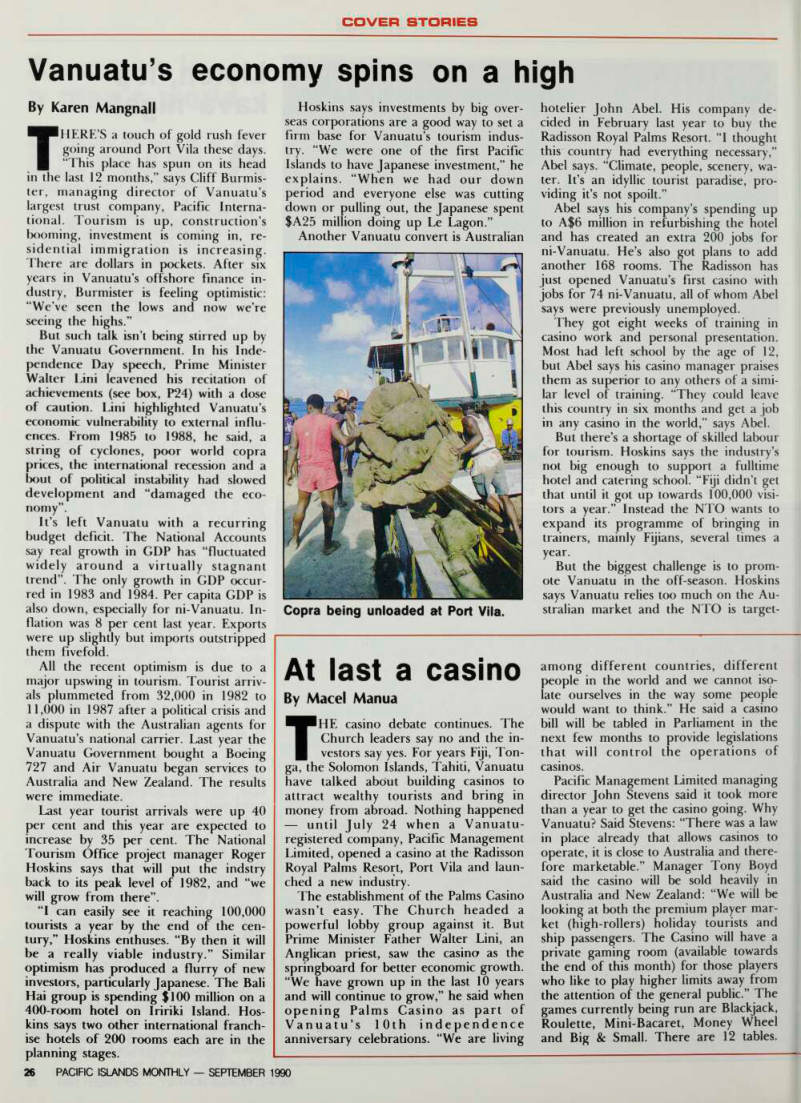
Copra being unloaded at Port Vila.
ting the northern hemisphere
Europe, North America, Japan to fill in the gaps. Volume is the key to expan sion. Hotels are merely upgrading at the moment because occupancy rates are still too low about 60 per cent. “As soon as the hotels here achieve 70 per cent occupancy rates, that will trigger them to expand,” says Hoskins. “Tourism will quickly become the number one foreign
exchange earner.”
A less spectacular expansion is forecast for Vanuatu’s tax haven industry. The Finance Centre the group of com panies deal with offshore banking and overseas investment is the quiet driv ing force behind the economy. It em ploys 400 staff all but 90 are ni- Vanuatu and has about 1500 clients on the books. Finance association presi dent and Westpac manager, lan Smith, says the finance centre has “undoubtedly proven its worth”, mitigating the impact during Vanuatu’s bad years.
Today it contributes a steady 12 per cent of GDP; with As 3 million going annually to the Government in fees and stamp duty, and $1.50 million paid out in local wages. “We’re putting a lot of money into the local economy,” says Smith. “The Government averages about 30 per cent of every dollar we spend, in import duties.” The centre is also an “enormous user” of Telecom and local service industries.
While Smith can’t foresee rapid growth, the centre has plans to cash in on capital flight from Hong Kong and new European Community trust rules
which come into force in 1992. Overseas investment in Vanuatu is growing, most ly from Japanese. At the end of the year, the centre intends hiring a public rela tions firm and, later, taking a roadshow to Hong Kong. “Our main aim is to get the reputation as the place to use in the Pacific if someone’s considering an offshore centre,” says Smith.
A key element in that strategy is leg islation, drawn up with the Vanuatu reg istrar of companies, to be enacted over the next two years. One law will give “more teeth” to the registrar and the Reserve Bank in policing those using the tax haven, and will set down rules for full disclosure. Vanuatu’s never got the big name, big ticket business or the
subsequent bad reputation for hiding tax
evaders. So when American authorities recently accused it of laundering drug money, Smith told them publicly to “put up or shut up”.
Smith says there’s never been any evi dence of Vanuatu being used to launder dirty money. US Comptroller of Curren cy John Shockey was given that message during a recent visit and departed “a wiser man”. But Pacific International’s Cliff Burmister says Vanuatu has lagged behind the world in offshore banking.
The centre manages about US$6O mil lion directly and gets fees for running about 60 offshore banks. Burmister says new legislation takes the best ideas from other tax havens. “We’ve come up with a package which will be at the forefront for tax havens.”
But perhaps the finance centre’s most
significant long-term contribution has
been to Vanuatu’s pool of skilled labour.
Burmister says it provides “very good
training for ni-Vanuatu by people with
experience and qualifications not nor mally available in the Islands”. That fil ters through the whole business com munity and is about to be more firmly cemented by an exchange programme with Government departments.
The lack of skilled labour is a knotty problem at the core of Vanuatu’s de
velopment strategy. On Independence
Day, Lini emphasised two threads to the problem: youth unemployment and get ting more ni-Vanuatu into government and private sector jobs. Much of the country’s professional and technical work
is done by expatriates, particularly con
sultants or advisers on foreign aid. The National Planning Office is about to launch a year-long survey to find out the level of manpower as aid because one day Vanuatu will have to staff and pay for those jobs.
Principal planning officer Gerald
Haberkern says most international aid goes on capital development: roads, wa ter supplies, airstrips. “The Vanuatu Government can’t afford to pay for it and that’s what it wants at the moment.”
Haberkorn wants to see the Vanuatu Government gradually commit more of its own budget to development, because the handouts can’t be sustained. “What happens if Australia or New Zealand or someone else says they don’t have any money any more?”
Vanuatu is taking the first steps in that direction with PASEP, a $2O million education programme with the Austra lian Government and the World Bank.
Billed as the country’s biggest develop ment project since independence, PASEP will provide over the next five years, an extra 180 upper secondary and 560 low
er secondary places and improved
teacher training. In 1986 only 2 of every 100 ni-Vanuatu students entered senior secondary education, and Haberkorn says that’s not enough to upgrade the ni-Vanuatu skilled labour force or in crease the pace of localising managerial and technical posts.
More disturbing is the fact that half of students never go beyond primary school. About 3200 young ni-Vanuatu reach the age of 16 each year and only a small number can be absorbed into the cash economy. Haberkorn says they are expected to find employment in “tradi tional activities” such as agriculture, which still employs 80 per cent of the adult workforce. But Haberkorn says ru ral training courses reach only a fraction of those teenagers. Combined with a sig nificant rural-urban drift, it threatens
growing youth under or unemploy
ment with resulting problems of crime and social unrest.
One area which could absorb these workers is the industrial-manufacturing sector. It now contributes 12 per cent to the GDP and employs over 5 per cent of the workforce, but Haberkorn says further expansion is being stymied by the lack of skilled labour. He hopes the third national development plan will emphasise technical and adult training;
“plumbers, nurses, planning officers.”
And all this when education’s share of the budget has dropped from 30 per cent in 1980 to 19 per cent this year.
Despite a similar drop in the proportion of the health vote, Haberkorn lauds the Vanuatu Government’s “phenomenal” achievements uniting the separate French and English health and educa tion systems inherited from the con dominium. “It’s quite a political achieve ment uniting the separate French and English health and education systems in herited from the condominium. “It’s quite a political achievement to run health and education with your own domestic resources when it was com pletely paid for 10 years ago,” says Haberkorn. “Usually in the post-colonial era, health and education fall by the
wayside.” □