Listen, it’s
p. 25 · Read in the full issue
kava night
ASK Melchior Ihu what he thinks of young ni-Vanuatu men get ting drunk on beer in town, and he looks disdainful. He shakes his head: “I don’t like it.”
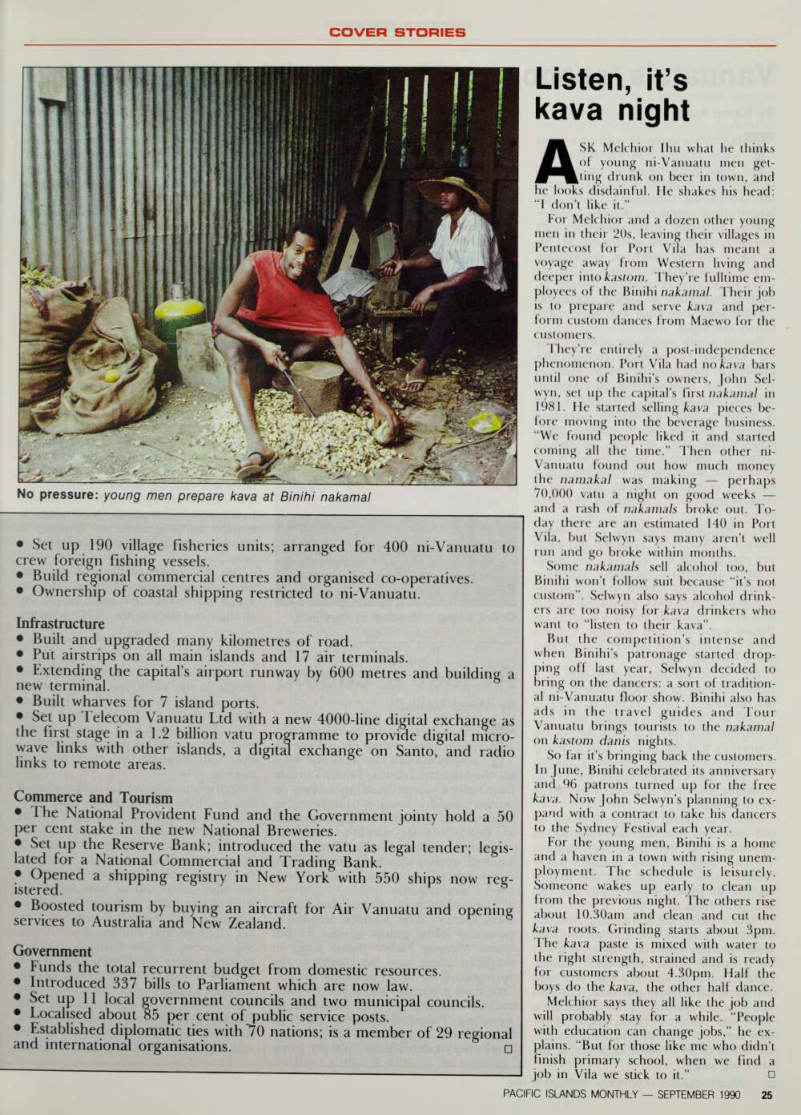
For Melchior and a dozen other young men in their 20s, leaving their villages in Pentecost for Port Vila has meant a voyage away from Western living and deeper into kastom. They’re fulltime em ployees of the Binihi nakamal. Their job is to prepare and serve kava and per form custom dances from Maewo for the customers.
They’re entirely a post-independence
phenomenon. Port Vila had no kava bars until one of Binihi’s owners, John Sel wyn, set up the capital’s first nakamal in 1981. He started selling kava pieces be fore moving into the beverage business.
“We found people liked it and started coming all the time.” Then other ni- Vanuatu found out how much money the namakal was making perhaps 70,000 vatu a night on good weeks and a rash of nakamals broke out. To day there are an estimated 140 in Port Vila, but Selwyn says many aren’t well run and go broke within months.
Some nakamals sell alcohol too, but Binihi won’t follow suit because “it’s not custom”. Selwyn also says alcohol drink ers are too noisy for kava drinkers who want to “listen to their kava”.
But the competition’s intense and when Binihi’s patronage started drop ping off last year, Selwyn decided to bring on the dancers: a sort of tradition al ni-Vanuatu floor show. Binihi also has ads in the travel guides and Tour Vanuatu brings tourists to the nakamal on kastom danis nights.
So far it’s bringing back the customers.
In June, Binihi celebrated its anniversary and 96 patrons turned up for the free kava. Now John Selwyn’s planning to ex pand with a contract to take his dancers to the Sydney Festival each year.
For the young men, Binihi is a home and a haven in a town with rising unem ployment. The schedule is leisurely.
Someone wakes up early to clean up from the previous night. The others rise about 10.30 am and clean and cut the kava roots. Grinding starts about 3pm.
The kava paste is mixed with water to the right strength, strained and is ready for customers about 4.30 pm. Half the boys do the kava, the other half dance.
Melchior says they all like the job and will probably stay for a while. “People with education can change jobs,” he ex plains. “But for those like me who didn’t finish primary school, when we find a job in Vila we stick to it.” □