ocean-related aid
pp. 45-46 · Read in the full issue
Canada stresses ocean-related aid
WHEN Canada thinks about eco nomic assistance for the South Pacific it thinks, and acts, in terms of maritime resources. Canada, with the world’s second largest landmass (a little bigger than China, but smaller than Russia), plays a specialised role in extending economic assistance to the re latively tiny landmasses of the South Pacific nations it concentrates on com modities under the sea.
“Take house-building on Tarawa, for example,” explains John Harper, a Canadian geologist working with the is land nations, “there are about 5000 peo ple per square kilometre. When they need sand and gravel to build houses, or roads they cannot afford to dig it out of a hole in the ground (which will fill with water) they need to get the building materials elsewhere such as from
nearby lagoons.”
Harper is based on Vancouver Island in the North Pacific, and his work in the South Pacific has largely been funded by the International Centre for Ocean De velopment (ICOD), a Canadian Crown Corporation. He is one of a small collec tion of Canadian-funded scientists and economists who provide specialised ser vices to island nations on how best to cope with their underwater resources.
“Unlike the Atlantic, there are no con tinental shelves in the Pacific,” Harper explains. “When you fly in to a Pacific island you see the aqua-coloured water in the lagoons and at the fringes of the islands, that is measured in tens of metres, and then, almost immediately, you have the deep blue of the ocean, measured in hundreds to thousands of metres.”
Given this bit of geological reality, and the expense of removing material from great depths, Harper has become a spe cialist in the nearshore resources of the Pacific islands. He uses the latest in sci entific devices as well as some old fashioned ones to help island govern ments utilise and preserve mineral re sources in the shallow waters around the islands. (He has, for instance, installed sophisticated electronic echo sounders, to measure the depth of water, in dugout canoes for work in Papua New Guinea.) Harper’s specialty is not just under water geology, it is teaching others how to find and use underwater resources.
Harper worked for two years in an
ICOD-funded project implemented by
the Suva-based South Pacific Applied- Geoscience Commission (SOPAC).
SOPAC’s executive director is Jioji Koto balavu, a Fijian, and its members include Australia, Cook Islands, Fiji, Guam, Kiri
bati, New Zealand, Papua New Guinea, the Solomons, Tonga, Tuvalu, Vanuatu and Western Samoa.
Two of Harper’s recent assignments for SOPAC dealt with sand and gravel just off Western Samoa, and pink coral in Kiribati’s Exclusive Economic Zone
(Eez).
Western Samoa, unlike Kiribati, has a substantial amount of land area, but, according to Harper the landowners are reluctant to have gravel pits dug on their property, so the price is high for dry land gravel and sand; as a result there is a strong interest in securing it offshore. (And given the damage to the nation’s roads caused by Ofa, the need for offshore sand and gravel will continue for years to come.) Harper’s task in Western Samoa was to
train residents in the mapping of offshore sand and gravel deposits. “We get up a grid [on a map], used echo sounders to establish the depth of the water, and then stopped at various points to take samples.” If the samples looked promising, Harper’s crew then used a jet probe to test the depth of the deposit. “You use a pipe and a jet of water, like from a garden hose, to see how thick the sand or gravel is.”
When the process is finished, there is a map showing where the sand and gravel is located on the grid, what kinds are available, and how thick are the de posits. “Depth is important because dredging through more than six metres of water is prohibitively expensive,” he
explains.
Typically as part of such a survey, Harper also provides an assessment of the environmental impact of use of the
sand and gravel. “It takes thousands of years for coral to be ground into sand, so sand is, for all practical purposes, not a renewable resource.”
In addition to his work in PNG and Western Samoa, Harper has also done co-operative research with Fiji’s cement manufacturer, Island Industries, one of the only two such firms in the world making cement from coral sand; the company mixes the offshore sand with mineral sand from rivers to make its cement.
The stakes are different in the search for coral. While sand is worth a few dol lars a ton, pink coral can bring up to US$l5O a kilogram. (One of the prob lems is that poachers from distant places often get to the coral before the island state can harvest it few people bother to steal sand.) Further, it is located in a different manner, and at much greater depth, usually 400 to 1500 metres.
In his work with Kiribati maritime re sources people, Harper used a tradition
al harvesting technique while mapping
pink coral beds. “You attach a line to a big stone, weighing 50 to 100 pounds, and then you drag that along the bottom with a tangle net following. The strands of the net catch the coral broken off by the big rock. It sounds pretty crude, but it is really very effective.”
Thinking of the inadvertent catches of the driftnets and purse seines, Asked if the tangle nets brought up fish and vegetation as well. “No,” Harper replied, “not at that depth. But we do find a lot of rocks and weird sponges.”
The problem of poaching the pink
coral is a serious one, he said. “Half the pink coral harvested in Hawaiian waters is the work of poachers, and that’s in the waters of a great power,” implying that the US would be better able to prevent this activity than Kiribati, for example, He told the story of the maritime re
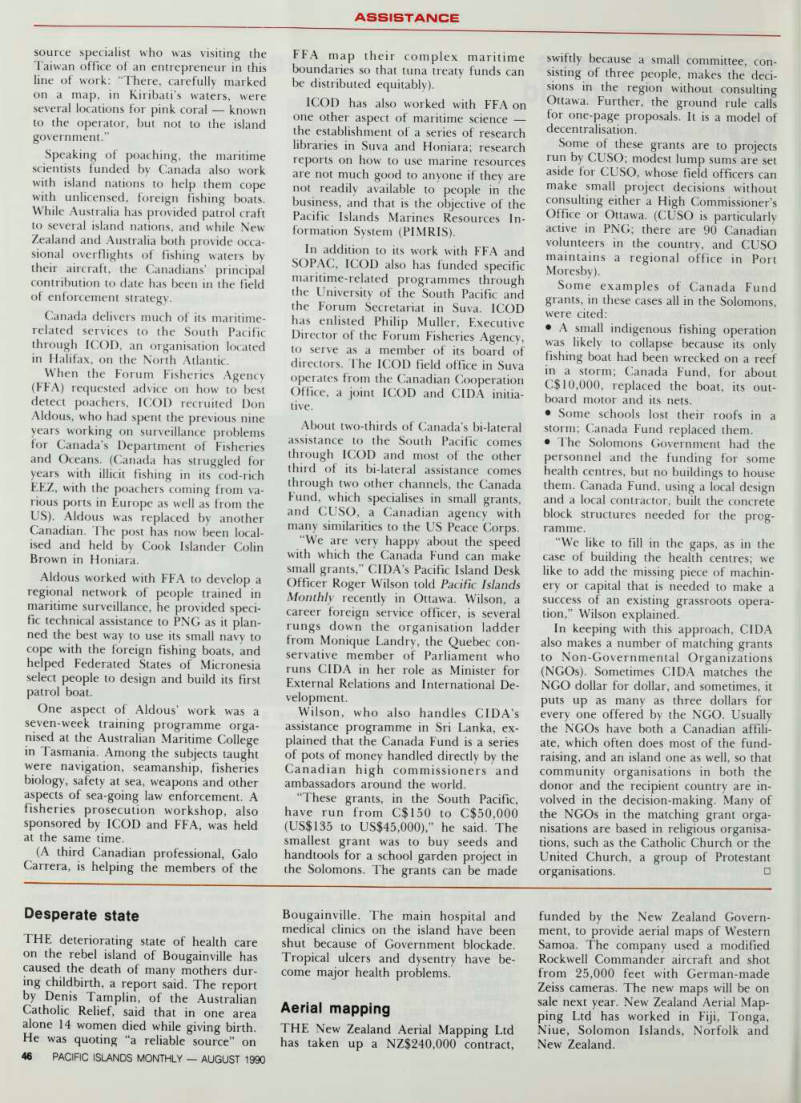
The Canadian Cooperation Office, Suva: a joint ICOD and CIDA initiative.
source specialist who was visiting the Taiwan office of an entrepreneur in this line of work: “There, carefully marked on a map, in Kiribati’s waters, were several locations for pink coral known to the operator, but not to the island government.”
Speaking of poaching, the maritime scientists funded by Canada also work with island nations to help them cope with unlicensed, foreign fishing boats.
While Australia has provided patrol craft to several island nations, and while New Zealand and Australia both provide occa
sional overflights of fishing waters by
their aircraft, the Canadians’ principal contribution to date has been in the field of enforcement strategy.
Canada delivers much of its maritime related services to the South Pacific through ICOD, an organisation located in Halifax, on the North Atlantic.
When the Forum Fisheries Agency (FFA) requested advice on how to best detect poachers, ICOD recruited Don Aldous, who had spent the previous nine years working on surveillance problems for Canada’s Department of Fisheries and Oceans. (Canada has struggled for years with illicit fishing in its cod-rich EEZ, with the poachers coming from va rious ports in Europe as well as from the US). Aldous was replaced by another Canadian. The post has now been local ised and held by Cook Islander Colin Brown in Honiara.
Aldous worked with FFA to develop a regional network of people trained in maritime surveillance, he provided speci fic technical assistance to PNG as it plan ned the best way to use its small navy to cope with the foreign fishing boats, and helped Federated States of Micronesia select people to design and build its first patrol boat.
One aspect of Aldous’ work was a seven-week training programme orga nised at the Australian Maritime College
in Tasmania. Among the subjects taught
were navigation, seamanship, fisheries
biology, safety at sea, weapons and other aspects of sea-going law enforcement. A fisheries prosecution workshop, also sponsored by ICOD and FFA, was held at the same time. (A third Canadian professional, Galo Carrera, is helping the members of the
FFA map their complex maritime boundaries so that tuna treaty funds can be distributed equitably).
ICOD has also worked with FFA on one other aspect of maritime science the establishment of a series of research libraries in Suva and Honiara; research reports on how to use marine resources are not much good to anyone if they are not readily available to people in the business, and that is the objective of the Pacific Islands Marines Resources In formation System (PIMRIS).
In addition to its work with FFA and SOPAC, ICOD also has funded specific maritime-related programmes through the University of the South Pacific and the Forum Secretariat in Suva. ICOD has enlisted Philip Muller, Executive Director of the Forum Fisheries Agency, to serve as a member of its board of directors. The ICOD field office in Suva operates from the Canadian Cooperation Office, a joint ICOD and CIDA initia tive.
About two-thirds of Canada’s bi-lateral assistance to the South Pacific comes through ICOD and most of the other third of its bi-lateral assistance comes through two other channels, the Canada Fund, which specialises in small grants, and CUSO, a Canadian agency with many similarities to the US Peace Corps.
“We are very happy about the speed with which the Canada Fund can make small grants,” CIDA’s Pacific Island Desk Officer Roger Wilson told Pacific Islands Monthly recently in Ottawa. Wilson, a career foreign service officer, is several rungs down the organisation ladder
from Monique Landry, the Quebec con
servative member of Parliament who runs CIDA in her role as Minister for External Relations and International De
velopment.
Wilson, who also handles CIDA’s assistance programme in Sri Lanka, ex plained that the Canada Fund is a series of pots of money handled directly by the Canadian high commissioners and ambassadors around the world.
“These grants, in the South Pacific, have run from Cslso to C 550,000 (US$l35 to U 5545,000),” he said. The smallest grant was to buy seeds and handtools for a school garden project in the Solomons. The grants can be made
swiftly because a small committee, con sisting of three people, makes the deci sions in the region without consulting Ottawa. Further, the ground rule calls for one-page proposals. It is a model of decentralisation.
Some of these grants are to projects run by CUSO; modest lump sums are set aside for CUSO, whose field officers can make small project decisions without consulting either a High Commissioner’s Office or Ottawa. (CUSO is particularly active in PNG; there are 90 Canadian volunteers in the country, and CUSO maintains a regional office in Port
Moresby).
Some examples of Canada Fund grants, in these cases all in the Solomons, were cited:
• A small indigenous fishing operation
was likely to collapse because its only fishing boat had been wrecked on a reef in a storm; Canada Fund, for about Cslo,ooo, replaced the boat, its out board motor and its nets. • Some schools lost their roofs in a storm; Canada Fund replaced them. • The Solomons Government had the personnel and the funding for some health centres, but no buildings to house them. Canada Fund, using a local design and a local contractor, built the concrete block structures needed for the prog ramme.
“We like to fill in the gaps, as in the case of building the health centres; we like to add the missing piece of machin ery or capital that is needed to make a success of an existing grassroots opera tion,” Wilson explained.
In keeping with this approach, CIDA also makes a number of matching grants to Non-Governmental Organizations (NGOs). Sometimes CIDA matches the NGO dollar for dollar, and sometimes, it puts up as many as three dollars for every one offered by the NGO. Usually the NGOs have both a Canadian affili ate, which often does most of the fund raising, and an island one as well, so that community organisations in both the donor and the recipient country are in volved in the decision-making. Many of the NGOs in the matching grant orga nisations are based in religious organisa tions, such as the Catholic Church or the United Church, a group of Protestant organisations. □