A first for Polynesia
p. 44 · Read in the full issue
Relations
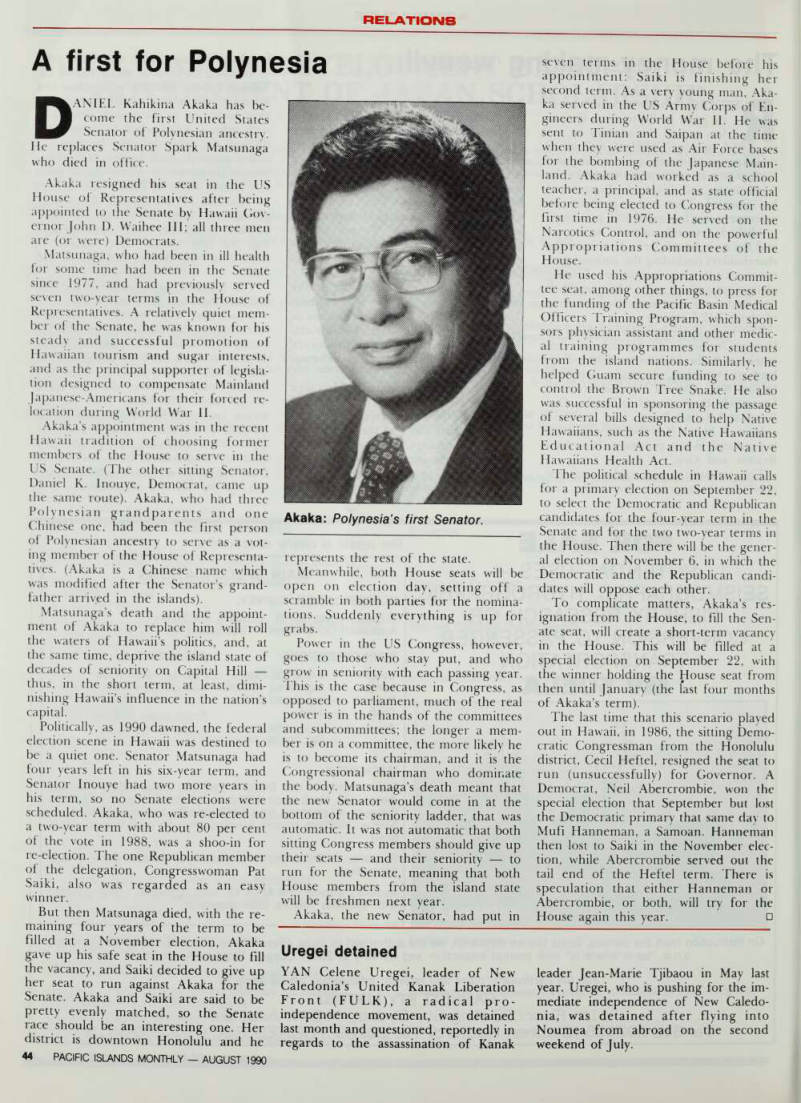
DANIEL Kahikina Akaka has be come the first United States Senator of Polynesian ancestry.
He replaces Senator Spark Matsunaga who died in office.
Akaka resigned his seat in the US House of Representatives after being appointed to the Senate by Hawaii Gov ernor John D. Waihee HI; all three men are (or were) Democrats.
Matsunaga, who had been in ill health for some time had been in the Senate since 1977, and had previously served seven two-year terms in the House of Representatives. A relatively quiet mem ber of the Senate, he was known for his steady and successful promotion of Hawaiian tourism and sugar interests, and as the principal supporter of legisla tion designed to compensate Mainland Japanese-Americans for their forced re location during World War 11.
Akaka’s appointment was in the recent Hawaii tradition of choosing former members of the House to serve in the US Senate. (The other sitting Senator, Daniel K. Inouye, Democrat, came up the same route). Akaka, who had three
Polynesian grandparents and one
Chinese one, had been the first person of Polynesian ancestry to serve as a vot ing member of the House of Representa tives. (Akaka is a Chinese name which was modified after the Senator’s grand father arrived in the islands).
Matsunaga’s death and the appoint ment of Akaka to replace him will roll the waters of Hawaii’s politics, and, at the same time, deprive the island state of decades of seniority on Capital Hill thus, in the short term, at least, dimi nishing Hawaii’s influence in the nation’s capital.
Politically, as 1990 dawned, the federal election scene in Hawaii was destined to be a quiet one. Senator Matsunaga had four years left in his six-year term, and Senator Inouye had two more years in his term, so no Senate elections were scheduled. Akaka, who was re-elected to a two-year term with about 80 per cent of the vote in 1988, was a shoo-in for re-election. The one Republican member of the delegation, Congresswoman Pat Saiki, also was regarded as an easy winner.
But then Matsunaga died, with the re maining four years of the term to be filled at a November election, Akaka gave up his safe seat in the House to fill the vacancy, and Saiki decided to give up her seat to run against Akaka for the Senate. Akaka and Saiki are said to be pretty evenly matched, so the Senate race should be an interesting one. Her district is downtown Honolulu and he
represents the rest of the state.
Meanwhile, both House seats will be open on election day, setting off a scramble in both parties for the nomina tions. Suddenly everything is up for grabs.
Power in the US Congress, however, goes to those who stay put, and who grow in seniority with each passing year.
This is the case because in Congress, as opposed to parliament, much of the real power is in the hands of the committees and subcommittees; the longer a mem ber is on a committee, the more likely he is to become its chairman, and it is the Congressional chairman who dominate the body. Matsunaga’s death meant that the new Senator would come in at the bottom of the seniority ladder, that was automatic. It was not automatic that both
sitting Congress members should give up
their seats and their seniority to run for the Senate, meaning that both House members from the island state will be freshmen next year.
Akaka, the new Senator, had put in
seven terms in the House before his appointment: Saiki is finishing her second term. As a very young man, Aka ka served in the US Army Corps of En gineers during World War 11. He was sent to Tinian and Saipan at the time when they were used as Air Force bases for the bombing of the Japanese Main land. Akaka had worked as a school teacher, a principal, and as state official before being elected to Congress for the first time in 1976. He served on the Narcotics Control, and on the powerful Appropriations Committees of the House.
He used his Appropriations Commit tee seat, among other things, to press for the funding of the Pacific Basin Medical Officers Training Program, which spon sors physician assistant and other medic al training programmes for students from the island nations. Similarly, he helped Guam secure funding to see to control the Brown Tree Snake. He also was successful in sponsoring the passage of several bills designed to help Native Hawaiians, such as the Native Hawaiians Educational Act and the Native Hawaiians Health Act.
The political schedule in Hawaii calls for a primary election on September 22, to select the Democratic and Republican candidates for the four-year term in the Senate and for the two two-year terms in the House. Then there will be the gener al election on November 6, in which the Democratic and the Republican candi dates will oppose each other.
To complicate matters, Akaka’s res ignation from the House, to fill the Sen ate seat, will create a short-term vacancy in the House. This will be filled at a special election on September 22, with the winner holding the House seat from then until January (the last four months of Akaka’s term).
The last time that this scenario played out in Hawaii, in 1986, the sitting Demo cratic Congressman from the Honolulu district, Cecil Heftel, resigned the seat to run (unsuccessfully) for Governor. A Democrat, Neil Abercrombie, won the special election that September but lost the Democratic primary that same day to Mufi Hanneman, a Samoan. Hanneman then lost to Saiki in the November elec tion, while Abercrombie served out the tail end of the Heftel term. There is speculation that either Hanneman or Abercrombie, or both, will try for the House again this year. □
Akaka: Polynesia’s first Senator.