Sport
p. 41 · Read in the full issue
League offers the big money
By Samisoni Kakaivalu
THE recent switch to rugby league
of Auckland’s top Maori halfback, Brett Iti, continues the rather alarming exodus of top quality New Zea land players to that code. For New Zea land rugby and its cause, it is becoming a nuisance and it is creating considerable concern to rugby administrators and the sport.
The current generation who crossed the fence to the more lucrative and financially-secure rewards on the other side, must have given a lot of serious thought to their decisions. The straight running West Samoan All Blacks John Schuster left rugby union only because the rewards offered by league was too tempting to resist. And there lies the cause of defection: league’s got the money that union can’t offer.
British league clubs like Widnes, Hull, Wigan, Halifax, Huddersfield, Leeds and Oldan are always on the prowl, looking to trap the best that rugby union can offer. That they have been branded parasites and greedy is of no concern.
What is of concern is the knowledge that there are top rugby union players out there ready to be lured over the fence by the big money league can offer.
Wellington fullback John Gallagher,
for example, didn’t wait around after being offered $1 million to join English club Leeds. That he was rugby union’s finest player in 1989 helped. But he didn’t care that he was secured an All Black berth this season and the World Cup next year. He told his stunned New Zealand fans that the Leeds offer was irresistible. Among friends he is joining in Britain is Tongan Emosi Koloto.
Rugby league in the Pacific Islands is small, except in Papua New Guinea where the Kumuls, the national team, recently beat Britain. There is some amateur league in Western Samoa and Tonga, but generally the Pacific Islands is known for colourful performances in rugby union. Tongan team manager Semisi Tapueluelu is one of the island officials concerned with the influence of rugby league. He said that union players in Tonga play league in the off-season and get paid for scoring tries; “The money they are paid is very small, only a few dollars for a try, but it is enough to attract them.”
Tapueluelu is worried that someone might decide to do something big for
rugby league in Tonga and endanger
union. Says he: “The fact is that many of the players do not have permanent em ployment. They play rugby only for the love of the sport and the honour to rep resent their country overseas. Now, if
they get the chance to play rugby and be compensated for their efforts, they would make the switch.”
In Western Samoa, team manager Tate Simi is also beginning to have the same bad feeling. While Western Samoa beat Fiji 30-17 on June 23 to win the British Petroleum Three Nations cham pionship, Simi can’t see it continuing to keep players. One day the cream of his team could follow countryman Schuster across the fence to rugby league. League
is an attractive incentive for union play ers in the Pacific Islands where the in creasing cost of living is propped up by low wages and unemployment. The price of a pair of rugby boots, for example, can be a week’s wage.
This October, the International Rugby Board (IRB) is due to make new rulings on the amateur principles of rugby un ion and their appropriateness for mod ern times. Those rulings could help plug the drain of leading players. □
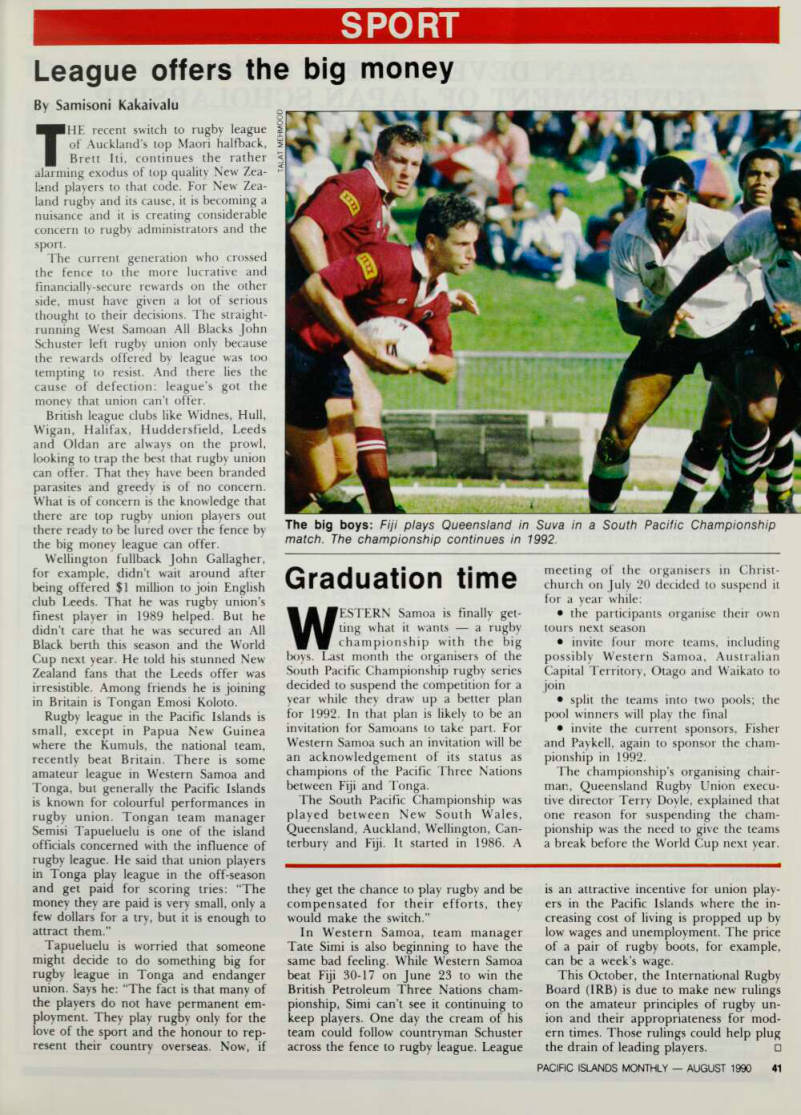
The big boys: Fiji plays Queensland in Suva in a South Pacific Championship match. The championship continues in 1992.