Decision soon on Congress seat
pp. 39-40 · Read in the full issue
Relations
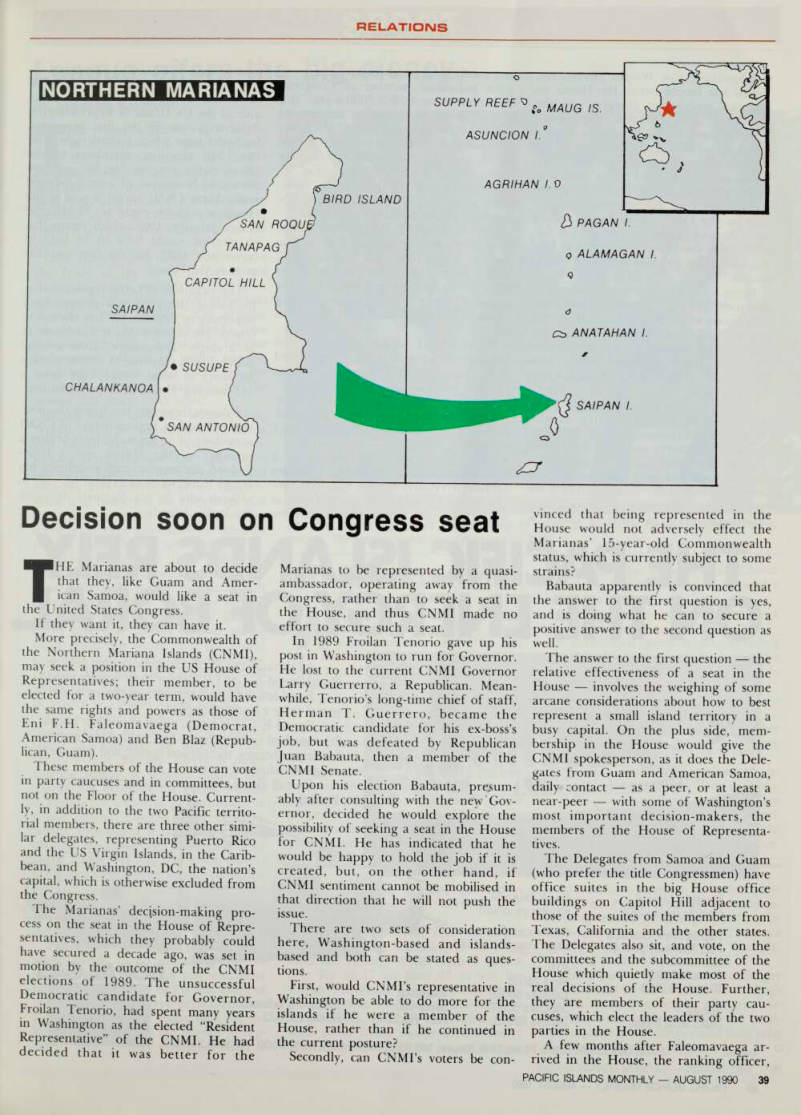
Northern Marianas
THE Marianas are about to decide that they, like Guam and Amer ican Samoa, would like a seat in the United States Congress.
If they want it, they can have it.
More precisely, the Commonwealth of the Northern Mariana Islands (CNMI), may seek a position in the US House of Representatives; their member, to be elected for a two-year term, would have the same rights and powers as those of Eni F.H. Faleomavaega (Democrat, American Samoa) and Ben Blaz (Repub lican, Guam).
These members of the House can vote in party caucuses and in committees, but not on the Floor of the House. Current ly, in addition to the two Pacific territo rial members, there are three other simi lar delegates, representing Puerto Rico and the US Virgin Islands, in the Carib bean, and Washington, DC, the nation’s capital, which is otherwise excluded from
the Congress.
The Marianas’ decision-making pro cess on the seat in the House of Repre sentatives, which they probably could have secured a decade ago, was set in motion by the outcome of the CNMI elections of 1989. The unsuccessful Democratic candidate for Governor, Froilan Tenorio, had spent many years in Washington as the elected “Resident Representative” of the CNMI. He had decided that it was better for the
Marianas to be represented by a quasi ambassador, operating away from the Congress, rather than to seek a seat in the House, and thus CNMI made no effort to secure such a seat.
In 1989 Froilan Tenorio gave up his post in Washington to run for Governor.
He lost to the current CNMI Governor Larry Guerrerro, a Republican. Mean while, Tenorio’s long-time chief of staff, Herman T, Guerrero, became the Democratic candidate for his ex-boss’s job, but was defeated by Republican Juan Babauta, then a member of the CNMI Senate.
Upon his election Babauta, presum ably after consulting with the new Gov ernor, decided he would explore the possibility of seeking a seat in the House for CNMI. He has indicated that he would be happy to hold the job if it is created, but, on the other hand, if CNMI sentiment cannot be mobilised in that direction that he will not push the issue.
There are two sets of consideration here, Washington-based and islands based and both can be stated as ques tions.
First, would CNMFs representative in Washington be able to do more for the islands if he were a member of the House, rather than if he continued in the current posture?
Secondly, can CNMFs voters be con
vinced that being represented in the House would not adversely effect the Marianas’ 15-year-old Commonwealth status, which is currently subject to some strains?
Babauta apparently is convinced that the answer to the first question is yes, and is doing what he can to secure a positive answer to the second question as well.
The answer to the first question the relative effectiveness of a seat in the House involves the weighing of some arcane considerations about how to best represent a small island territory in a busy capital. On the plus side, mem bership in the House would give the CNMI spokesperson, as it does the Dele gates from Guam and American Samoa, daily contact as a peer, or at least a near-peer with some of Washington’s most important decision-makers, the members of the House of Representa tives.
The Delegates from Samoa and Guam (who prefer the title Congressmen) have office suites in the big House office buildings on Capitol Hill adjacent to those of the suites of the members from Texas, California and the other states.
The Delegates also sit, and vote, on the committees and the subcommittee of the House which quietly make most of the real decisions of the House. Further, they are members of their party cau cuses, which elect the leaders of the two parties in the House.
A few months after Faleomavaega ar rived in the House, the ranking officer,
the Speaker, Jim Wright (Democrat,
Texas) was forced out of the House on fmancial misconduct charges, and the freshman member from Pago Pago found himself courted by more than a dozen senior Democratic members of the House, all running for various lead-
ership positions opened by the departure
of Wright and another member of the party hierarchy. Faleomavaega has no vote on the Floor, where formal ballots are taken on issues, but he had a full vote within the Democratic Party, as Blaz has within the Republican Party’s House caucus Being a member of committees, and of caucuses, gives the island delegates not only access to other decision-makers, but also the ability to wheel and deal on behalf of their constituencies. This position of power is the principal reason why CNMI will probably decide to seek a seat in the House.
There is a lesser reason as well.
Money The current office of the Washingtou Representative of CNMI is funded by moneys voted by the CNMI legislature which, in turn! are drawn from a fund including both taxes raised on the island locally and subsidies from Washington. The cost of running a Congressional office, like that of Guam, is
met totally by federal funds.
An individual member of Congress man now earns U5596,6000-a-year and is due to get a thumping increase to US$l2l,OOO-a-year in January; the other costs, of staff, rental of an office on the island, and travel to and from, can run to an additional US$l million-a-year. So, by deciding to go the House mem bership route, CNMI would save a sub stantial amount of money each year.
Further, since CNMI might not need it any longer, getting a seat in the House, and offices on Capitol Hill, would mean that CNMI could sell its attractive four-storey townhouse near the embassy district of Washington, netting another US$l milllion or so from that sale.
Were CNMI to get a seat in the House, and were Babauta to be elected to it, there would be three by-products for him and his staff: • Since he currently gets US $40,000-a -year (a ridiculously low salary for a signi ficant job in Washington) he would get a substantial raise; • Since Babauta has decided to set a $40,000 maximum on his staff salaries (although Tenorio did not have this poli cy), his staff would likely get increases as well. (No senior Congressional staff are
paid as little as $40,000 a year); and • The timing of elections to the posi tion would be changed to meet the sche dule of the US House of Representative.
Babauta is now in the first year of a four-year term which started right after the 1989 election; members of the House serve two-year terms, and are elected in November of even-numbered years. Were CNMI to get a seat in the House, it probably could not be effective before January, 1993, which means that an election would have to be held in November, 1992, for the first two-year term in the House.
The negatives of being represented in
the House, though they were apparently
important to Tenorio, are less obvious to others. He claimed that it was better to be a single “ambassador” from a small island group, than one of the six voteless members of what would have been a 441-member House of Representatives.
Babauta, however, has found the posi tion of Resident Representative of CNMI something of an anomaly ; he is neither a member of the House nor a fully fledged ambassador, and sometimes has found it awkward to explain his role to officials who do not routinely deal with the Pacific Islands. □