Soaring Hope
pp. 23-25 · Read in the full issue
Business
A volatile aviation industry continues to turn
By Robin Bromby
AIRLINE changes are continuing
in the volatile South Pacific avia tion industry. Hawaiian Airlines has announced its withdrawal from New' Zealand which leaves Air Rarotonga without an international service, Air Tungaru has finally got its jet service
operating and perhaps the most signi
ficant Polynesian Airlines has won the right to fly through Auckland to Austra lia, signalling the airline’s breakthrough with fifth freedom rights. Also on the good news front, Air Pacific announced a pre-tax profit almost double that of the
preceding year.
As of July 4, Hawaiian withdrew from flying into Auckland. The Honolulu based carrier had operated the Auck land-Rarotonga section on Air Raroton
ga’s rights, and the service ran with both airline flight numbers. Air Rarotonga has two small aircraft which it uses on inter-island flights in the Cook Islands, and took up the country’s landing rights in Auckland after Cook Islands International withdrew from that route.
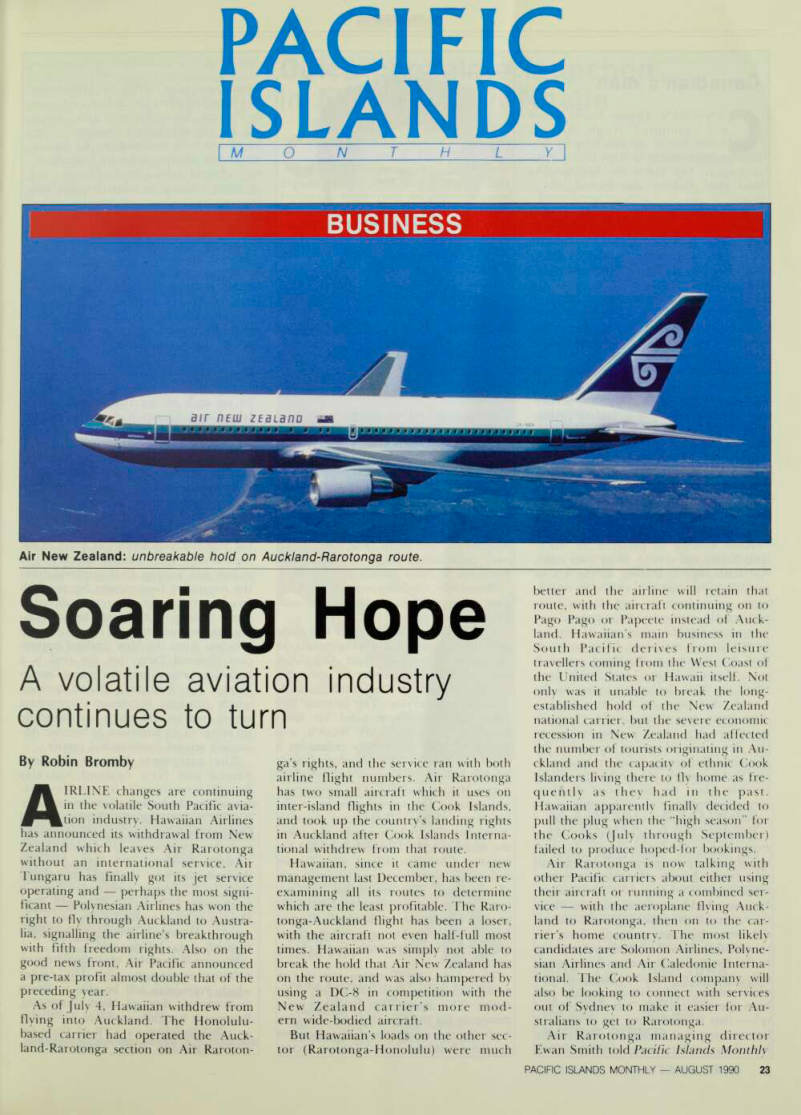
Hawaiian, since it came under new management last December, has been reexamining all its routes to determine which are the least profitable. The Rarotonga-Auckland flight has been a loser, with the aircraft not even half-full most times. Hawaiian was simply not able to break the hold that Air New Zealand has on the route, and was also hampered by using a DC-8 in competition with the New Zealand carrier’s more modern wide-bodied aircraft.
But Hawaiian’s loads on the other sector (Rarotonga-Honolulu) were much
better and the airline will retain that route, with the aircraft continuing on to Pago Pago or Papeete instead of Auck land. Hawaiian’s main business in the South Pacific derives from leisure travellers coming from the West Coast of the United States or Hawaii itself. Not only was it unable to break the long established hold of the New Zealand national carrier, but the severe economic recession in New' Zealand had affected the number of tourists originating in Au ckland and the capacity of ethnic Cook Islanders living there to fly home as fre quently as they had in the past.
Hawaiian apparentlv finally decided to pull the plug when the “high season” for the Cooks (July through September)
failed to produce hoped-for bookings.
Air Rarotonga is now talking with other Pacific carriers about either using their aircraft or running a combined ser vice with the aeroplane flying Auck land to Rarotonga, then on to the car rier’s home country. The most likely candidates are Solomon Airlines, Polyne sian Airlines and Air Caledonie Interna tional. The Cook Island company will also be looking to connect with services out of Sydney to make it easier for Au stralians to get to Rarotonga.
Air Rarotonga managing director Ewan Smith told Pacific Islands Monthly
that part of the problem with the service was that it was not able to tap the people travelling between Honolulu and Auck land to supplement those booking for one just half of the service. The through traffic had plenty of alternatives with American, Continental, United, Air New Zealand and Qantas offering more direct services from Honolulu to the South Pacific.
While looking to preserve an Auck land-Rarotonga service in its own right, A.r Rarotonga is looking to the US as providing the real growth for its opera tions; apart from its own domestic air services, the company acts as general ser vice agent for Hawaiian and its own in bound tourist company. “The reality is that the Rarotonga-Auckland sector is static, if not shrinking,” said Smith. Even when the New Zealanders come to the Cooks, they are not big spenders Americans spend about 2.5 times as much per day. Smith is now looking to the day when Hawaiian upgrades the Honolulu-Rarotonga route from one to two flights a week. He thinks that will be feasible when the new hotel develop ments, including a new Sheraton and a rebuilt Aitutaki resort, are completed.
Hawaiian, though, is planning to keep
expanding in the South Pacific. Market ing senior vice-president Bill Henderson told Pacific Islands Monthly that, since management changed in December, Hawaiian had been re-assessing its whole operation. It was sticking with what it did best, which was primarily flying in ter-island in Hawaii. But then operating in the South Pacific was much the same,
only they were five-hour flights instead
of 20 minutes. The last six months had been spent improving “schedule integri ty” that is, eliminating the delays and late-running that had given Hawaiian a less than perfect image in the South
Pacific.
Henderson said the company was now making the final decisions on the plan ned Honolulu-Nadi-Sydney service. All the permissions had been obtained and it looked as if Hawaiian would start a twice-weekly run from October. It was not yet certain whether the aircraft type would be a DC-8 or LlOll. They were also looking at operating a direct Los Angeles-Papeete flight, and what to do with permissions to fly in Japan and Northern Mariana Islands and Guam.
Meanwhile, the long-awaited Air Tun garu jet service got under way in mid- J ul Y- The Kiribati national carrier had some time ago completed arrangements to charter a 737 airliner from Aloha Air lines, of Hawaii, in order to operate a weekly Honolulu-Christmas Island- Tarawa-Nadi service. The country had been suffering from poor air com munications after Air Nauru was grounded, and was largely reliant on a small Airlines of the Marshall Islands aircraft calling at Tarawa en route be tween Majuro and Fiji. The new service was delayed for several months at the insistence of the US Federal Aviation Administration, which would not allow the two-engined 737 to fly the 3000 km between Christmas Island and Tarawa without an alternative aerodrome in case of emergency. This meant that Air Tun garu had to put its plans on hold while an old aerodrome on Kiribati’s Canton Island was brought up to international
standard, complete with fire-fighting
equipment.
That done, Air Tungaru was able to swing into action. It did so at very short notice. This meant that bookings were miniscule for the first trip; Air Tungaru is aiming at a minimum of 50 passengers on the Christmas Island-Tarawa sector,
30 on each of the Honolulu-Christmas Island and Tarawa-Nadi parts, but the first flight did not reach even these mod est targets. The aircraft leaves Honolulu each Wednesday, overnight at Nadi and flies the return trip the next day.
As Pacific Islands Monthly went to print, it seems that Polynesian Airlines had secured fifth freedom rights from Auckland to Sydney, which would give the Western Samoan carrier entry to the high-density trans-Tasman market. The airline was waiting final approval from the Australian Government for the fifth freedom rights for the return direction (from Sydney to Auckland) before mak ing the announcement. There was some criticism from the New Zealand opposi tion National Party that the deal is a back-door entry into the trans-Tasman market for Australia’s Ansett airlines,
which manages Polynesian’s operations
under contract and which has also made no secret of its ambitions to become Au stralia’s second international carrier.
The agreement between Western Samoa and New Zealand has also brought some benefits for Air New Zea land, New Zealand Civil Aviation minis ter Bill Jeffries said the airline now had the right to work an extra Boeing 767 and three additional 737 flights a week between Auckland and Apia. Air New Zealand also won the right to operate Apia to Rarotonga and return twice a week using 767 aircraft. This will allow the airline to consider routine one of its weekly Honolulu-Auckland services
through Apia, Jeffries said.
Western Samoa has also signed a new aviation agreement with Fiji, under which Polynesian will be able to fly its own aircraft through Nadi. Previously, Polynesian bought seats from Air Pacific on the Fijian airline’s ATR-42 flight be tween Apia and Nadi. Under the new
arrangements, Polynesian will be flying its Boeing 727 Apia-Nadi-Brisbane with limited rights in Fiji: it will not have fifth freedom rights, but can allow passengers travelling the full route to stopover in Fiji and continue the balance of the jour ney at a later date.
Symptomatic of the improving for tunes of island carriers, Air Pacific has announced an after-tax profit to March 31 this year of F 516.84 million (U 5511.24 million), which means the company has now used up its accumu lated losses meaning that the airline will be paying income taxes this year. Chair man Gerald Barrack said Air Pacific had achieved positive shareholder equity of F 513.2 million.
Highlights of the report included a 52 per cent increase in revenue to F$ 145.4 million, a 48 per cent increase in spend ing and the repayment of three major loans. Barrack said the airline recorded increased traffic on every route in the last financial year and this had been a significant contributor to the higher earnings. The period also saw the first full year of operations on the Melbourne and Tokyo routes.
Barrack said that, with the introduc tion of the Boeing 767 aircraf and plan ned relocation of the head office from Suva to Nadi, Air Pacific was moving to position itself strategically for the future.
The new Boeing 767 service was intro duced in the first week of July.
Chief executive Andrew Drysdale said the airline would hold on to the Nadi- Suva route as it was a strategic connec tion for its international services. While the Japan service had proved successful, Air Pacific had no immediate plans to extend its routes to either Taiwan or South Korea. “The timing is not right but we’ve arranged with China Airlines and Korean Airlines to introduce special air fares for passengers connecting with Air Pacific flights in Tokyo,” he said.
The company had also received requests from Tonga and Niue for a link between the two countries. □