From under the counter
p. 22 · Read in the full issue
Media
Tonga
From under the counter emerges a rival to Kele’a
By Pesi Fonua
Editor, Matangi Tonga ONCE there was the Kele'a, a controversial newsletter that launched a political party and changed forever the face of Tongan politics. The Kele'a and its Editor, Mem ber of Parliament Akilisi Pohiva, were branded leftwingers. Now a rival has emerged from under the counter and selling hot in Tonga. Titled Tonga Ngaue, it is a publication with a differ ence. “We oppose any move for change,” said Editor Tevita Manu Fasi. “Things are quite alright as they are and we want to keep it exactly as it is,” he added,
clearly voicing disapproval for the consti
tutional reform moves being headed by Pohiva, the most controversial politician to have been elected to the Tongan Par liament.
Unlike Pohiva’s Kele'a, Fasi’s Tonga Ngaue is no anti-establishment, policy
trail-blazing publication. “The prime
purpose of Tonga Ngaue,” he said, “is to campaign against any move to change the present structure of our govern ment.”
The idea to start a publication like Tonga Ngaue was born in 1979 during discussions by Fasi and Topi Tapueluelu, a church minister living in Sydney. No thing was done until this year when Tapueluelu returned to Tonga and con tested February’s general elections for a seat in the General Assembly as a Peo ple’s Representative. He failed. In March, with the help of two other mem bers of the Fofo’anga Kava Club Taniela Ngaluola and Sione Fakaosi he launched the rightwing Tonga Ngaue. The newsletter carried no pub lisher’s imprint and it soon became clear why.
Tonga Ngaue got off to a bit of rough start. Fasi said when his first issue came out he felt like he was making more ene mies than friends: “When we delivered the first issue, not one shop in the whole of the Western District wanted to sell the Tonga Ngaue. In the Eastern District, one or two shops stocked the paper but when we returned to check a few days later we found them hiding the paper under the counter. I asked the girl, ‘Why under the counter?’ and she said that a Catholic priest had told her not to sell the paper. ‘But what has the priest got to do with your shop?’ I asked Tm a Catholic,’ she replied.”
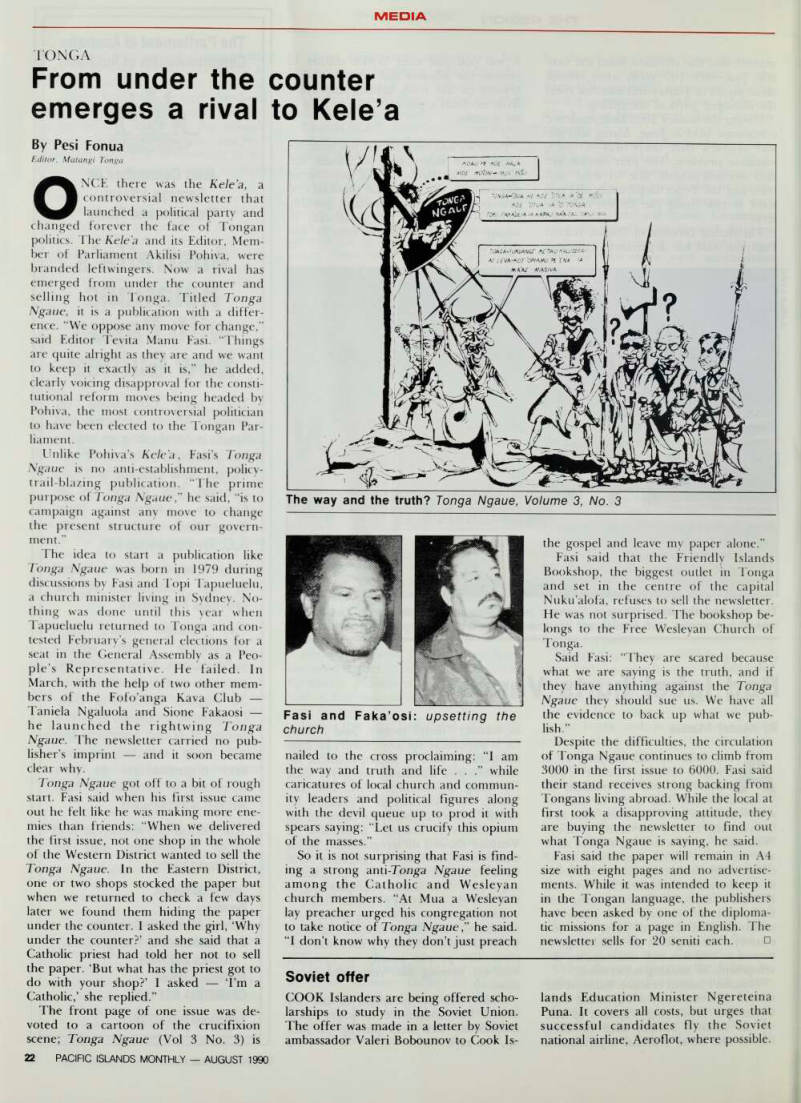
The front page of one issue was de voted to a cartoon of the crucifixion scene; Tonga Ngaue (Vol 3 No. 3) is
nailed to the cross proclaiming: “I am the way and truth and life . . .” while caricatures of local church and commun ity leaders and political figures along with the devil queue up to prod it with spears saying: “Let us crucify this opium of the masses.”
So it is not surprising that Fasi is find ing a strong anti -Tonga Ngaue feeling among the Catholic and Wesleyan church members. “At Mua a Wesleyan
lay preacher urged his congregation not
to take notice of Tonga Ngaue,” he said.
“I don’t know why they don’t just preach
the gospel and leave my paper alone.”
Fasi said that the Friendly Islands Bookshop, the biggest outlet in Tonga and set in the centre of the capital Nukualofa, refuses to sell the newsletter.
He was not surprised. The bookshop be longs to the Free Wesleyan Church of Tonga.
Said Fasi: “They are scared because what we are saying is the truth, and if they have anything against the Tonga Ngaue they should sue us. We have all the evidence to back up what we pub lish.”
Despite the difficulties, the circulation of Tonga Ngaue continues to climb from 3000 in the first issue to 6000. Fasi said their stand receives strong backing from Tongans living abroad. While the local at first took a disapproving attitude, they are buying the newsletter to find out what Tonga Ngaue is saying, he said.
Fasi said the paper will remain in A 4 size with eight pages and no advertise ments. While it was intended to keep it in the Tongan language, the publishers have been asked by one of the diploma tic missions for a page in English. The newsletter sells for 20 seniti each. □
The way and the truth? Tonga Ngaue, Volume 3, No. 3
Fasi and Faka’osi: upsetting the church