Asbestos drives out Apia MPs
pp. 20-21 · Read in the full issue
By Ulafala Aiavao
WESTERN Samoa’s 18-year-old
Parliament building has been closed temporarily because in
creasing damage to asbestos sheets lining
the ceiling mean that the chamber is a health hazard. The asbestos, used to help the acoustics and cooling of the dome-shaped chambers, was installed when the country’s second Parliament building was constructed in 1972. It was safe as long as the sheets were firmly fixed in a matrix. But wear and tear over the years, which worsened after Cyclone Ofa last February caused more leaks in the roof, has exposed the edges of the material.
Fibres have been drifting down from the central part of the ceiling to cover furniture, politicians and anyone else with a fine coat of dust if they sit still
long enough.
Earlier this year, Legislative office staff wearing makeshift gloves and facemasks, tried clearing away the dust. But they soon stopped. One reason was that the dust and fibres they vacuumed or swept up in the evenings were replaced by the next morning. The second reason was that the Clerk of the House, Mase Toia Alama, called off her staff due to the health hazard. (Alama is a gynaecologist obstetrician. The Speaker of the House, Aeau Peniamina, is a dentist).
Cabinet had approved a post-Ofa plan
to eventually remove the asbestos, although MPs still met in the chamber after the cyclone to approve a recovery
plan.
The Clerk of the House later wrote to the Prime Minister, Tofilau Eti Alesana, advising that the Parliament chamber was unsafe and should not be used until all the asbestos was removed and not
replaced. Government agreed.
The last meeting in the asbestos-lined chamber was on May 31 when the Head of State, Malietoa Tanumafili 11, opened the 1990 session, and Finance Minister, Tuilaepa Sailele, tabled a Second Sup plementary Estimates for this year.
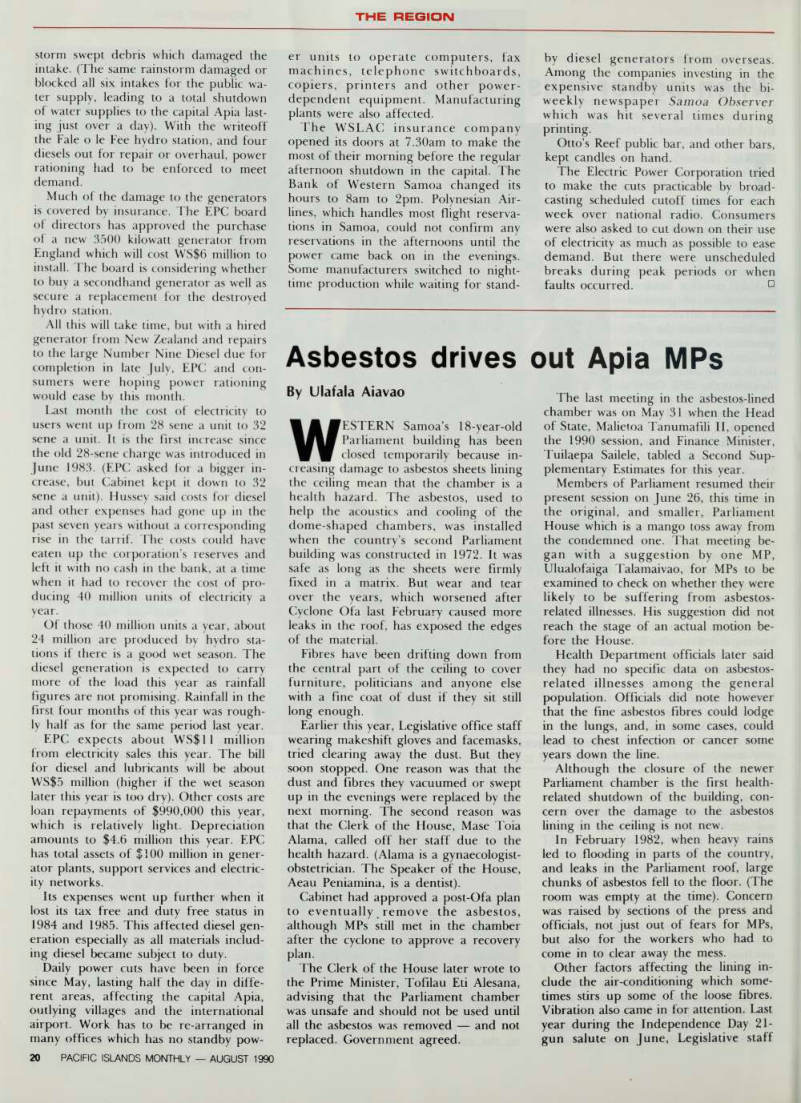
Members of Parliament resumed their present session on June 26, this time in the original, and smaller, Parliament House which is a mango toss away from the condemned one. That meeting be gan with a suggestion by one MP, Ulualofaiga Talamaivao, for MPs to be examined to check on whether they were likely to be suffering from asbestos related illnesses. His suggestion did not reach the stage of an actual motion be fore the House.
Health Department officials later said they had no specific data on asbestos related illnesses among the general population. Officials did note however that the fine asbestos fibres could lodge in the lungs, and, in some cases, could lead to chest infection or cancer some years down the line.
Although the closure of the newer Parliament chamber is the first health related shutdown of the building, con cern over the damage to the asbestos lining in the ceiling is not new.
In February 1982, when heavy rains led to flooding in parts of the country, and leaks in the Parliament roof, large chunks of asbestos fell to the floor. (The room was empty at the time). Concern was raised by sections of the press and officials, not just out of fears for MPs, but also for the workers who had to come in to clear away the mess.
Other factors affecting the lining in clude the air-conditioning which some times stirs up some of the loose fibres.
Vibration also came in for attention. Last year during the Independence Day 21gun salute on June, Legislative staff
noticed that the vibration from the can non just over 100 yards away, shook small pieces of plaster and asbestos from the damaged parts of the ceiling.
During the lowkey 1990 Independence celebration held in June, Alama said she was relieved that there was no such vibration problem. The four cannon are also deemed unsafe due to wear and tear, and the Police Department did not want to risk firing the 29-year-old bat tery.
The Acting Director of Works, Isikuki Punivalu, said his department estimates
it will cost just over WSTI million to remove the asbestos and carry out other repairs on the roof, lighting and other fixtures. Such a job may take as long as six months.
Punivalu said his staff did not have the appropriate safety gear to handle the asbestos. The Public Works Department was recently discussing the possibility of getting an overseas consultant, possibly from New Zealand or Australia, to advise on how to safely remove the material. □
The old and the new: Western Samoa's new Parliament house (background) was closed for repairs and Parliament resumed in the old building (foreground).