When power fails you’re in Samoa
pp. 19-20 · Read in the full issue
Western Samoa
By Ulafala Aiavao
THE Electric Power Corporation (EPC) in Western Samoa hasn’t made many new friends in the past two months, thanks to a series of rolling cuts affecting thousands of consumers.
The problems are due partly to the lack of maintenance of generator plants a difficult job at any time because the aging generators are out of pro duction and spares can be hard to locate. There is also what the EPC General Manager, Eric Hussey, calls “an unprecedented run of bad luck.”
EPC has four hydro sta tions (one written off last May) and eight diesel generators (of which four diesels are out of action due to repairs or overhaul).
The story of what hap pened to the five gener ators out of action partly explains why Western Sa moans experienced their worst round of power cuts yet.
In August last year a bearing failed on what EPC calls Diesel Number Five.
Because the generator is out of production a spare had to be specially made overseas. So an order was placed last October and the
bearing finally arrived,
nine months later, in June this year. That was when
EPC ofticials found out the spare bearing could not fit. Although the bear ing was the right size, the tunnel bore was out by I.smm. How come? In 1979 there was a minor explosion and fire in the generator and the repair job in 1979 had changed the internal dimensions of the generator very slightly. Officials who ordered the spare bearing were not aware of the earlier repair job. EPC is pinning its hopes on a retired Australian machinist who is confident he can machine the unit so the spare can be used.
Another repair job, this time on Diesel Number Ten, was ordered after a fire last October damaged the switchboard on the unit. EPC sent the damaged switchboard to Melbourne, or, they
thought they did. In February the Mel bourne company wrote back asking when the switchboard would be sent over. And EPC officials discovered, in
February, that the damaged equipment
they thought was shipped around Christ mas was still at Apia wharf in Western Samoa. The damaged switchboard was shipped over but was further damaged in Sydney when the large package fell
during transit.
EPC soon found they had more to worry about because water had somehow entered the oil chamber in Diesel Num ber Four and emulsified the oil. Hun dreds of hours after the water was be lieved to have mixed with the oil, there was a bearing failure. Tests were made on the crankshaft and the results sent
overseas to see if re pairs could be carried out, or whether the Number Four Diesel would have to be scrapped. The gener ator is 25 years old and, if scrapped, then a replace ment would cost several million Samoan Tala.
So, with three diesels down, EPC had to take a calculated risk on whether to carry out an overdue overhaul on the large Diesel Number Nine.
Number Nine was sup posed to be overhauled ev ery 6000 hours, but had already reached 10,000 hours of operation. A deci sion was made to take it out for the overhaul to avoid a sudden and costly breakdown. Officials cros sed their fingers and
hoped no unexpected fai
lures would take place with the remaining generators which were carrying the load.
Then during a night time rainstorm on May 16, a lightning hit the power lines to two hydro stations, Alaoa and Fale o le Fee.
The lightning strike trip ped the circuits to both hydro stations but only the Alaoa station shutdown
completely.
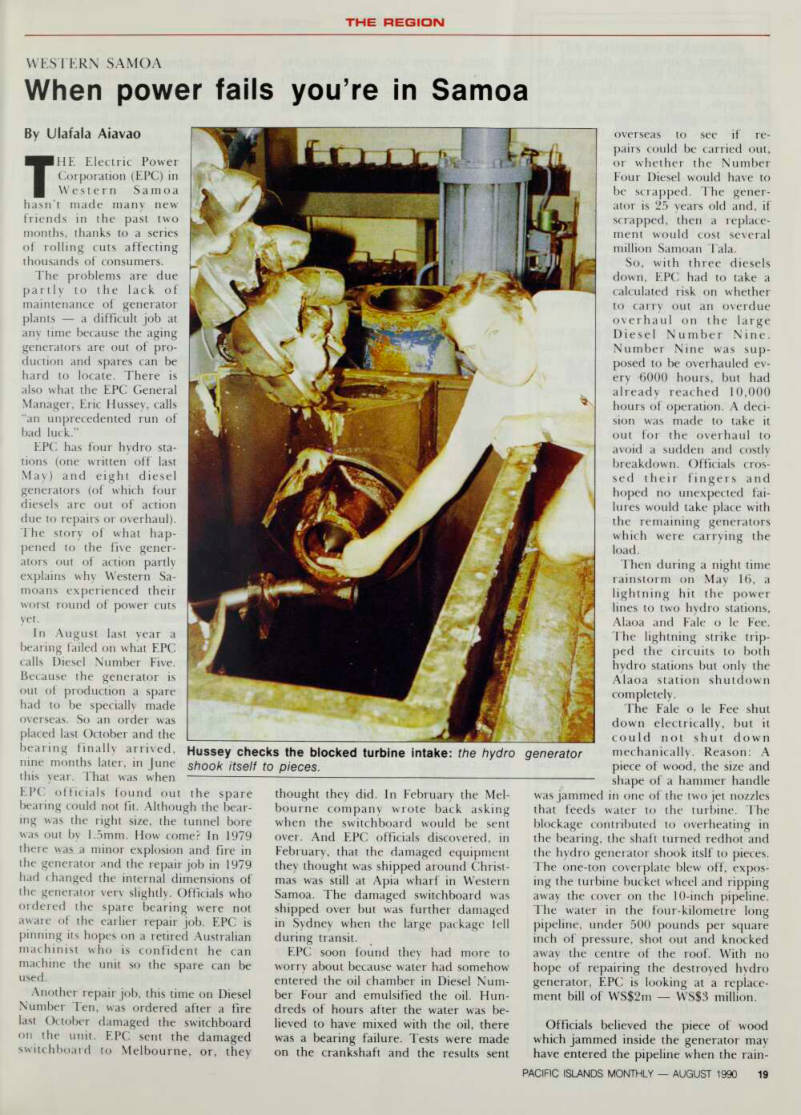
The Fale o le Fee shut down electrically, but it could not shut down mechanically. Reason: A piece of wood, the size and shape of a hammer handle
was jammed in one of the two jet nozzles that feeds water to the turbine. The blockage contributed to overheating in the bearing, the shaft turned redhot and the hydro generator shook itslf to pieces.
The one-ton coverplate blew off, expos ing the turbine bucket wheel and ripping away the cover on the 10-inch pipeline.
The water in the four-kilometre long pipeline, under 500 pounds per square inch of pressure, shot out and knocked away the centre of the roof. With no
hope of repairing the destroyed hydro
generator, EPC is looking at a replace ment bill of WSs2m WS$3 million.
Officials believed the piece of wood which jammed inside the generator may have entered the pipeline when the rain
Hussey checks the blocked turbine intake: the hydro generator shook itself to pieces.
storm swept debris which damaged the intake. (The same rainstorm damaged or blocked all six intakes for the public wa ter supply, leading to a total shutdown of water supplies to the capital Apia last ing just over a day). With the writeoff the Fale o le Fee hydro station, and four diesels out for repair or overhaul, power rationing had to be enforced to meet demand.
Much of the damage to the generators is covered by insurance. The EPC board of directors has approved the purchase of a new 3500 kilowatt generator from England which will cost WS$6 million to install. The board is considering whether to buy a secondhand generator as well as secure a replacement for the destroyed hydro station.
All this will take time, but with a hired generator from New Zealand and repairs to the large Number Nine Diesel due for completion in late July, EPC and con sumers were hoping power rationing would ease by this month.
Last month the cost of electricity to users went up from 28 sene a unit to 32 sene a unit. It is the first increase since the old 28-sene charge was introduced in June 1983. (EPC asked for a bigger in crease, but Cabinet kept it down to 32 sene a unit). Hussey said costs for diesel and other expenses had gone up in the past seven years without a corresponding rise in the tarrif. The costs could have eaten up the corporation’s reserves and left it with no cash in the bank, at a time when it had to recover the cost of pro ducing 40 million units of electricity a year.
Of those 40 million units a year, about 24 million are produced by hydro sta tions if there is a good wet season. The diesel generation is expected to carry more of the load this year as rainfall figures are not promising. Rainfall in the first four months of this year was rough ly half as for the same period last year.
EPC expects about WS$ll million from electricity sales this year. The bill for diesel and lubricants will be about WS|5 million (higher if the wet season later this year is too dry). Other costs are loan repayments of $990,000 this year, which is relatively light. Depreciation amounts to $4.6 million this year. EPC has total assets of $lOO million in gener ator plants, support services and electric
ity networks.
Its expenses went up further when it lost its tax free and duty free status in 1984 and 1985. This affected diesel gen eration especially as all materials includ ing diesel became subject to duty.
Daily power cuts have been in force since May, lasting half the day in diffe
rent areas, affecting the capital Apia,
outlying villages and the international airport. Work has to be re-arranged in many offices which has no standby pow
er units to operate computers, fax machines, telephone switchboards, copiers, printers and other powerdependent equipment. Manufacturing plants were also affected.
The WSLAC insurance company opened its doors at 7.30 am to make the most of their morning before the regular afternoon shutdown in the capital. The Bank of Western Samoa changed its hours to Sam to 2pm. Polynesian Airlines, which handles most flight reservations in Samoa, could not confirm any reservations in the afternoons until the power came back on in the evenings.
Some manufacturers switched to nighttime production while waiting for stand-
by diesel generators from overseas, Among the companies investing in the expensive standby units was the bi weekly newspaper Samoa Observer which was hit several times during
printing,
Otto’s Reef public bar, and other bars, kept candles on hand, The Electric Power Corporation tried to make the cuts practicable by broad casting scheduled cutoff times for each week over national radio. Consumers were also asked to cut down on their use of electricity as much as possible to ease demand. But there were unscheduled breaks during peak periods or when faults occurred. D