United States told: pay islands more attention
pp. 44-45 · Read in the full issue
By David North
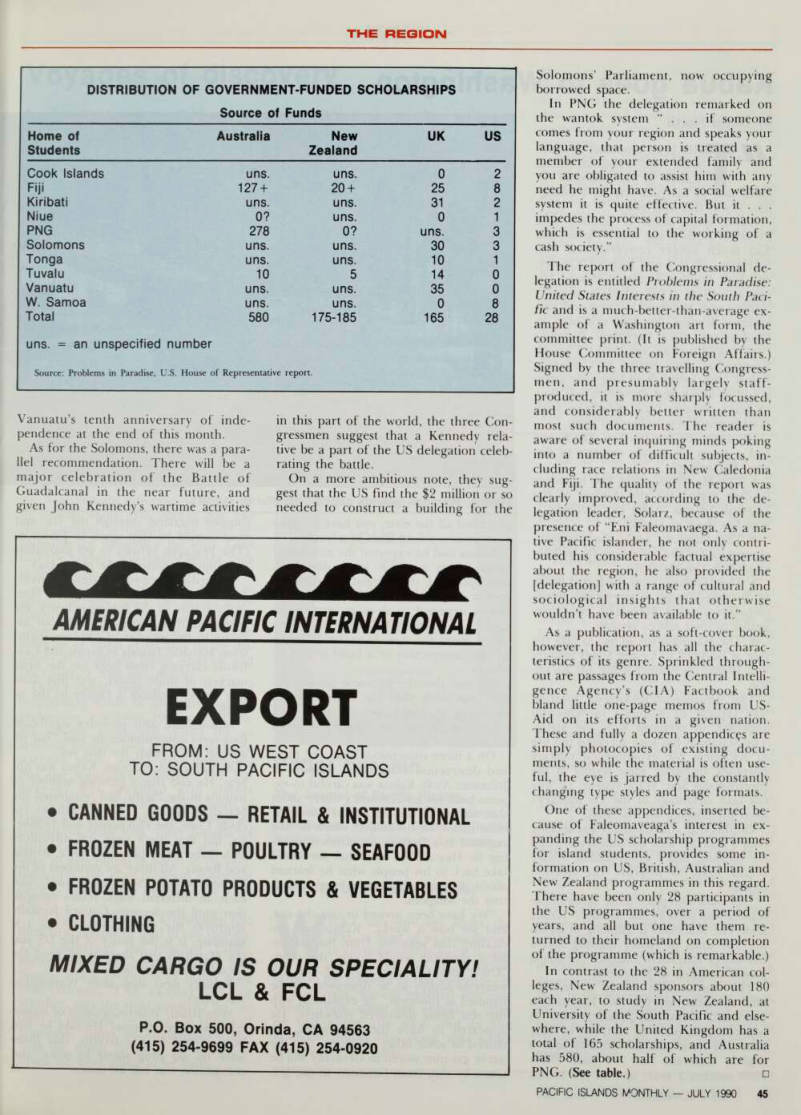
THE United States should pay con siderably more attention to the South Pacific. That was the prin cipal thrust of a report filed by a bi partisan group of members of the Un ited States House of Representatives af ter a hectic tour of seven South Pacific countries, including New Caledonia. The group was led by Congressman Steve Solarz (Democrat, New York) and in cluded Congressman Eni F.H. Faleoma vaega (Democrat, American Samoa) and Robert K. Dornan (Republican, Cali fornia).
They urged the United States to: • continue to provide leadership in the efforts to ban driftnets • ratify the South Pacific Nuclear Free Zone (SPNFZ) Treaty; • increase its diplomatic presence in the area, as well as the number of bi lateral US Agency for International De velopment (AID) missions • create a US$2 million scholarship programme to send South Pacific stu dents to American universities (this is a Faleomavaega proposal which has been
adopted by the US House of Representative but not yet by the Senate)
• participate
in a major way in the forth
coming
celebrations of the 50th anniversaries of World War II battles, such as those in Guadalcanal,
Tarawa and in Papua New Guinea • expand high-level contacts between South Pacific leaders and those of the US (they suggested that US Secretary of States Baker could have broken his long flight from the US to Australia recently with a visit to one or more of the island countries); and to • realign some US diplomatic posts On the latter point, the delegation, noting the awkwardness of air travel be tween Suva and Tarawa, suggested that the current arrangement of having the US ambassador in Fiji accredited to Kiri bati be dropped, and that the task be assigned to the US Ambasasdor in the Marshalls. Further, Western Samoa, the delegation argued, should have a full fledged embassy with a resident ambas sador (rather than the current one-man post) and that ambassador be also
assigned to Tuvalu (now covered from
Fiji).
The recently released report was long in the writing. The three Congressmen had made their trip back in August, last year visiting Kiribati, Fiji, Western Samoa, New Caledonia, Vanuatu, Papua New Guinea and the Solomons. They used a US military plane for the 10-day trip, saying that it would have taken them three to four weeks to cover the same ground if they had used commer cial flights. In addition to their general policy recommendations, they made a number of observations about US poli cies and island conditions.
Regarding aid to the independent na tions of the South Pacific, the delegation wrote “US aid levels are particularly modest. Excluding the $lO million .. . pursuant to the . . . Fisheries Treaty, the United States provided a modest $6.9 million to the region in Fiscal Year 1989.
When this amount is compared to the $154.5 million that we provided to just two of the Freely Associated States [FSM and the Marshalls] it is not hard to understand why US assistance levels are the source of some bitterness in the re
gion.” (see box.) In Kiribati they were im
pressed with
the nation’s strong interest in global warming trends, and heard many criticisms of the lack-lustre performance of the Bush Administration on this score.
They were told that a six-foot increase in the level of the ocean would flood all but two of the nation’s islands.
The delegation recommended that the US provide Kiribati with assistance in
surveillance of foreign-owned fishing
boats in its waters, whose size they com pared with the European landmass; they also suggested that two seaworthy milit ary landing craft be given to the nation for inter-island transportation.
In Fiji they noted the significance to that nation’s budget of the non-payment by the US of $152.7 million to the Un ited Nations for its peace-keeping forces; this has meant that Fiji has not yet re ceived $21.5 million for the operations of the Fiji Army in the Middle East, a major chunk of money from the nation’s budget of $338 million.
In Western Samoa the delegation re-
Comparison of 1989 Assistance Levels in the South Pacific (in millions of US$) Australia (including PNG) 302.8 New Zealand 103.0 Japan 93.1 Australia (excluding PNG) 66.2 World Bank 40.3 US* 17.2 * US total excludes subsidies to US territories and associated states.
Comparable data were not available for France.
Source: Problems in Paradise: US House of Representa tive report.
ported with pleasure the “unabashedly
pro-American sentiments of the lead ership”, but warned that it would be “a mistake for the United States to take Western Samoa for granted”.
It noted both the continuing unhappi ness of Western Samoa, the oldest of the independent nations of the South Paci fic, with the continuing lack of a resident US Ambassador, and various Soviet efforts to woo Western Samoa. The Rus sians have offered “to base an oceanic research ship out of Apia, and have ex
pressed a willingness to provide 100
scholarships for Western Samoan stu dents to Moscow University. Thus far, Western Samoa has not accepted either offer.”
While in New Caledonia the delega tion encountered, and brushed off, a suggestion made by some American ex patriates that the French territory be admitted as America’s 51st state. The de
legation was puzzled by the diametrically
opposite expectations of the Kanaks and the French loyalists regarding the 1998 referendum; each side is convinced that it is sure to win it.
Regarding Vanuatu, the Congressmen wrote: “On no other stop of the trip did [we] . . . find the actual situation on the ground more different from its expecta tions than in Vanuatu. Having heard of Vanuatu’s aggressive commitment to the non-aligned movement, its ties to Libya, and its good relationship with the Soviet Union . . . [we were] surprised by the extreme warmth with which [we were] received and by the obvious desire of the present government to improve relations with the United States.”
The delegation suggested that the State Department open a one-man mis sion in Port Vila, as it has in Honiara and in Apia, and that it send a high-level delegation to the celebration of
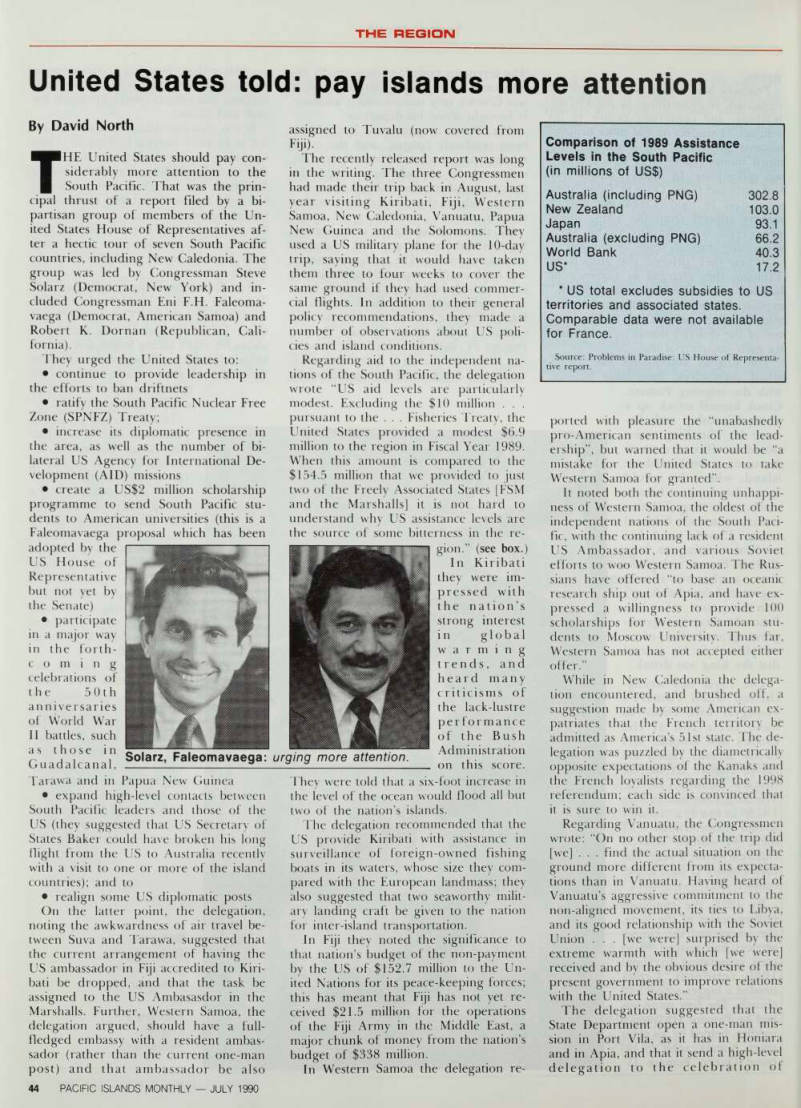
Solarz, Faleomavaega: urging more attention.
Distribution Of Government-Funded Scholarships
Source of Funds
Vanuatu’s tenth anniversary of inde pendence at the end of this month.
As for the Solomons, there was a para llel recommendation. There will be a major celebration of the Battle of Guadalcanal in the near future, and given John Kennedy’s wartime activities
in this part of the world, the three Con gressmen suggest that a Kennedy rela tive be a part of the US delegation celeb rating the battle.
On a more ambitious note, they sug gest that the US find the $2 million or so needed to construct a building for the
Solomons’ Parliament, now occupying borrowed space.
In PNG the delegation remarked on the wantok system “ ... if someone comes from your region and speaks your language, that person is treated as a member of your extended family and you are obligated to assist him with any need he might have. As a social welfare system it is quite effective. But it . . . impedes the process of capital formation, which is essential to the working of a cash society.”
The report of the Congressional de legation is entitled Problems in Paradise: United States Interests in the South Paci fic and is a much-betler-lhan-average ex ample of a Washington art form, the committee print. (It is published by the House Committee on Foreign Affairs.)
Signed by the three travelling Congress
men, and presumably largely staff produced, it is more sharply focussed, and considerably belter written than most such documents. The reader is aware of several inquiring minds poking into a number of difficult subjects, in cluding race relations in New- Caledonia and Fiji. The quality of the report was
clearly improved, according to the de
legation leader, Solarz, because of the presence of “Eni Faleomavaega. As a na tive Pacific islander, he not only contri buted his considerable factual expertise about the region, he also provided the [delegation] with a range of cultural and
sociological insights that otherwise
wouldn’t have been available to it.”
As a publication, as a soft-cover book, however, the report has all the charac teristics of its genre. Sprinkled through out are passages from the Central Intelli gence Agency’s (CIA) Factbook and bland little one-page memos from US- Aid on its efforts in a given nation.
These and fully a dozen appendices are
simply photocopies of existing docu
ments, so while the material is often use ful, the eye is jarred by the constantly changing type styles and page formats.
One of these appendices, inserted be cause of Faleomaveaga’s interest in ex panding the US scholarship programmes for island students, provides some in formation on US, British, Australian and New Zealand programmes in this regard.
There have been only 28 participants in the US programmes, over a period of years, and all but one have them re turned to their homeland on completion of the programme (which is remarkable.) In contrast to the 28 in American col leges, New Zealand sponsors about 180 each year, to study in New Zealand, at University of the South Pacific and else where, while the United Kingdom has a total of 165 scholarships, and Australia has 580, about half of which are for PNG. (See table.) □
rgdfdHome of Students Australia New Zealand UK US Cook Islands uns. uns. 0 2 Fiji 127 + 20 + 25 8 Kiribati uns. uns. 31 2 Niue 0? uns. 0 1
Png
278 0? uns. 3 Solomons uns. uns. 30 3 Tonga uns. uns. 10 1 Tuvalu 10 5 14 0 Vanuatu uns. uns. 35 0 W. Samoa uns. uns. 0 8 Total 580 175-185 165 28 uns. = an unspecified number Source: Problems in Paradise, U.S. House of Representative report.