Kabua goes to Washington
p. 46 · Read in the full issue
By David North
MM HHIS is an economic develop ® ment trip,” President Amata Kabua of the Marshall Is lands said of his June trip to Washing ton. It was that and more.
Kabua spent about 15 minutes with President Bush at the White House, and had much longer conversations with Secretary of Defense Richard Cheney, and with Interior Secretary Manuel Lu jan, as well as a full schedule of other sessions with Mainland business and gov ernment leaders. He had not been in
Washington since President Reagan’s
first inauguration in 1981. Though Reagan has since retired to California, Kabua (now in his third four-year term) is still in office and decided it was time to have face-to-face meetings with
Washington’s new leadership team.
His approach was low-key. But Kabua had a series of specific subjects to dis cuss. For example: • The Marshalls would like to secure landing rights for the Airline of the Marshall Islands (AMI) in California; it now has them in Hawaii. • The Marshalls seeks the necessary clearances for the airline to fly military cargo into the Marshalls. • The Marshalls (and Federated States of Micronesia) seek to extend the about to-be-terminated Mainland education grants to their school systems. • The Marshalls would like to play the role of landlord to United States military
and civilian personnel living on Kwaje
lein.
The housing-on-Kwajelein question
was typical of Kabua’s incremental approach to relations with the States.
The Marshalls has long accepted the use of Kwajelein for experimental military purposes, including some testing of the controversial Star Wars system, so why not take advantage of the US military’s need for housing on that atoll?
On this trip, the Marshalls was seeking both a contract with the military to build the housing, and a multi-million private sector loan to provide the needed
capital.
“We want to replace those aging house trailers now used by the military,” Kabua said. The Marshalls is thinking of build ing 150 units of family housing and a
five-storey apartment complex for single
people assigned to Kwajalein.
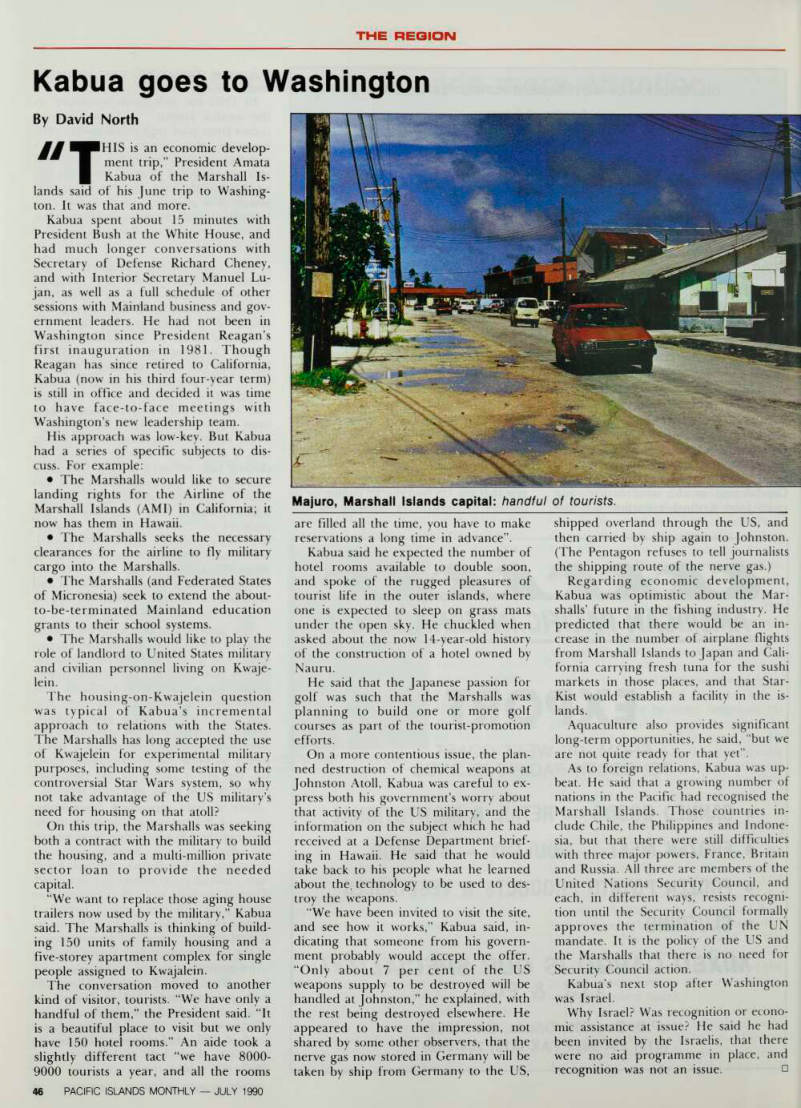
The conversation moved to another kind of visitor, tourists. “We have only a handful of them,” the President said. “It is a beautiful place to visit but we only have 150 hotel rooms.” An aide took a slightly different tact “we have 8000- 9000 tourists a year, and all the rooms
are filled all the time, you have to make reservations a long time in advance”.
Kabua said he expected the number of hotel rooms available to double soon, and spoke of the rugged pleasures of tourist life in the outer islands, where one is expected to sleep on grass mats under the open sky. He chuckled when asked about the now 14-year-old history of the construction of a hotel owned by Nauru.
He said that the Japanese passion for golf was such that the Marshalls was planning to build one or more golf courses as part of the tourist-promotion efforts.
On a more contentious issue, the plan ned destruction of chemical weapons at Johnston Atoll, Kabua was careful to ex press both his government’s worry about that activity of the US military, and the information on the subject which he had received at a Defense Department brief ing in Hawaii. He said that he would take back to his people what he learned about the, technology to be used to des troy the weapons.
“We have been invited to visit the site, and see how it works,” Kabua said, in dicating that someone from his govern ment probably would accept the offer.
“Only about 7 per cent of the US weapons supply to be destroyed will be handled at Johnston,” he explained, with the rest being destroyed elsewhere. He appeared to have the impression, not shared by some other observers, that the nerve gas now stored in Germany will be taken by ship from Germany to the US,
shipped overland through the US, and then carried by ship again to Johnston. (The Pentagon refuses to tell journalists the shipping route of the nerve gas.)
Regarding economic development,
Kabua was optimistic about the Mar shalls’ future in the fishing industry. He predicted that there would be an in crease in the number of airplane flights from Marshall Islands to Japan and Cali fornia carrying fresh tuna for the sushi markets in those places, and that Star- Kist would establish a facility in the is lands.
Aquaculture also provides significant
long-term opportunities, he said, “but we are not quite ready for that yet”.
As to foreign relations, Kabua was up beat. He said that a growing number of nations in the Pacific had recognised the Marshall Islands. Those countries in clude Chile, the Philippines and Indone sia, but that there were still difficulties with three major powers, France, Britain and Russia. All three are members of the United Nations Security Council, and each, in different ways, resists recogni tion until the Security Council formally approves the termination of the UN mandate. It is the policy of the US and the Marshalls that there is no need for Security Council action.
Kabua’s next stop after Washington was Israel.
Why Israel? Was recognition or econo mic assistance at issue? He said he had been invited by the Israelis, that there were no aid programme in place, and recognition was not an issue. □
Majuro, Marshall Islands capital: handful of tourists.