The crazy life of Rev Crook
pp. 42-43 · Read in the full issue
By Karen Mangnall
PAPEETE’S recent centenary celebrations held little to suggest the town’s history had not always been with France. Amidst the legions of French politicians, a lone Australian guest provided a reminder that Papeete started life as an English settlement. And that it was religion, as in many colonies, which altered the destiny of Tahiti, and ultimately the South Pacific.
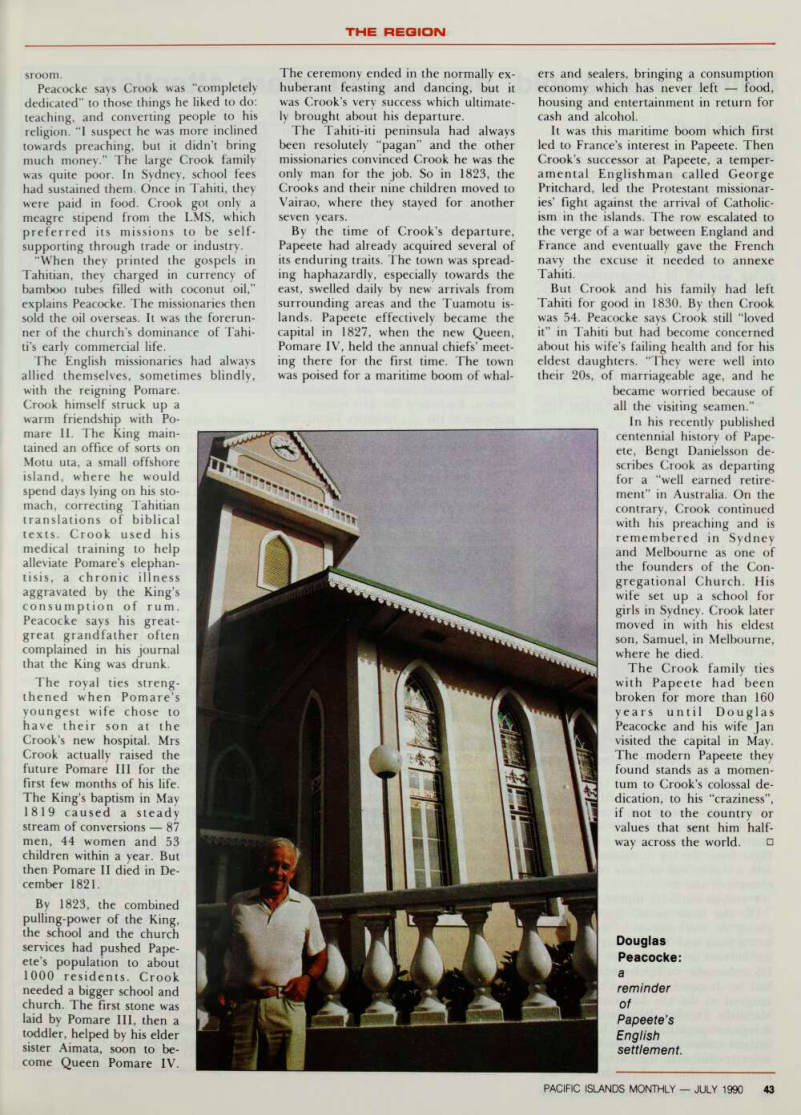
That lone Australian was Douglas Peacocke, the great-great grandson of an English missionary, William Crook, who founded Papeete on April 14, 1818.
Crook was a dissenter who described himself as a Calvinistic Methodist, and who ended up spending 17 years of his life preparing for as many years evange lising in Tahiti.
Today, Douglas Peacocke views his great-great grandfather’s dedication with bemusement. “He was a nut,” he says, shaking his head. “A complete nut. All those sorts of people have got a little bit of craziness in them.” Peacocke, the only
descendant of Papeete’s early settlers who could be traced by the centenary organisers, has spent his five years of retirement researching Crook’s life.
“I always knew of him,” Peacocke says.
“There were some most astounding tales told by the family, true or otherwise, ab out his experiences.” In the end, Peacocke says his researches proved these stories were either “completely false” or had understated the truth.
Crook had first gone to Tahiti in 1797 on a London Missionary Society ship, the HMS Duff, with 19 other missionaries.
The young Englishman spent two years alone in the Marquesas without convert ing a soul. Undaunted, he set out again from London two years later. But when Crook and his new wife arrived in Syd ney in 1803, they discovered Tahiti had plunged into a series of bloody wars be tween the new King, Pomare 11, and other chiefs.
“Samuel Marsden was the LMS rep in Sydney at the time,” says Peacocke. “It was on his advice that Crook didn’t go immediately to Tahiti.” In fact the wait
lasted 13 years. Crook and his wife set up a school in Sydney and preached to convicts and remittance men while their
missionary colleagues one by one fled
Tahiti.
By 1816, Pomare II had reconquered Tahiti and in that year Crook, his wife and seven children moved to the island of Moorea, where four remaining mis sionaries had taken refuge since 1808 with a temporarily defeated Pomare 11.
During his years of waiting, Crook had apprenticed himself to a leading surgeon and a Sydney printer. His two years of training in each discipline were to prove invaluable.
The Moorea mission had a printing press and Crook, with his gift for lan
guages, helped produce hymnals in
Tahitian. In 1818, he moved his family across the channel to a scrubby, swampy uninhabited plain. Crook named it Wilks Harbour, after an LMS luminary. He built a villa back in the hills to escape the humidity and mosquitoes much as wealthy residents do today. On the fore shore he built a church and school at Paofai, now downtown Papeete. Crook preached in Tahitian on Sundays and for the rest of the week joined his wife and two eldest daughters in the clas
sroom.
Peacocke says Crook was “completely dedicated” to those things he liked to do: teaching, and converting people to his religion. “I suspect he was more inclined towards preaching, but it didn’t bring much money.” The large Crook family was quite poor. In Sydney, school fees had sustained them. Once in Tahiti, they were paid in food. Crook got only a meagre stipend from the LMS, which preferred its missions to be self
supporting through trade or industry.
“When they printed the gospels in
Tahitian, they charged in currency of bamboo tubes filled with coconut oil,” explains Peacocke. The missionaries then sold the oil overseas. It was the forerun ner of the church’s dominance of Tahi ti’s early commercial life.
The English missionaries had always allied themselves, sometimes blindly,
with the reigning Pomare.
Crook himself struck up a warm friendship with Po mare 11. The King main tained an office of sorts on Motu uta, a small offshore island, where he would
spend days lying on his sto
mach, correcting Tahitian translations of biblical texts. Crook used his
medical training to help
alleviate Pomare’s elephan tisis, a chronic illness
aggravated by the King’s
consumption of rum.
Peacocke says his great great grandfather often
complained in his journal
that the King was drunk.
The royal ties streng thened when Pomare’s youngest wife chose to have their son at the Crook’s new hospital. Mrs Crook actually raised the future Pomare 111 for the first few months of his life.
The King’s baptism in May 1819 caused a steady stream of conversions 87 men, 44 women and 53 children within a year. But then Pomare II died in De cember 1821.
By 1823, the combined
pulling-power of the King,
the school and the church
services had pushed Pape
ete’s population to about 1000 residents. Crook needed a bigger school and church. The first stone was laid by Pomare 111, then a toddler, helped by his elder sister Aimata, soon to be come Queen Pomare IV.
The ceremony ended in the normally ex huberant feasting and dancing, but it was Crook’s very success which ultimate
ly brought about his departure.
The Tahiti-iti peninsula had always been resolutely “pagan” and the other missionaries convinced Crook he was the only man for the job. So in 1823, the Crooks and their nine children moved to Vairao, where they stayed for another seven years.
By the time of Crook’s departure, Papeete had already acquired several of its enduring traits. The town was spread
ing haphazardly, especially towards the
east, swelled daily by new arrivals from surrounding areas and the Tuamotu is lands. Papeete effectively became the capital in 1827, when the new Queen, Pomare IV, held the annual chiefs’ meet ing there for the first time. The town was poised for a maritime boom of whal-
ers and sealers, bringing a consumption economy which has never left food, housing and entertainment in return for cash and alcohol.
It was this maritime boom which first led to France’s interest in Papeete. Then Crook’s successor at Papeete, a temper
amental Englishman called George
Pritchard, led the Protestant missionar ies’ fight against the arrival of Catholic ism in the islands. The row escalated to the verge of a war between England and France and eventually gave the French navy the excuse it needed to annexe Tahiti.
But Crook and his family had left Tahiti for good in 1830. By then Crook was 54. Peacocke says Crook still “loved it” in Tahiti but had become concerned about his wife’s failing health and for his eldest daughters. “They were well into their 20s, of marriageable age, and he
became worried because of all the visiting seamen.”
In his recently published
centennial history of Pape
ete, Bengt Danielsson de scribes Crook as departing for a “well earned retire ment” in Australia. On the contrary, Crook continued with his preaching and is remembered in Sydney and Melbourne as one of the founders of the Con gregational Church. His wife set up a school for girls in Sydney. Crook later moved in with his eldest son, Samuel, in Melbourne, where he died.
The Crook family ties with Papeete had been broken for more than 160 years until Douglas Peacocke and his wife Jan visited the capital in May.
The modern Papeete they
found stands as a momen tum to Crook’s colossal de dication, to his “craziness”, if not to the country or values that sent him half way across the world. □
Douglas Peacocke: a reminder of Papeete's English settlement.