Small hoist, big help
pp. 40-41 · Read in the full issue
ON the remote Vanuatu island of Futuna, life has become easier.
Last March two New Zealand Army officers stayed on the island and built a small hoist, ending hours of
dangerous and backbreaking work.
Futuna, meaning “rock all around”, is an extinct volcano 11 square kilometres big. It stretches itself upwards from black rocky shores to a flat plateau reaching 666 metres into the often raindrenched South Pacific sky. There are only 400 people living on the island and they are distinctly different from their Ni-Vanuatu countrymen. The Futunese trace their ancestry more from Polynesian sources rather than Melanesian.
The language is similar to Maori which helps make a New Zealander feel at home on this lush green volcanic conservatory even though it is one of the most isolated islands in the entire Pacific Ocean. For three weeks in March, Lieutenant Greg Wilson, of Dunedin,
and Sergeant Geoff Downes, of Gis borne, lived on the island. Their task was to construct a hoist for Itavai village, one of six on Futuna, The tiny settlement is perched on a hillside terrace. There are no roads on Futuna. Itavai’s only access by foot is a steep and winding goat track which cir cles the island. This track is about three kilometres as the crow flies from the is land’s only airstrip. Travellers have to make their way around wave-beaten cliff faces, short stretches of coral and sand beaches and steep rock climbs.
Itavai is located near a sheer seaside cliff top. At the deep water inlet below, island boats call in good weather. At the site of the New Zealand built hoist is an old pulley extended on a corroding met al arm with which the villagers transfer red goods up and down. This old machine was barely trustworthy and not
capable of carrying heavy loads.
Placed 30 metres up a cliff, the hoist
now enables the villagers to transport loads to and from the ship with only a five-minute walk from their settlement.
The hoist will be important to every islander and to many other Futunese who have now left their home and are living and working on the other islands of Vanuatu.
Many islanders still live in woven thatched huts like their ancestors. Hav ing the hoist now means that building materials, such as timber, concrete and corrugated iron, can be easily brought onto the Itavai region of the island. The hoist will enable the transport of 150 kg loads compared to 50kg with the pulley-arm.
Dragging materials off the boats was
dangerous. When the pulley-arm
couldn’t be used, the men carried the loads on their backs up a steep cliff-side track or around the coast from Mission Bay where the airstrip is located. “To get the materials, such as concrete, lengths of timber and iron, from there to the other sites, is a mammoth task,” said Wilson Three countries were involved in the aid project. A British Army officer first conducted the reconnaissance and de signed the hoist which, because of time restrictions, was left with the Vanuatu Mobile Force’s (VMF) engineering pla
toon. This small group is currently headed by New Zealanders Captain Paul
King and Staff Sergeant Red Mackay
who are on secondment to the VMF.
Engineer platoon commander, Captain
King, couldn’t spare the time to com plete the task, but considered it a worth while project for New Zealand aid. The materials and most of the costs were funded by Australia while New Zealand provided the manpower and expertise.
Wilson and Downes arrived in Port Vila in early March and assembled the
equipment required to complete the job.
These materials had to be transported by ship to the island. The two flew to Futu na on a small island-hopping aircraft operated by Air Vanuatu. They con structed the new hoist and trained the islanders how to use the machine prop
erly.
Assistance during the project was pro vided by a former Futunese villager now a soldier in the VMF engineer platoon.
Affectionately nick-named ‘Rambo’, Ramoia Lishi, recently completed one year’s training at the New Zealand Army
School of Military Engineering. A simple
engineering project such as the Futuna hoist may not seem so significant to many, but to the islanders of Futuna and to officials of the Vanuatu Government, it means a lot.
Life is simple for most Ni-Vanuatu.
The only consumables Futunese ever consider buying are soap for washing and kerosene for lighting lamps. Mater
ially, they require little else.
Food is provided by cultivated gardens
and taro, watermelon, and other root crops grown on the island’s plateau and slopes. Fruits such as bananas and coco nuts are plentiful all year round. Much of the harvests are sent to friends and relatives who have emigrated to other islands within Vanuatu’s vast archipela go. Futunese are seafaring people and often fish from canoes. Pigs and chick ens are the other sources of meat.
A little money can be made from gathering copra which is sent to Port Vila, the capital of Vanuatu. However, all spare money is channelled into the church. The villagers of Itavai are im mensely proud of their limestone and timber church located in the neighbour
ing village of Marae.
Itavai Chief, Natuoivi Yapai, was hap py with the hoist. He explained that the old metal pulley-arm was built in Decem ber 1977, and before that, manpower was the only source of transport. There is still no electricity or plumbing on the island, but a reticulation system provides fresh clean water to villages all over the island. □
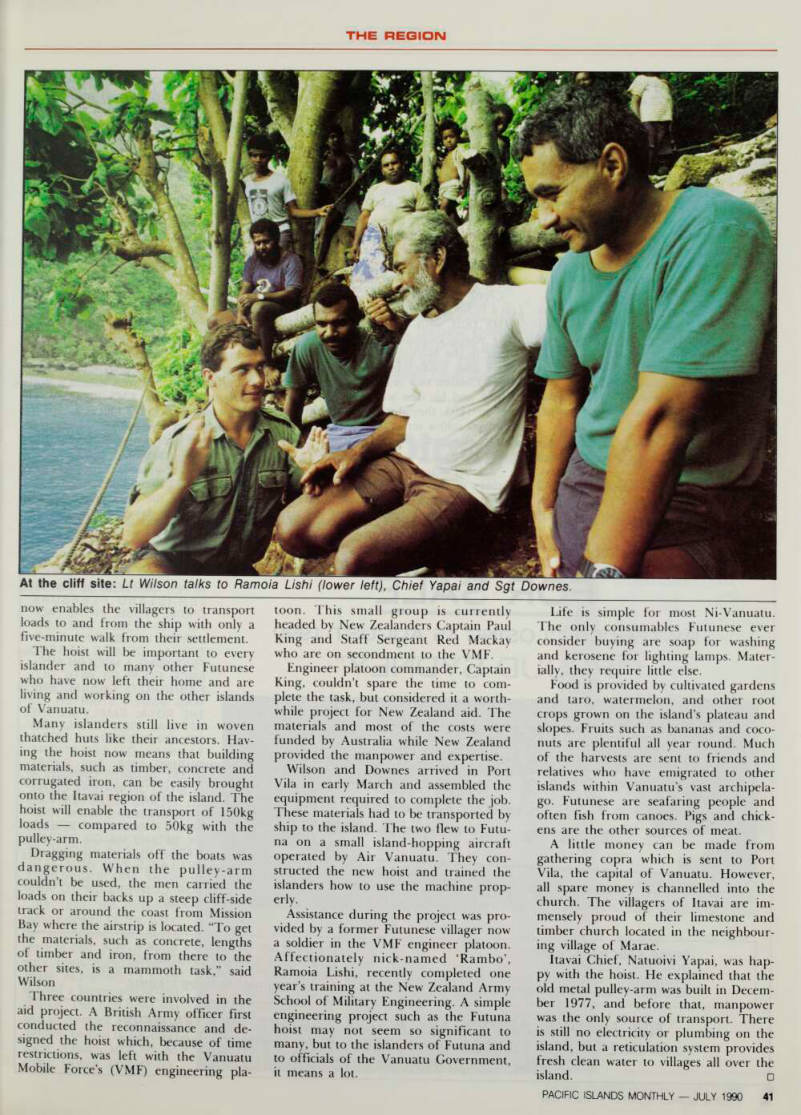
At the cliff site: Lt Wilson talks to Ramoia Lishi (lower left), Chief Yapai and Sgt Downes.