Matangi Tonga
pp. 39-40 · Read in the full issue
The Region
Tonga
Passport case troubles the elite
By David Robbie
CRUSADING Tongan editor and Member of Parliament Samuela ’Akilisi Pohiva has won yet another court battle, but he faces mounting pressure to silence him in his quest for open government and public accounta bility.
A recent controversy over bizarre claims of a coup threat in the Pacific kingdom diverted attention from the real story — a crisis facing the monar chy-dominated cabinet over a lawsuit alleging a huge passport scam.
The case involves accusations of breach of trust, unconstitutional and illegal practices in the controversial sale of Tongan passports to foreigners, main
ly Asians.
Backers of the lawsuit, led by Pohiva, allege several million pa’anga could be missing from the public coffers.
“The passport case will change the his tory of Tonga — for better or for worse,” says Auckland-based barrister Nalesoni Tupou, but he is confident the result will eventually lead to open gov ernment.
Already, he says, the government is stalling. The case was filled in the Sup reme Court last August and was amended in October.
Pohiva seeks a court order declaring ownership of the passport payments, re quiring an account of the payments to the Legislative Assembly, a declaration that granting of naturalisation letters to
foreigners are illegal, and an injunction
preventing sale of further passports.
When lawyers, for Finance Minister Cecil Cocker and Police Minister ’Akau’ola — who are named in the law suit along with the Kingdom of Tonga — tried to have the case struck out an appeal hearing was set for the Privy Council. Then the sitting judge, New Zealand Chief Justice, Sir Clinton Roper, upheld a plea by Tupou to have Cocker and Akau’ola barred from sitting on the
council hearing. King Taufa’ahau Tupou
IV was also asked to vacate his seat as council chairman.
Tupou successfully argued that the council — “rather like King Arthur and his men” — could not be the judges while also being defendants. Govern ment lawyer Clive Edwards succeeded in having the case referred to the newly created Appeal Court, which will include several judges from Pacific nations on the bench, because of the constitutional implications of the Privy Council meet
ing without the King. However, although
the court is supposed to be constituted in
July, no budget has been allocated so far this year.
Pressure to block the reforms sought by Pohiva have been mounting in recent
months, including an alleged conspiracy
to discredit the MP and force him out of
the Legislative Assembly.
A legal attempt to prevent Pohiva tak ing his seat in Parliament when the new session opened at the end of May found ered when Chief Justice Geoffrey Martin ruled in his favour on an electoral peti tion. Pohiva, who won a landslide victory in the February general election, was ac cused by a conservative rival of bribery, corrupt and illegal practices, and thre
atening voters during the campaign.
The bribery allegation involved a gift
of almost 20,000 pa’anga during the past three years from his MP’s salary and allowances to an overseas scholarship fund for Tongan students. Pohiva has
campaigned vigorously against excessive
payments to MPs.
Rejecting the
accusation, the Chief Justice said that what ever Pohiva had done in the circumst ances would have laid him open to being accused of
bribery.
“If (as occur red) he re turned the money, he
could be accused of bribery,” said the Chief Justice. “If he kept the money he could be accused of incon
sistency or even dishonesty, by keeping
the benefit of the payments about which
he had previously complained.
“What he did was consistent with his previous public stance, and it is difficult to see what else he could have done if he were to retain his credibility.”
The Chief Justice was also scathing in his judgment about the testimony of the chief prosecution witness, Sione Tu’i Moala, who claimed to have attended three of Pohiva’s campaign meetings.
“1 find the whole of [Moala’s] evidence [about the meetings] has been invented.
Whenever he was asked a question out side his prepared script he had to guess, and in these three instances at least his guess was wrong,” said Judge Martin.
“There must therefore be considerable doubt about the remainder of his evi dence. As evidence to support the peti tioner’s case the only possible course is to
ignore it altogether.
“But his evidence has another effect.
It affects the credibility of the whole of the petitioner’s case. His stories tie in
very closely with the petitioner’s allega
tions . . . The inescapable conclusion is that someone has put these stories into his head and persuaded him to repeat them in court.”
A defamation case filed against Pohiva by nobelman Fusitu’a has been ad journed indefinitely. The writ was filed after the MP, his wife ’Eseta, director of education Paula Bloomfield and lands and survey chief superintendent Sione
Tongilava.
Tonga approaches next century with a constitution written in 1875 by a Wes
leyan missionary, Shirley Baker. Under
this constitution, Tonga’s 30-seat Parlia-
Matangi Tonga
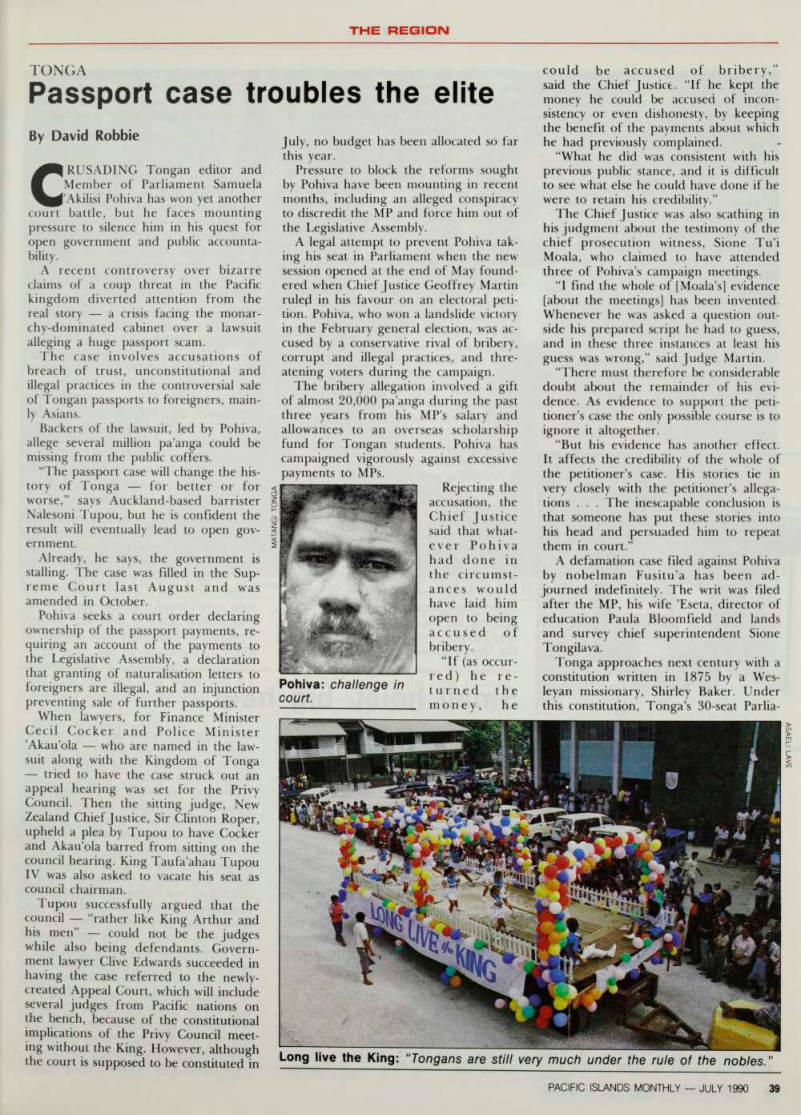
Pohiva: challenge in court.
Long live the King: “Tongans are still very much under the rule of the nobles.”
ment has 10 cabinet members plus two governors appointed by the King, nine members voted for by the 33 nobles, and nine members elected by the country’s 100,000 “commoners”.
Although all basic freedoms are consti tutionally guaranteed a heritage of
reformist King George Tupou I they
are hampered by feudal aspects of the traditional system. There is no provision
for political parties.
“In our constitution Tongans have many freedoms,” said one Tongan wri ter, “but the reality is that Tongans are still very much under the rule of the nobles.” Pohiva, co-editor of the crusad ing newsletter Kele’a (conch shell), has been campaigning to change this ever since he was first elected to Parliament in 1987.
He and his reformers contested the February election portrayed as an official opposition and they easily won six out of the nine commoner seats. Their vic tory was seen as a triumph for a new wave of idealistic politicians campaigning
on issues rather than on status and tradi tional lines.
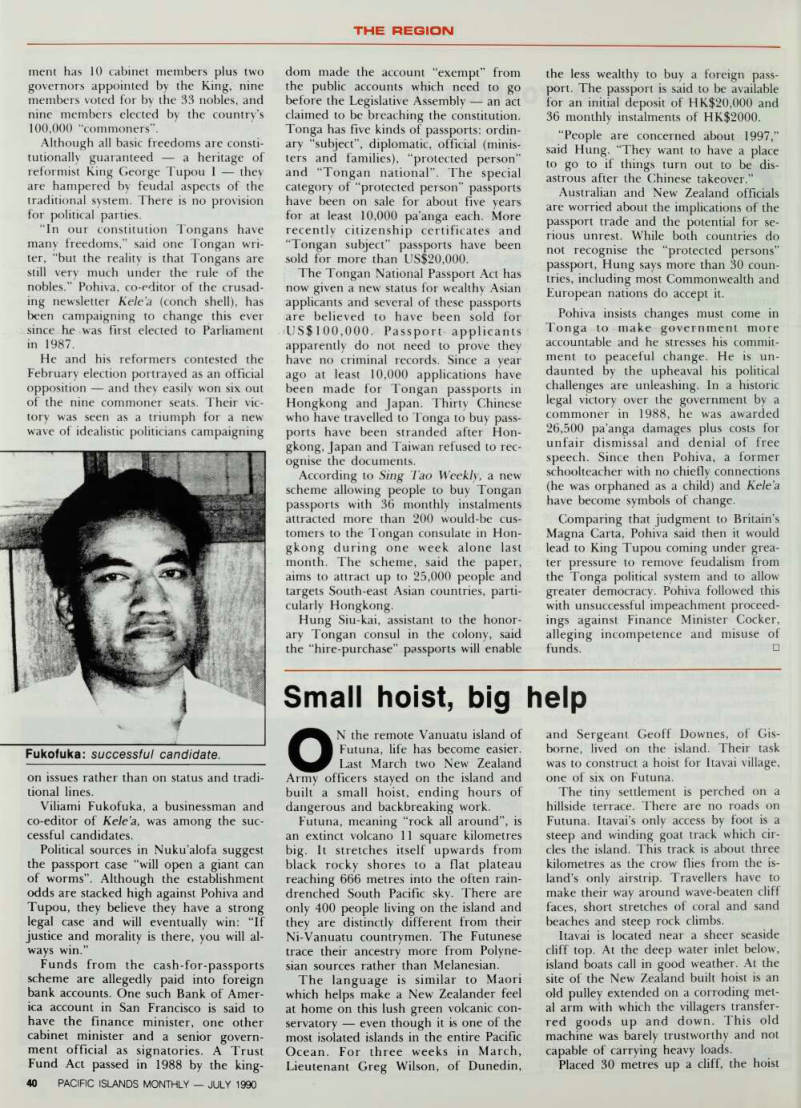
Viliami Fukofuka, a businessman and co-editor of Kele’a, was among the suc cessful candidates.
Political sources in Nukualofa suggest the passport case “will open a giant can of worms”. Although the establishment odds are stacked high against Pohiva and Tupou, they believe they have a strong legal case and will eventually win: “If justice and morality is there, you will al ways win.”
Funds from the cash-for-passports
scheme are allegedly paid into foreign
bank accounts. One such Bank of Amer ica account in San Francisco is said to have the finance minister, one other cabinet minister and a senior govern ment official as signatories. A Trust Fund Act passed in 1988 by the king
dom made the account “exempt” from the public accounts which need to go before the Legislative Assembly an act claimed to be breaching the constitution.
Tonga has five kinds of passports: ordin-
ary subject , diplomatic, official (minis-
ters and families), protected person
and Tongan national . The special
category of protected person passports have been on sale for about five years for at east 10,000 paanga each. More
recently citizenship certificates and
Tongan subject passports have been sold formcrc than US$2O,OOO. he Tongan National Passport Act has now given a new status for wealthy Asian applicants and several or these passports are believed to have been sold for US$lOO,OOO. Passport applicants apparently do not need to prove they have no criminal records. Since a year ago at least 10,000 applications have been made for Tongan passports in Hongkong and Japan. Thirty Chinese who have travelled to Tonga to buy passports have been stranded after Hongkong, Japan and Taiwan refused to recognise the documents.
According to Sing Tao Weekly, a new
scheme allowing people to buy Tongan
passports with 36 monthly instalments attracted more than 200 would-be customers to the Tongan consulate in Hongkong during one week alone last month. The scheme, said the paper, aims to attract up to 25,000 people and targets South-east Asian countries, parti-
cularly Hongkong.
Hung Siu-kai, assistant to the honorary Tongan consul in the colony, said the “hire-purchase” passports will enable
the less wealthy to buy a foreign pass port. The passport is said to be available for an initial deposit of HK$2O,OOO and 36 monthly instalments of HK$2OOO.
“People are concerned about 1997,” said H “ They want t 0 have a place t 0 to if things turn out to be ' dls . astrous after the chinese takeover Australian and New Zealand officials are worried abou( the imp i ications of the t trade and the potemia for se . rious unrest while bo [ h coumries do not recognise the .. protect ed persons” passport, Hung says r ' m)re than £ 0 coun . tries, including most Commonwealth and European nations do accept it Pohiva insists changes must come in Tonga to make government more accountable and he stresses his commit ment to peaceful change. He is un
daunted by the upheaval his political
challenges are unleashing. In a histone le g al victory over the government by a commoner in 1988, he was awarded 26 ’ 500 pa’anga damages plus costs for unfair dismissal and denial of free speech. Since then Pohiva, a former schoolteacher with no chiefly connections (^ e was orphaned as a child) and Kelea have become symbols of change, Comparing that judgment to Britain’s Magna Carta, Pohiva said then it would lead to King Tupou coming under grea ter pressure to remove feudalism from the Tonga political system and to allow greater democracy. Pohiva followed this
with unsuccessful impeachment proceed
ings against Finance Minister Cocker, alleging incompetence and misuse of funds. □
Fukofuka: successful candidate.