Interview
pp. 51-53 · Read in the full issue
Pacific People
Gickmai Kundun: contemporary artist
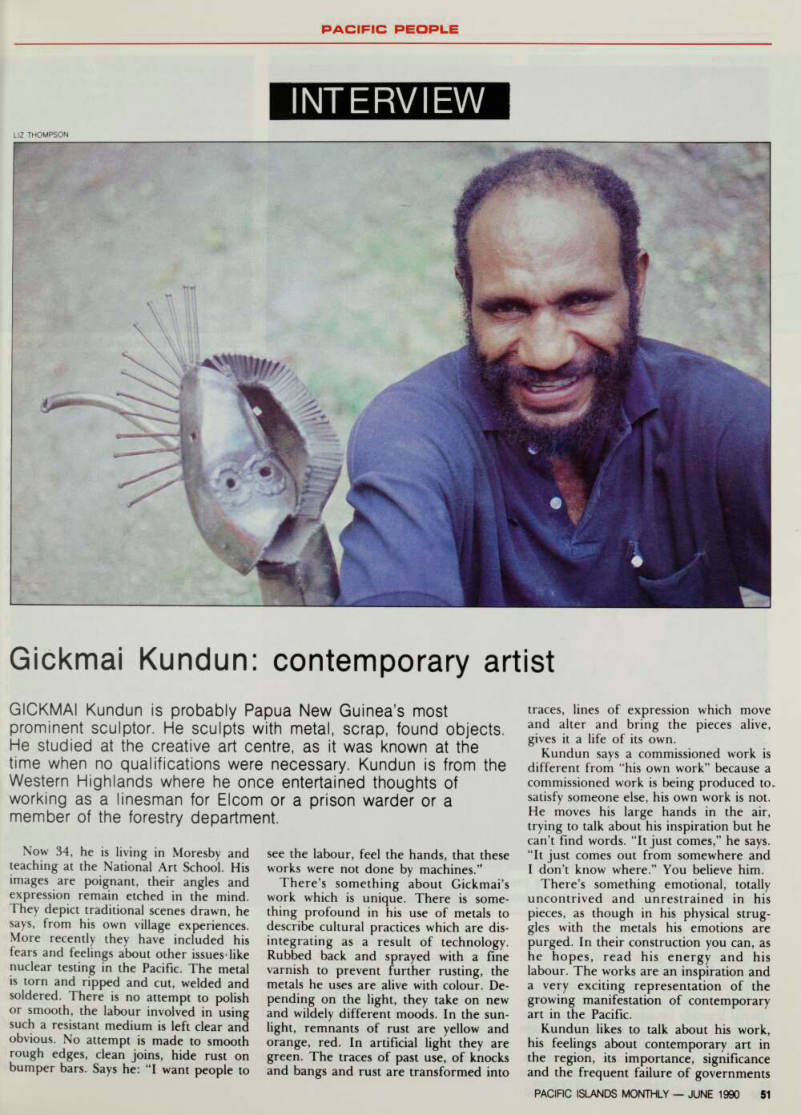
GICKMAI Kundun is probably Papua New Guinea’s most prominent sculptor. He sculpts with metal, scrap, found objects.
He studied at the creative art centre, as it was known at the time when no qualifications were necessary. Kundun is from the Western Highlands where he once entertained thoughts of working as a linesman for Bloom or a prison warder or a member of the forestry department.
Now 34, he is living in Moresby and teaching at the National Art School. His
images are poignant, their angles and
expression remain etched in the mind.
They depict traditional scenes drawn, he says, from his own village experiences.
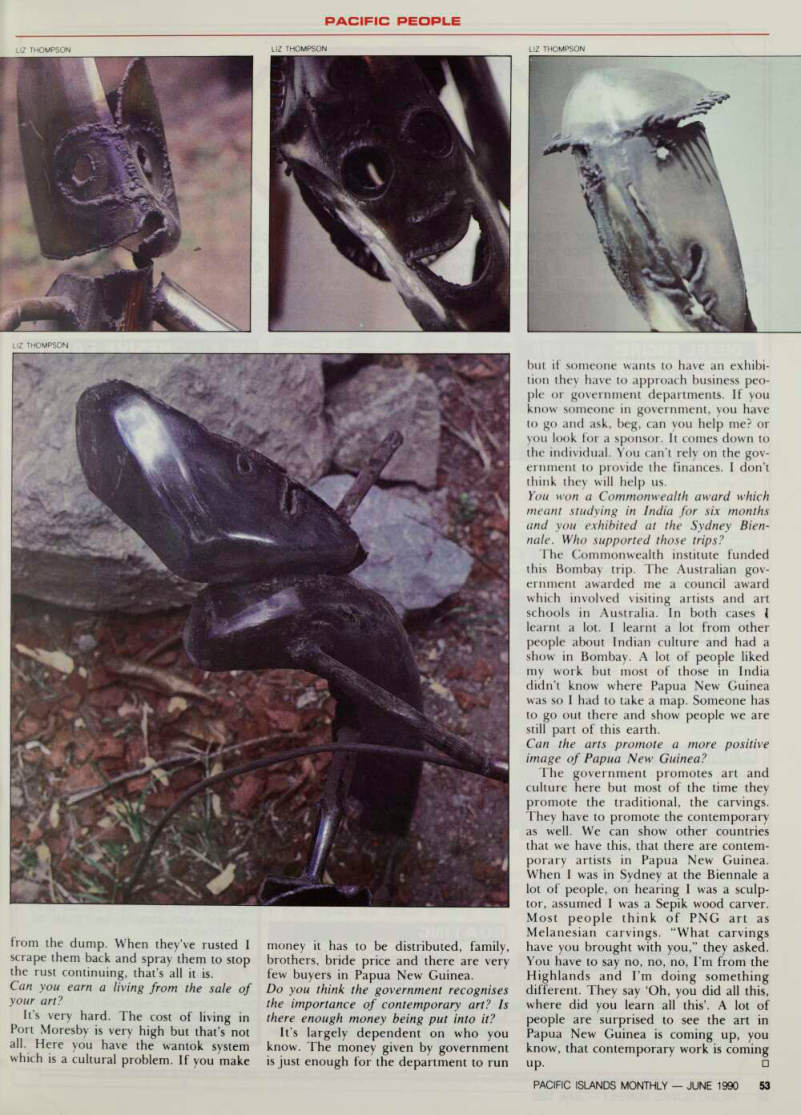
More recently they have included his fears and feelings about other issues* like nuclear testing in the Pacific. The metal is torn and ripped and cut, welded and soldered. There is no attempt to polish or smooth, the labour involved in using such a resistant medium is left clear and obvious. No attempt is made to smooth rough edges, clean joins, hide rust on bumper bars. Says he: “I want people to
see the labour, feel the hands, that these works were not done by machines.”
There’s something about Gickmai’s work which is unique. There is some thing profound in his use of metals to describe cultural practices which are dis integrating as a result of technology.
Rubbed back and sprayed with a fine varnish to prevent further rusting, the metals he uses are alive with colour. De pending on the light, they take on new and wildely different moods. In the sun light, remnants of rust are yellow and orange, red. In artificial light they are green. The traces of past use, of knocks and bangs and rust are transformed into
traces, lines of expression which move and alter and bring the pieces alive, gives it a life of its own.
Kundun says a commissioned work is different from “his own work” because a commissioned work is being produced to satisfy someone else, his own work is not.
He moves his large hands in the air, trying to talk about his inspiration but he can’t find words. “It just comes,” he says.
“It just comes out from somewhere and I don’t know where.” You believe him.
There’s something emotional, totally
uncontrived and unrestrained in his pieces, as though in his physical strug gles with the metals his emotions are purged. In their construction you can, as he hopes, read his energy and his labour. The works are an inspiration and a very exciting representation of the growing manifestation of contemporary art in the Pacific.
Kundun likes to talk about his work, his feelings about contemporary art in
the region, its importance, significance
and the frequent failure of governments
Liz Thompson
to recognise and adequately support the arts. He spoke to Pacific Island Month ly’s Liz Thompson: What serves as your subject matter?
Normally my work is based on tradi tional legends because I grew up in the village. I have grown up in the village and seen all these things and now they
are dying out, sing sings, celebrations.
The everyday life that I have been
through is what influences me. I really enjoy it you know, if there is a sing sing and I get into my traditional costume and participate. When I was a kid I’d go out into the bush and hunt for birds and insects, we’d find fruits. But now when I go out to my village there is a big highl way cutting across it and you hear noise, pollution, all these things. The place has changed, roofing irons, cars, vehicles.
People are drinking beer out there at a big club, when I was a kid there was no beer, no clubs, nothing. People are going after money, a lot of people are losing the culture that we have. I think I was lucky to see it.
As I moved into the city I could see the influence of the Americans, Austra lians, French, the powerful nations, we are too small. We try to say this is where we live, it is our environment. Ther are people out there, but they throw their nuclear rubbish, they test their nuclear bombs, so that is what I’m trying to do . . . let them know there are people living on that small island.
Are there other issues in the Pacific re gion which concern you?
Not really. I think about politics and equal rights for women but they haven’t really appeared in my work as yet. Most of the time it’s the tradition and the cul ture that I work on because I’m sad to see it dying out.
There is a new art emerging. How im portant is that to Papua New Guinea society as a whole.
For Papua New Guinea, for me, it’s very important. If I have my culture, it’s a support, if I don’t have that I don’t have any backing up. Things are chang ing. Modern civilisation is bringing in the power and the steel, when things are changing so fast it’s very important to retain an idea and understanding of your culture. People, artists, must have this tradition and culture backing us up, otherwise we are nowhere.
Do you have clear pictures of what you’re going to do before you start work or does it just evolve?
No, I don’t have a maquette, I don’t have drawing, it just comes to me when I work. I cut bits and pieces of metal and put them together and so on. It’s the heart you know, not the mind.
You have in your work, some clean cuts, some ripped metal with no attempt to smooth it over . . . those textures created through welding are very expressive tex tures. How do you achieve that and are they also part of how you’re feeling ab out the work?
It’s all part of it. I don’t like polishing my work, varnishing it or making it shine. I want to leave the texture and colour, it’s natural. Someone has been putting a lot of time in and people have to see that. Welding, cutting and if you polish it or paint it that doesn’t show, it looks like it’s been produced by a machine. A lot of people say I should paint my work or sand blast it but I want to leave some mark on it, so people can see, see that someone has been working on it, it’s made by my hands.
How do you produce those wonderful variations of colour?
The rusty colours are there already. I collect all the bumper bars and metals
Liz Thompson
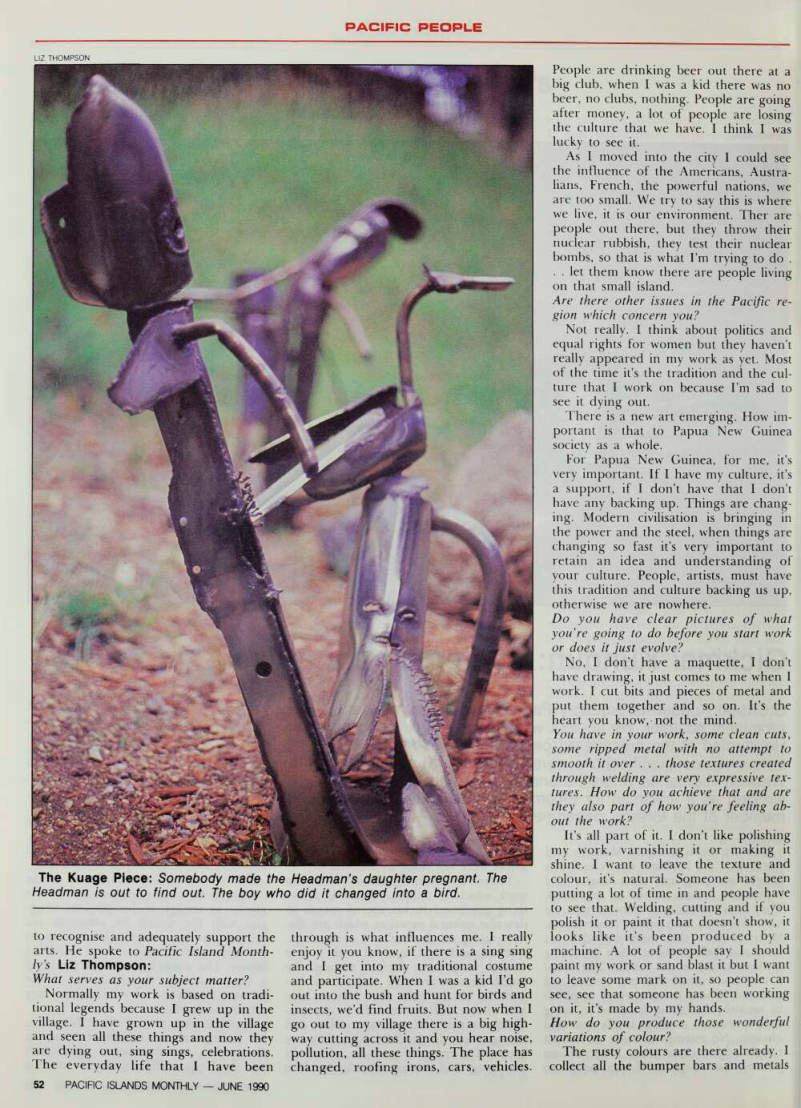
The Kuage Piece: Somebody made the Headman’s daughter pregnant. The Headman is out to find out. The boy who did it changed into a bird.
from the dump. When they’ve rusted I scrape them back and spray them to stop the rust continuing, that’s all it is.
Can you earn a living from the sale of your art?
It’s very hard. The cost of living in Port Moresby is very high but that’s not all. Here you have the wantok system which is a cultural problem. If you make
money it has to be distributed, family, brothers, bride price and there are very few buyers in Papua New Guinea.
Do you think the government recognises the importance of contemporary art? Is there enough money being put into it?
It’s largely dependent on who you know. The money given by government is just enough for the department to run
but if someone wants to have an exhibi tion they have to approach business peo ple or government departments. If you know someone in government, you have to go and ask, beg, can you help me? or you look for a sponsor. It comes down to the individual. You can’t rely on the gov ernment to provide the finances. I don’t think they will help us.
You won a Commonwealth award which meant studying in India for six months and you exhibited at the Sydney Bien nale. Who supported those trips?
The Commonwealth institute funded this Bombay trip. The Australian gov ernment awarded me a council award which involved visiting artists and art schools in Australia. In both cases I learnt a lot. I learnt a lot from other people about Indian culture and had a show in Bombay. A lot of people liked my work but most of those in India didn’t know where Papua New Guinea was so I had to take a map. Someone has to go out there and show people we are still part of this earth.
Can the arts promote a more positive image of Papua New Guinea?
The government promotes art and culture here but most of the time they promote the traditional, the carvings.
They have to promote the contemporary as well. We can show other countries that we have this, that there are contem porary artists in Papua New Guinea.
When I was in Sydney at the Biennale a lot of people, on hearing I was a sculp tor, assumed I was a Sepik wood carver.
Most people think of PNG art as
Melanesian carvings. “What carvings
have you brought with you,” they asked.
You have to say no, no, no, I’m from the Highlands and I’m doing something different. They say ‘Oh, you did all this, where did you learn all this’. A lot of people are surprised to see the art in Papua New Guinea is coming up, you know, that contemporary work is coming up. □