The surrender of the tuna packers
p. 50 · Read in the full issue
Environment
By David North
BECAUSE of America’s love affair with dolphins, more tuna boats will work the Western Pacific, and island governments will receive higher fees under the United States tuna treaty.
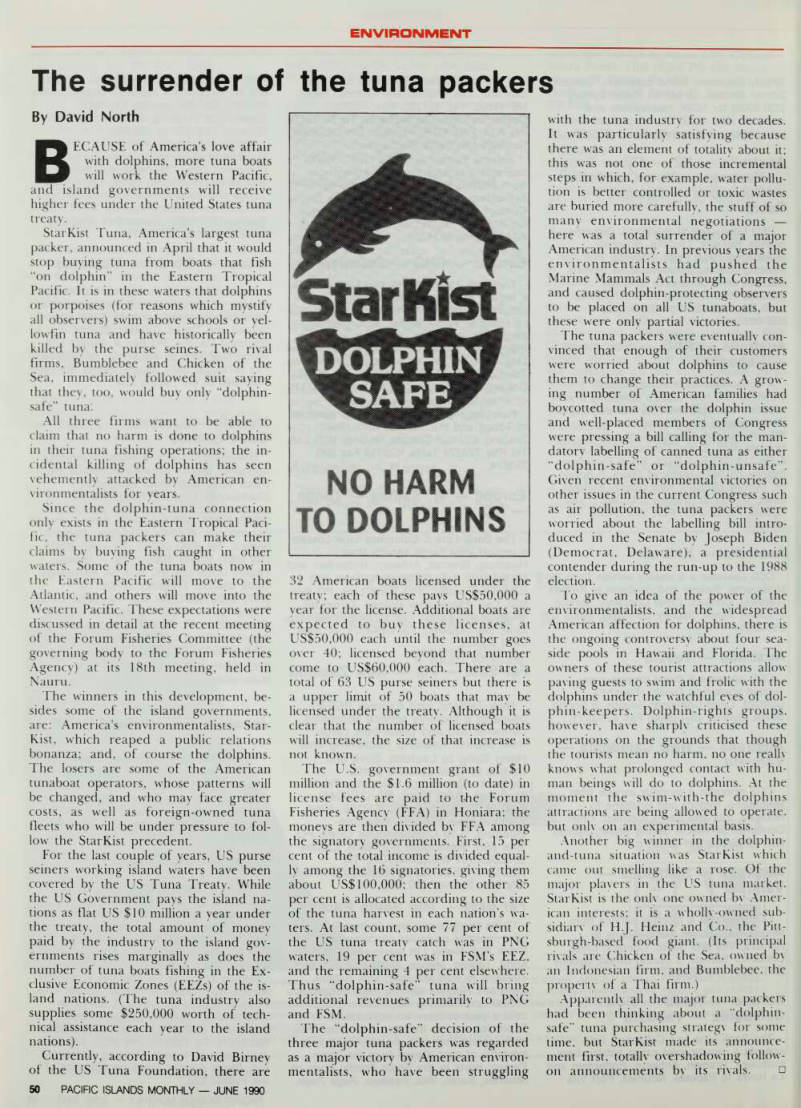
StarKist Tuna, America’s largest tuna packer, announced in April that it would stop buying tuna from boats that fish “on dolphin” in the Eastern Tropical Pacific. It is in these waters that dolphins or porpoises (for reasons which mystify all observers) swim above schools or yel lowfin tuna and have historically been killed by the purse seines. Two rival firms, Bumblebee and Chicken of the Sea, immediately followed suit saying that they, too, would buy only “dolphin safe” tuna; All three firms want to be able to claim that no harm is done to dolphins in their tuna fishing operations; the in cidental killing of dolphins has seen vehemently attacked by American en vironmentalists for years.
Since the dolphin-tuna connection only exists in the Eastern Tropical Paci fic, the tuna packers can make their claims by buying fish caught in other waters. Some of the tuna boats now in the Eastern Pacific will move to the Atlantic, and others will move into the Western Pacific. These expectations were discussed in detail at the recent meeting of the Forum Fisheries Committee (the governing body to the Forum Fisheries Agency) at its 18th meeting, held in Nauru.
The winners in this development, be sides some of the island governments, are; America’s environmentalists, Star- Kist, which reaped a public relations bonanza; and, of course the dolphins.
The losers are some of the American tunaboat operators, whose patterns will be changed, and who may face greater costs, as well as foreign-owned tuna fleets who will be under pressure to fol low the StarKist precedent.
For the last couple of years, US purse seiners working island yvaters have been covered by the US Tuna Treaty. While the US Government pays the island na tions as flat US $lO million a year under the treaty, the total amount of money paid by the industry to the island gov ernments rises marginally as does the number of tuna boats fishing in the Ex clusive Economic Zones (EEZs) of the is land nations. (The tuna industry also supplies some $250,000 worth of tech nical assistance each year to the island nations).
Currently, according to David Birney
of the US Tuna Foundation, there are
32 American boats licensed under the treaty; each of these pays USSSO,OOO a year for the license. Additional boats are expected to buy these licenses, at USSSO,OOO each until the number goes over 40; licensed beyond that number come to US$6O,OOO each. There are a total of 63 US purse seiners but there is a upper limit of 50 boats that may be licensed under the treaty. Although it is clear that the number of licensed boats yvill increase, the size of that increase is not known.
The U.S. government grant of $lO million and the $1.6 million (to date) in license fees are paid to t-he Forum Fisheries Agency (FFA) in Honiara; the moneys are then divided by FFA among the signatory governments. First, 15 per cent of the total income is divided equal ly among the 16 signatories, giving them about US$100,000: then the other 85 per cent is allocated according to the size of the tuna harvest in each nation’s yva ters. At last count, some 77 per cent of the US tuna treaty catch yvas in PNG yvaters, 19 per cent yvas in FSM’s FEZ, and the remaining 4 per cent elseyvhere.
Thus “dolphin-safe” tuna yvill bring additional revenues primarily to PNG and FSM.
The “dolphin-safe” decision of the
three major tuna packers was regarded
as a major victory by American environ mentalists, who have been struggling
with the tuna industry for two decades.
It was particularly satisfying because there was an element of totality about it; this was not one of those incremental steps in which, for example, water pollu tion is better controlled or toxic wastes are buried more carefully, the stuff of so many environmental negotiations here was a total surrender of a major American industry. In previous years the environmentalists had pushed the Marine Mammals Act through Congress, and caused dolphin-protecting observers to be placed on all US tunaboats, but these were only partial victories.
The tuna packers were eventually con vinced that enough of their customers were worried about dolphins to cause them to change their practices. A grow ing number of American families had boycotted tuna over the dolphin issue and well-placed members of Congress were pressing a bill calling for the man datory labelling of canned tuna as either
“dolphin-safe” or “dolphin-unsafe”.
Given recent environmental victories on other issues in the current Congress such as air pollution, the tuna packers were worried about the labelling bill intro duced in the Senate by Joseph Biden (Democrat, Delaware), a presidential contender during the run-up to the 1988 election.
To give an idea of the power of the environmentalists, and the widespread American affection for dolphins, there is the ongoing controversy about four sea side pools in Hawaii and Florida. The owners of these tourist attractions allow paving guests to swim and frolic with the dolphins under the watchful eves of dol
phin-keepers. Dolphin-rights groups,
however, have sharplv criticised these
operations on the grounds that though
the tourists mean no harm, no one really knows what prolonged contact with hu man beings will do to dolphins. At the moment the swim-with-the dolphins attractions are being allowed to operate, but onlv on an experimental basis.
Another big winner in the dolphin and-tuna situation was StarKist which came out smelling like a rose. Of the major plavers in the US tuna market, StarKist is the only one owned bv Amer ican interests; it is a wholly-owned sub sidiary of H.J. Heinz and Co., the Pitt
sburgh-based food giant. (Its principal
rivals are Chicken of the Sea, oyvned by an Indonesian firm, and Bumblebee, the property of a Thai firm.)
Apparently all the major tuna packers
had been thinking about a “dolphin safe” tuna purchasing strategy for some time, but StarKist made its announce ment first, totally overshadoyving lollow on announcements bv its rivals. □