Hotel’s top 3: numbers,
pp. 35-36 · Read in the full issue
cohesion and carrier
THE Fiji Hotel Association (FHA) is hoping this month’s Tourism Convention will address three issues: the availability of statistics; the need for more industry cohesion; and the need for a North American courier. FHA Chief Executive, Kevin Mutton, said hotels would like more information out of Government: “I don’t think anyone is very happy with the way visitor numbers are failing to come out of Government,”
The FHA, which represents about 70 hotels, wants the statistics so it can advise members, the Visitors Bureau, Government, investors, self-interest groups, advertisers and others about the tourist target market. Hotels need to know who is going where in Fiji and why, and to
couple this with expenditure to get an overall picture of the market. Mutton said the statistics could be retrieved vir tually any way required: “With the new arrival cards at the airport, the Bureau of Statistics has a lot to offer in statistical analysis it has the recipe, but just needs to get the quantities of ingredients correct,”
He said a North American carrier was essential based on the assumption that
Fiji was going through a development
stage: “It’s no good building a hotel and three years down the track it’s still emp ty. There is plenty of accommodation around.” He said Air Pacific had a major role to play in opening the North Amer ican market, but if it could not take the
initiative, Fiji could look at an ‘Open
Skies’ policy.
Mutton said the 1990 convention was important for Fiji to assess where it was in terms of world tourism: “Given the way the Australian economy is develop ing and an understanding of what New Zealand has gone through . . . people will be thinking again about an overseas holiday. Maybe now is the time to assess where our future lies.”
The FHA is very supportive of the ‘Fiji Incorporated’ concept as it sees the need for more cohesion between all in dustries involved; without some form of corporate body, tourism would not de velop, Mutton said. With the tourist in dustry expected to earn around Fs3oo million this year and service 270,000 tourists, the hotel industry has a major role to play in the country’s economy.
The FHA represents almost 70 hotels with a total of 3500 rooms, including virtually all hotels with eight or more rooms. The hotels directly employ 7000 people, about 6.6 per cent of the official workforce, and generate 1.8 jobs for ev ery room built.
As an employer association, the FHA seeks to improve the profile of the hotel industry by promoting excellent service and increasing public awareness of the
importance of the hotel industry to Fiji.
It negotiates with unions, advises Gov ernment about tourism legislation and policy and helps develop staff and man agement training courses.
It provides training scholarships, is on the National Training Council, contri butes to course content and product de velopment at the Fiji Institute of Tech nology’s School of Hotel and Catering Services and has developed a brochure on career prospects in the hotel industry.
It also runs competitions which are de signed to produce excellence and im prove the ability and confidence of hotel staff. The Barman-of-the-Year competi
tion'is to be held during the Convention with the major sponsor being South Paci fic Distilleries.
A major function of the FHA is to lobby Government on matters which affect hotels. It reviews and contributes to overall tourism marketing strategies and works in concert with the Fiji Visi tors’ Bureau.
As the representative of a large group of employers, the FHA sits on the Hotel
and Catering Industry Wages Council
and has a representative on the Labour Advisory Council. It investigates the ramifications and implications of indust rial agreements. □
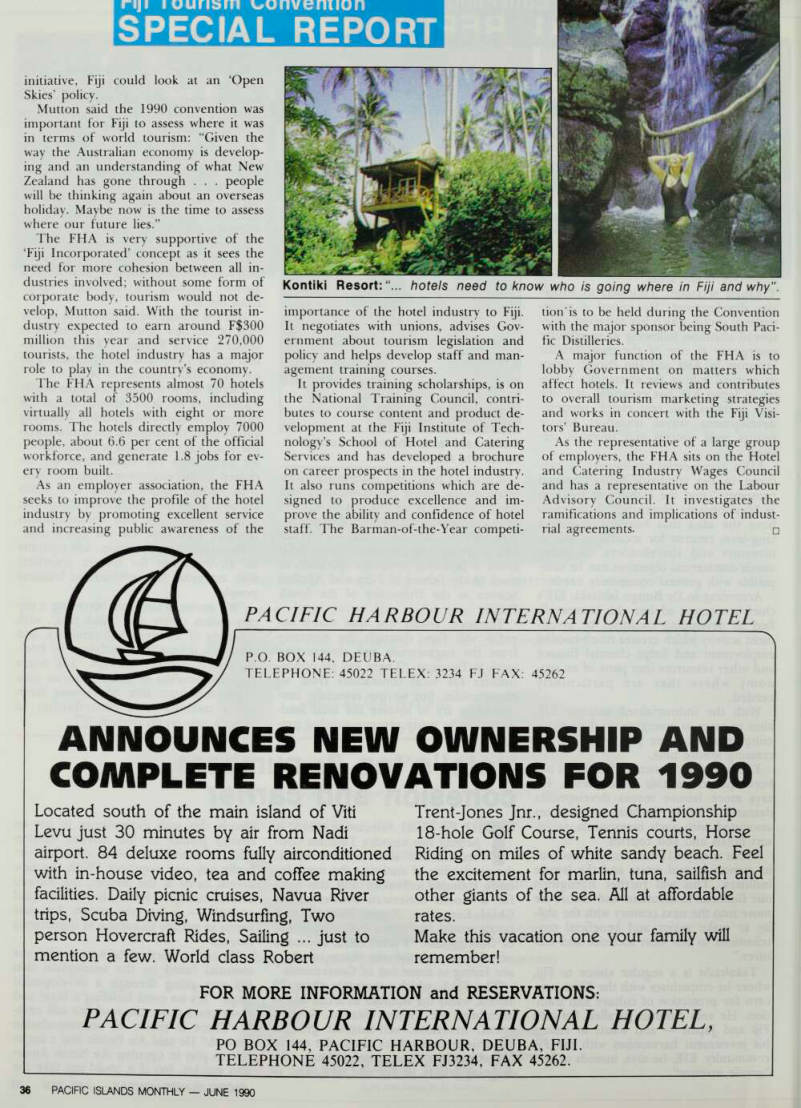
Kontlki Resort:"... hotels need to know who is going where in Fiji and why”.