Jewel in
pp. 33-35 · Read in the full issue

the Crown
A CONVENIENTLY located is land in the Western division of Viti Levu is the investment jewel in Fiji’s tourism crown. The 680 acres of Denarau on the shores of Nadi Bay are being transformed into Fiji’s first integrated destination resort.
Denarau is already the site of two of Fiji’s finest hotels, the Regent and the Sheraton and during the next five years about $3OO million will be spent to bring a host of new attractions to the island. Eventually upwards of 5000 visi tors at a time will stay in a total of five hotels, with 1500 rooms, plus 618 town houses, condominiums and villas. Other amenities are to include an 18-hole golf course, cultural centre, convention and business facilities, and five kms of water ways.
The master plan for the development of Denarau is part of a grand strategy by Japan’s EIE International Corporation to position the company as the leading lei sure industry investor in the Pacific Rim.
ElE’s chief executive in Fiji, Andrew Thomson, says Fiji’s location in the re gion makes it an important link in this scheme. “We believe Fiji has enormous potential as a centre for tourism and other forms of investment. The Pacific Rim is the most economically dynamic region of the world and Fiji is well placed to capitalise on this.”
The EIE approach is reflected in the company’s substantial holdings in Au stralia, New Zealand, Saipan and French Polynesia. It has also endeavoured to se cure the international aviation connec tions crucial for any corporate policy de pendent on the growth of tourism in the
region. EIE has purchased minority
shareholdings in Air Tahiti and Air Caledonie and recently concluded nego tiations for a stake in Air Pacific.
“We are taking a long-term view,” says Thomson, “and we are very confident about the future of Fiji and the region.”
Fiji’s natural attractions, its established tourism industry and infrastructure, out weighed concerns about the political situation following the 1987 coups. “In frastructure in particular is crucial for a developer,” Thomson said. “If a country does not have good infrastructure, de velopment is very difficult. One of the major advantages in Fiji is that tfye coun try has excellent amenities in terms of
roads, water supplies, hydro-electric
power, ports, airports and efficient transportation. It also has a skilled tour ism workforce.”
ElE’s involvement in Fiji began when the company’s president and chief ex ecutive, Harunori Takahashi, met Fiji
born Thomson in Auckland just over two years ago.
Takahashi was a guest at the Regent of Auckland, then managed by Thom son, who was also a former manager of the Regent of Fiji, at Denarau. Thomson extolled the virtues of Fiji’s tourism in dustry and described the opportunities at Denarau, already earmarked as an
outstanding development site. Within
months EIE had purchased the Regent of Fiji and developed a master plan for the island, which is close to Nadi Inter national Airport, in one of Fiji’s most important resort areas.
Takahasi recruited Thomson to super vise development. He joined a multi national group which has attracted wide
spread attention following its spectacular
emergence as one of the most prolific investors in Asia and the Pacific. From its original role in the electronics indus try in Japan EIE has expanded at home and overseas into real estate, property development, travel, transport, leisure resorts, golf courses and financial ser vices.
ElE’s commercial philosophy is cap tured in the company motto “mutual prosperity” and the concept of business as “development enterprise”. It espouses here the idea that business produces long-term returns for society, as well as investors and shareholders. In other words commercial objectives can be com
patible with general community needs.
According to Dr Bungo Ishizaki, ElE’s chief investment adviser, this is exempli fied in developing countries by invest ment activity which creates much-needed employment and helps channel finance and other resources into parts of an eco nomy where they are particularly needed.
With the industrialised nations, EIE aims to cater to emerging markets stem ming from economic prosperity and in creasing leisure time.
EIE president Harunori Takahashi has been quoted on this same theme. He says more leisure means development demand is led by facilities and services associated with such investments as re sort hotels and golf courses.
“That is why EIE has centred much of its growth in real estate and the leisure industry. This will further strengthen our financial foundations and ensure we move into the next century with the abil ity to make major and beneficial con tributions to our host societies and cul tures.”
Takahashi is a regular visitor to Fiji, where he empathises with the Fijian con cern for protection of culture and tradi tion. He sees cultural parallels between Fiji and Japan and wants to ensure his investment harmonises with the Fiji community. EIE, he says, intends to be a “gentle investor”.
It aims to build and maintain positive relationships within the community and one of its early initiatives was to offer to
help Fiji develop technological expertise,
especially in computer skills. As a result EIE is sponsoring Professor Sunao Seki moto, a Japanese computer specialist, to teach at the School of Pure and Applied Science at the University of the South Pacific.
Thomson points out that many be nefits will flow through the economy from the engineering and construction work at Denarau. “There will be oppor tunities for local contractors from all communities, but we are especially con cerned to try to involve the local land owners in as many revenue-earning pro
jects as possible. We have excellent rela tionships with the Tui Nadi, th local pa ramount chief, and his people. One of our first contracts for site clearance was awarded to the Tui Nadi’s company.”
The Fiji Government welcomes the Denarau scheme for the jobs it will cre ate and the other economic spinoffs.
EIE expects 2000 positions to be created during the construction phase, with at least 5000 permanent positions available when the project is completed.
In the first phase, over two million cubic metres of earth fill is being moved onto the low-lying island as a protection against flooding and hurricane surge from the sea.
Work is scheduled to start soon on the first of the new hotels on a 30-acre site adjacent to the Regent of Fiji. Construc
tion of the 7200-yard championship golf
course is also expected to begin.
Part of the first phase envisages nearly Fs3omillion worth of expenditure on the
extensive engineering works, including
earthworks, reclamation, excavations and the waterways. Channels to drain rainwa ter away from the main island are in cluded in the engineering specifications.
In further stages another two hotels are to rise on the beachfront, along with villas, townhouses and condominiums fronting waterways and the golf course.
Denarau, says Thomson, will combine an environment for leisure travellers with amenities for international business
people.
“We envisage Denarau becoming a top convention centre and ‘think tank’, with a variety of meetings and seminars, and
high-tech information exchange by satel
lite and computer,” he says. “EIE wants Japanese tourists to share Denarau with a cosmopolitan mix of visitors from other nations a contribution to Japan’s new world outlook/’^
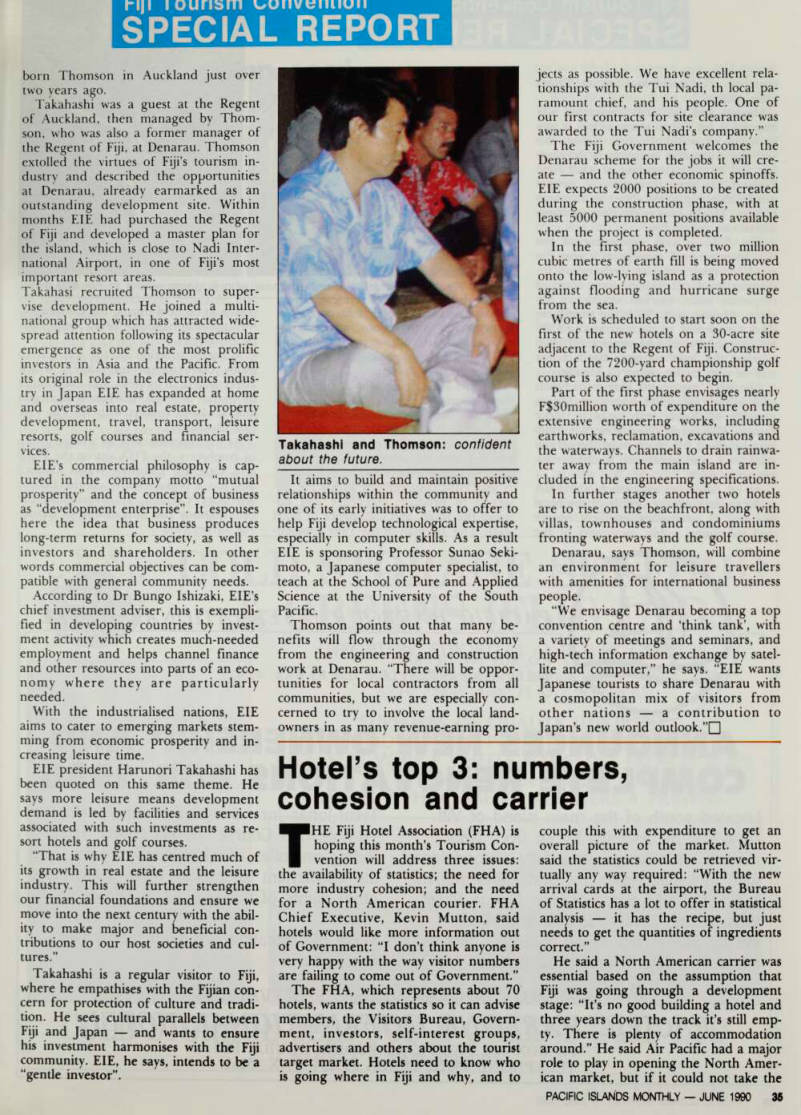
Takahashi and Thomson: confident about the future.