New debate on economy
pp. 26-27 · Read in the full issue
faces obstacle in PNG
ABORT Moresby economist has
opened up the debate by calling
for the country to lay the groundwork for industrial development but there are many obstacles in the way. However, there seems to be wide spread agreement in Papua New Guinea business circles that diversification is needed, but this depends on the govern ment being prepared to tackle several problems law and order, education,
wages before anything meaningful
can happen.
In a recent speech Dr Hanumant Mannur, associate professor of econo-
mics at the University of Papua New Guinea, urged preparation for indus trialisation by the year 2000. He said the Bougainville crisis must serve as a warn ing that the country should stop concen trating on the mining industry and de velop other sectors of the economy.
In an interview with Pacific Islands Monthly Dr Mannur said one of the problems with Papua New Guinea was the high wage structure compared with neighbouring Third World nations, and the cost of living and land when rent for a house in Port Moresby could cost KlOOO (US$1000), he said this problem was compounded by low labour per formance with poor workforce discipline
and productivity.
“The government has to do something about labour skills before Papua New Guinea can become competitive,” he said. “We have to learn from the Singa pore and South Korean experience.”
Just attacking the level of wages was no solution, and it could generate new labour relations problems. Dr Mannur argues that the country needs to develop a “productivity consciousness”, with the political will to get people to perform.
“What we should be spending on educa tion both primary and secondary
we are spending on military operations,”
he said.
Transport was another problem to be addressed, and that trying to get a manufacturing sector going would be jumping the gun without better trans port. Industry would have to be largely export-oriented, and concentrated in one or two places, probably Lae and Port Moresby. There was no point in wor
rying about balanced growth and giving
each region a manufacturing sector; nor was there a likelihood that any substan tial import-substitution sector would be feasible as it was usually far cheaper to import goods than try and manufacture them locally in small quantities.
The bureaucracy was another blockage to economic development. It was simply too hard for people to get approval for projects. “It’s not geared to help manu facturing you need a one-stop shop for foreign investment,” said Dr Mannur.
Overall, he said, the outlook for diver sification was not bright. “As long as the minerals boom continues, people here will take it easy. They will pay high wages and forget about developing a
manufacturing industry.”
In the meantime, there needed to be greater efforts made to diversify the ru ral sector following the collapse of cof fee, cocoa and copra prices. Rice and
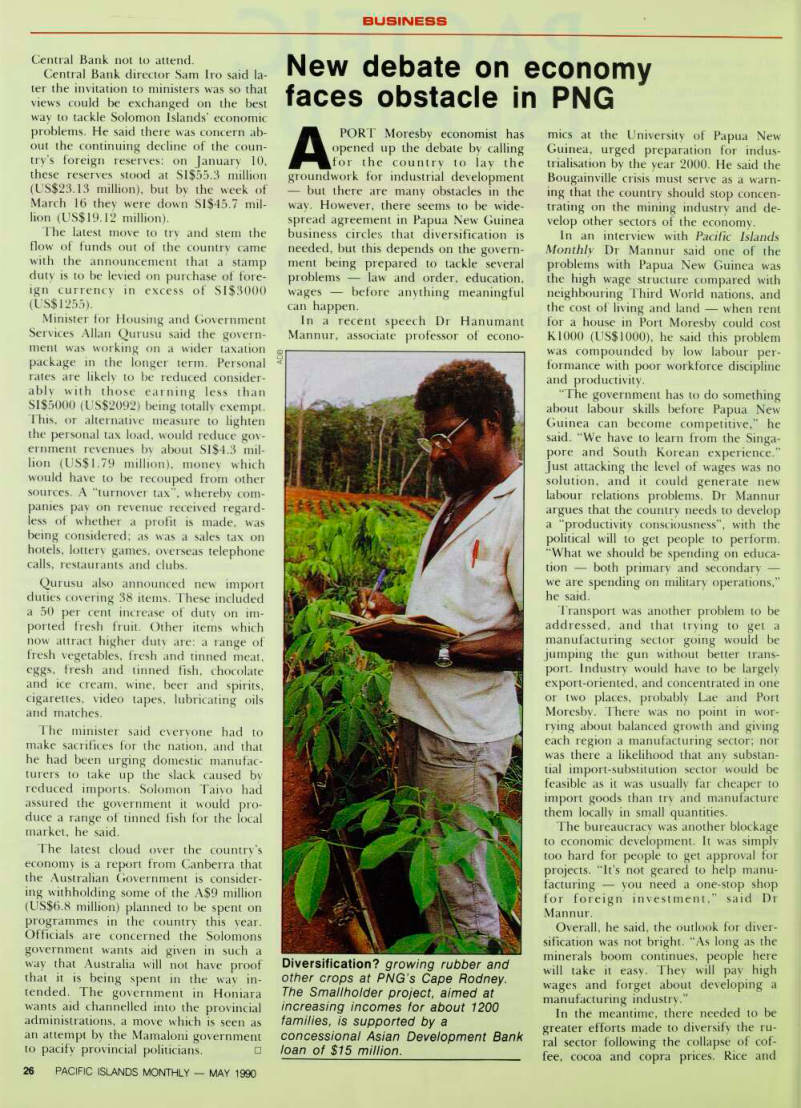
Diversification? growing rubber and other crops at PNG’s Cape Rodney.
The Smallholder project, aimed at increasing incomes for about 1200 families, is supported by a concessional Asian Development Bank loan of $15 million.
fruit could be developed in many areas in order to cut imports of those com modities rice imports alone cost Papua New Guinea KBO million (US$7B.9 million) a year. Fishing could also help, but it was an industry still in its infancy producing export revenue of a mere K 9 million a year.
Graham Hogg, executive director of the Papua New Guinea Employers’ Fed eration, said that much investment was “on hold” simply due to fear fear of the implications of the Bougainville cri sis, and of serious law and order prob lems throughout the country.
But, said Hogg, even without those problems there was a general feeling that there were limited opportunities for
industrial expansion or development.
The average urban wage was eight times that of typical rates in South-East Asia, while rural wages were 3.5 times higher.
Without any sizeable internal market, these cost factors were a major barrier to
developing a manufacturing sector.
The PNG Chamber of Commerce is now engaged on preparing a submission to the national government aimed to overcoming blockages which inhibit the private sector and which are currently in its view inhibiting new investment.
Chamber of Commerce President Stan Joyce said the general view in the private sector was that law and order needed to be re-established through Papua New Guinea. Also, bureaucratic blockages needed to be eliminated, such as those which made it difficult to acquire visas and work permits.
Joyce said it was difficult to encourage investors into a country where they could be afraid for their lives.
The country had too many regula tions. A local person had to get official permission to go into business with a
foreigner, and major superannuation
funds had a great deal of money but were very restricted as to how they could invest they could not go into the stock market, for example which was a se vere inhibitor to the development of a
local capital market.
In a recent article, John Millett of the Institute of National Affairs in Port Moresby drew attention to the fact that the country had intensive but not exten sive growth. And another problem; “The population increase is mostly in the rural areas and hence that is where most of the output increase must come from.
Such a focus would dictate, for example, that much more effort be put into mobi lising customary land than into exploit ing other natural resources.”
Millett said it was the unbalanced de velopment strategy which was causing the breakdown in law and order. Crop diversification alone could not overcome the problems caused by low prices for the main export agricultural products.
“Tea was introduced into the High lands to reduce dependency on coffee.
Villagers and smallholders weren’t attracted to it they dedicated their land to the crop providing the best re turns, measured in the broadest sense.
On the basis of relative prices, of tea and coffee, some plantations switched from tea to coffee, at considerable cost in both investment and foregone produc tion. Today relative prices of these two crops have reversed for how long, though, is another question,” Millett said.
No amount of crop diversification could prevent the individual farmers from the behaviour of his particular crop. Millet argues that consolidation rather than diversification was needed now, especially in the rural sector.
What is clear is that the debate about the fundamental strategy for Papua New Guinea’s economy is only beginning. Mil lett makes the point that “three miner als”, four major crops plus a few minor ones, timber and fish seems to be an impressive line-up for the size of the economy”, so the question could well be asked: why are so many people so wor ried. It is this fear in the minds of inves tors which could be the main inhibitor to Papua New Guinea’s short-term develop ment. □
Rice trials a failure TRIALS with rice cultivation in Morobe’s Markham Valley have been de cribed as a failure, although Rice Indus tries Pty Ltd the company behind the scheme said it was still determined to develop the industry on a commercial scale. It said the first experiment failed because of poor soil, and problems with
management techniques, the irrigation
and weed control.
Livestock and Agriculture Minister Galen Lang said the Government still held high hopes that rice would prove a viable industry in Papua New Guinea.
Telecommunications boost ABOUT KBO million (U 5578.52 million) is to be spent by the Post and Telecom munications Corporation to upgrade communications throughout Papua New Guinea. The new works announced by Communications Minister Brown Sina moi include money for more rural tele phone services, a contract to digitalise Papua New Guinea’s telecommunications network, a new headquarters building in Port Moresby, cable and transmission equipment and a satellite development programme.