Pacific
pp. 25-26 · Read in the full issue
Islands
Monthly
Business
The Honiara S.O.S.
Dropping trade shakes the economy
By Robin Bromby
SIGNALS that the Solomon Islands Government is extremely worried about the state of the nation’s eco nomy have been emanating from Hon iara. Prime Minister Solomon Mamaloni has said that major changes will be made in the economic policy, although there emerged an apparent conflict between the government and the Central Bank of Solomon Islands, the latter being ac cused of trying to devalue the currency to aid exports and make imports more expensive. There have also been reports that Australia may withhold aid from the Solomon Islands because the authorities in Canberra are unhappy about the way in which the money is being distributed.
Solomon Islands terms of trade have been deteriorating for a year after an improvement in 1989. This reverse was brought about by lower international prices for copra, palm oil, cocoa and fish, while import costs tended to rise, particularly for fuel and manufactured goods.
But like their counterparts in Papua New Guinea farmers are finding that world price falls are hitting them hard.
The Commodity Export Marketing Au thority (CEMA) announced its payments for copra would drop from late March and they were substantial falls. The new prices were to be Sls4oo (US$l67) per tonne for first grade against a pre vious price of Slssoo a tonne. Second grade dropped to 515390 (US$l63) a tonne from 515490, and third grade cop ra will now be bought at 515370 (US$l54) a tonne, down from $470.
CEMA chairman James Roni said the cuts were made to prevent the copra re serve fund running out of money. “This is becoming a critical situation to us,” he said.
Reserve funds could be exhausted by September if prices continue at their present depressed level; one that occurs
(assuming there is no government in tervention), then CEMA estimtes that farmer will receive about one-third of the present reduced prices for copra.
Roni said his board had asked the gov ernment to reduce copra export duties and to pick up the tab for part of what CEMA is paying the growers by way of subsidies which wofald allow the re serve fund to last into the first quarter of 1991.
Low prices have also hit cocoa incomes in the Solomon Islands, and farmers are ■growing reluctant to increase their pro duction of both cocoa and copra which could lead, CEMA believes, to consider able falls in export volumes. Copra accounted for 9.2 per cent of Solomon Islands export revenue in 1988, taking third place after timber and fish. The government moved quickly, and agreed to drop export duties not only on copra,
but crude coconut oil, cocoa, fish, palm oil and kernal.
Prime Minister Mamaloni, in an eco nomic statement, said the prospects for the Solomon Islands economy during the next decade were better than many cri tics were making them out to be, and tried to sustain optimism by predicting that his government’s plans will see full economic recovery by 1995/1996.
The government is to bring in new measures, which includes new income lax laws, a sales tax, new incentives pack age to attract investment, industrial de velopment strategies, plus review of pro vincial government funding and all cen tral government fees and licences. Priva tisation is to continue and there will be what have been described as drastic changes in the Public Service.
Mamaloni stressed that he was not planning to devalue the Solomon Islands dollar.
“To devalue the dollar any further than its current value would be favour able to the prices of exports but dis astrous to the Solomon Islands commun ity at large in terms of prices of goods, cash savings and purchasing power,” he said. The alternatives were to leave the currency where it is, or gradually pursue revaluation as the new fiscal measures took effect.
Later, at a Press conference in Hon iara, Mamaloni revealed he had been told by the Central Bank that it intended not only to devalue the Solomon Islands dollar but it had also requested the gov ernment cut its budget by Sls 10 million (US$4.lB million) out of a total budget drawn up last December of 51597.6 mil lion (US$4O.4 million). Mamaloni said the Cabinet had instructed the bank not to act immediately, and indicated he was angry it had moved towards devaluation when the government’s plan had been in favour of revaluation if anything. He in dicated that he had instructed those ministers invited to a briefing by the
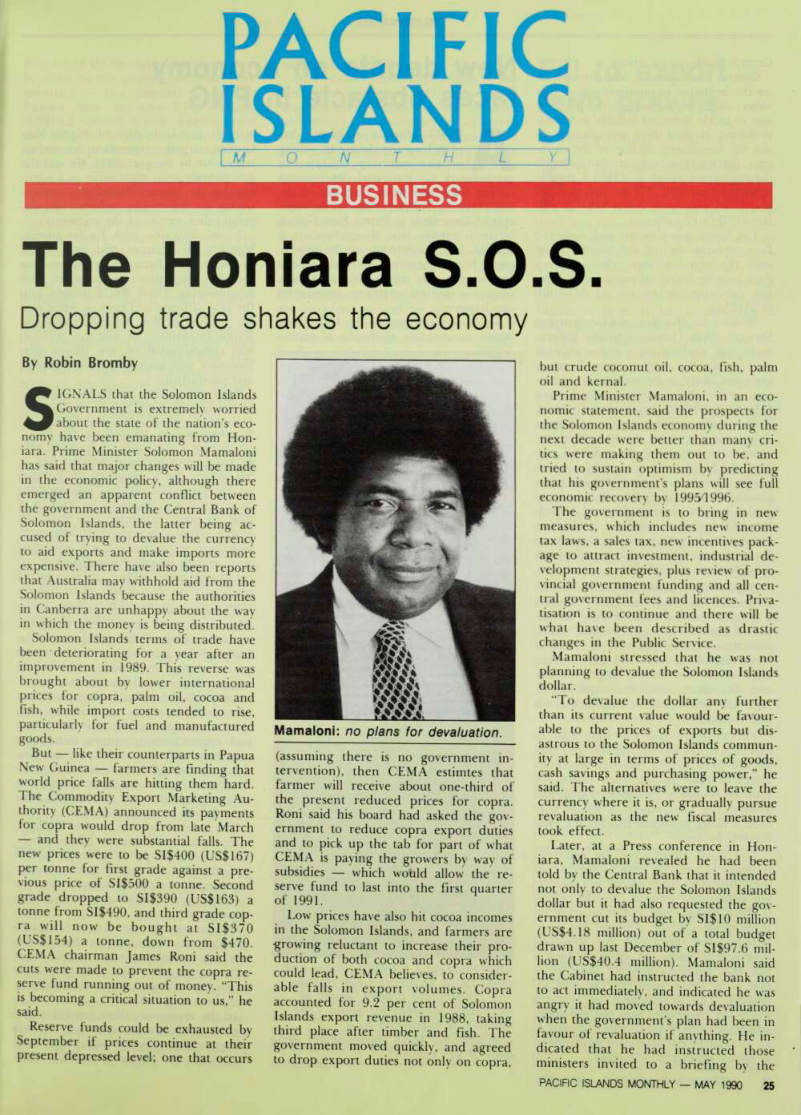
Mamaloni: no plans for devaluation.
Central Bank not to attend.
Central Bank director Sam Iro said la ter the invitation to ministers was so that views could be exchanged on the best way to tackle Solomon Islands’ economic problems. He said there was concern ab out the continuing decline of the coun try’s foreign reserves: on January 10, these reserves stood at 51555.3 million (U 5523.13 million), but by the week of March 16 they were down 51545.7 mil lion (U 5519.12 million).
The latest move to try and stem the flow of funds out of the country came with the announcement that a stamp duty is to be levied on purchase of fore ign currency in excess of Sls3ooo
(US$l255).
Minister for Housing and Government Services Allan Qurusu said the govern ment was working on a wider taxation package in the longer term. Personal rates are likely to be reduced consider ably with those earning less than Slssooo (US$2O92) being totally exempt.
This, or alternative measure to lighten the personal tax load, would reduce gov ernment revenues by about 5154.3 mil lion (US$l.79 million), money which would have to be recouped from other sources. A “turnover tax”, whereby com panies pay on revenue received regard less of whether a profit is made, was being considered; as was a sales tax on hotels, lottery games, overseas telephone calls, restaurants and clubs.
Qurusu also announced new import duties covering 38 items. These included a 50 per cent increase of duty on im ported fresh fruit. Other items which now attract higher duty are: a range of fresh vegetables, fresh and tinned meat, eggs, fresh and tinned fish, chocolate and ice cream, wine, beer and spirits, cigarettes, video tapes, lubricating oils and matches.
The minister said everyone had to make sacrifices for the nation, and that he had been urging domestic manufac turers to take up the slack caused by reduced imports. Solomon Taiyo had assured the government it would pro duce a range of tinned fish for the local market, he said.
The latest cloud over the country’s economy is a report from Canberra that the Australian Government is consider ing withholding some of the As 9 million (US$6.B million) planned to be spent on programmes in the country this year.
Officials are concerned the Solomons government wants aid given in such a way that Australia will not have proof that it is being spent in the way in tended. The government in Honiara wants aid channelled into the provincial administrations, a move which is seen as an attempt by the Mamaloni government to pacify provincial politicians. □