Coming in
pp. 60-61 · Read in the full issue
Pacific People
Coming in from the sea
By Diana McManus
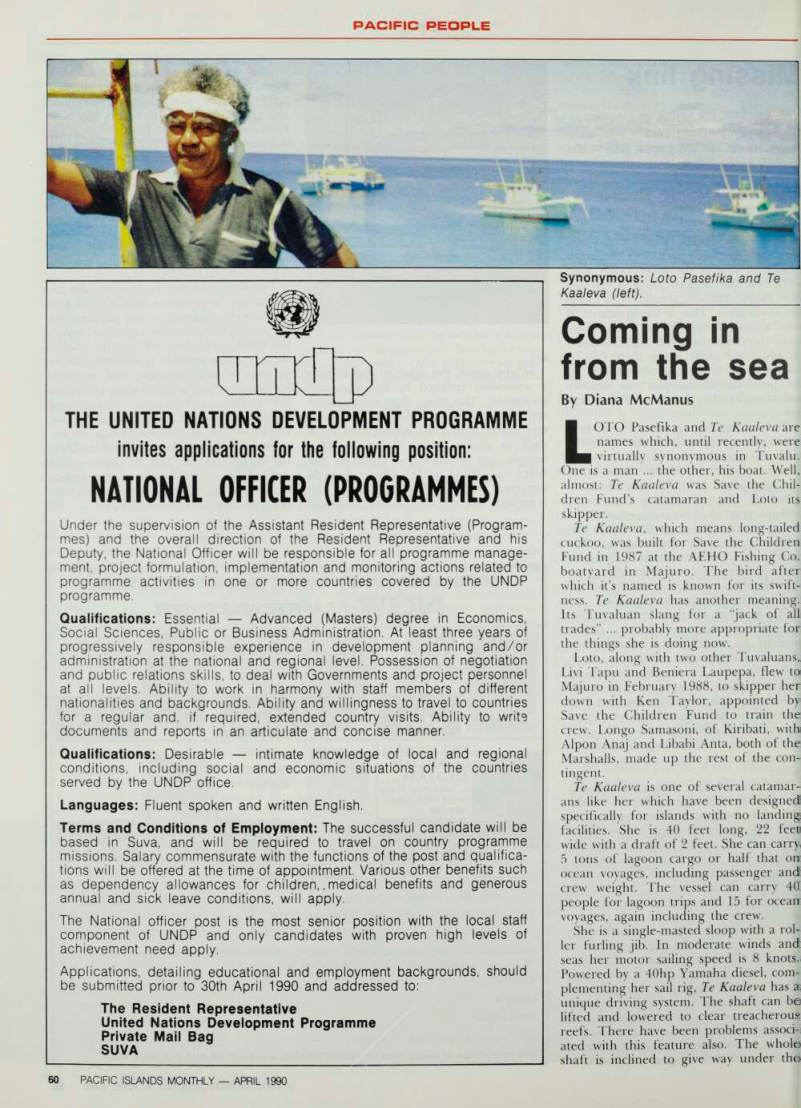
LOTO Pasefika and Te Kaaleva are names which, until recently, were virtually synonymous in Tuvalu.
One is a man ... the other, his boat. Well, almost: Te Kaaleva was Save the Chil dren Fund’s catamaran and Loto its skipper.
Te Kaaleva, which means long-tailed cuckoo, was built for Save the Children Fund in 1987 at the AEHO Fishing Co. boatyard in Majuro. The bird after which it’s named is known for its swift ness. Te Kaaleva has another meaning.
Its Tuvaluan slang for a “jack of alll trades” ... probably more appropriate for the things she is doing now.
Loto, along with two other Tuvaluans,, Livi Tapu and Beniera Laupepa, flew to Majuro in February 1988, to skipper her down with Ken Taylor, appointed by Save the Children Fund to train the crew. Longo Samasoni, of Kiribati, with Alpon Anaj and Libabi Anta, both of the Marshalls, made up the rest of the con tingent.
Te Kaaleva is one of several catamar ans like her which have been designed! specifically for islands with no landings facilities. She is 40 feet long, 22 feet) wide with a draft of 2 feet. She can 5 tons of lagoon cargo or half that onr ocean voyages, including passenger and crew weight. The vessel can carry 40[ people for lagoon trips and 15 for ocean voyages, again including the crew.
She is a single-masted sloop with a rol ler furling jib. In moderate winds and seas her motor sailing speed is 8 knots..
Powered by a 40hp Yamaha diesel, com plementing her sail rig, Te Kaaleva has as unique driving system. The shaft can be lifted and lowered to clear treacherous reefs. There have been problems associ-i ated with this feature also. The whole shaft is inclined to give way under the
Synonymous: Loto Pasefika and Te Kaaleva (left).
■stress of ocean voyages. The vessel has [lost its propeller and shaft once and has its share of problems.
Loto’s eyes sparkle with amusement as he recalls the first time he laid eyes on Te Kaaleva. “I was a seaman for years and years and the smallest boat I ever had command of was my first vessel, and she was 79 feet long. Never in my life did I even think about the possibility of my life being in danger. But I took one look at this little boat, thought of sailing her all the way from the Marshalls to Tuvalu, and I thought, ‘Get me out of
here on the next plane’. But the next day Ken took me out on sea trials with him and over the next two weeks we had her out in all kinds of conditions. I could feel my confidence in this boat growing, and I knew that we could do it.”
It’s just as well he did gain that confi dence because the trip turned out to be quite an initiation for Loto a crash course in sailing, as he puts it. He and Taylor came to an agreement whereby Loto would navigate and Taylor would teach the rest of the crew to sail. Just south of Tarawa Taylor took ill and they
had to return and drop him off at hos pital. They had 10 days to get to Tuvalu for the official launching, for which Joy Carrol, Director, AsiaTacific Region of Save the Children Fund would fly from America to attend. And Loto was now in command.
“We went slowly, slowly past the south ern atolls of Kiribati. And suddenly when we came to the last, the wind swung around from the north-east and was very strong. I was afraid but I knew it was exactly the wind we wanted to get home quickly, so I said, ‘Come on. We’ll go for it.’ And we did. We got home in two days. Never before in all my days on bigger ships did I do that trip so quickly.
That boat flew! And since then I know I could go around the world in that boat.”
Until recently its main objective was to carry Save the Children Fund staff to the outer islands to meet people and to
implement projects.
At present Save the Children Fund is being absorbed into the Island Develop ment Office, a government department and only recently Te Kaaleva was trans ferred to the Department of Works and Communications. The Save the Children Fund will continue to play an advisory role and seek funding but it will slowly
phase out.
And what of the cheerful, accommo dating Loto Pasefika? Here is an indi vidual with an amazing variety of experi ence behind him; from seaman to public servant and diplomat. He hails from an interesting family. His father, Frank Pasefika, was a Senior Clerk with the District Commissioner in the days when Tuvalu was British colony of the Ellice Islands. He was based at Funafuti during the war and was transferred to Tarawa when the war ended.
Young Loto stayed behind to study at the government school of Elisefou in Vaitupu. When the new King George V secondary school was completed at Bike nibou on Tarawa, the Elisefou school and the old King George V school on Abemama were closed and the students formed the first intake of the new school. This included former Prime Minister Dr Tomasi Puapua. Loto finished school there in 1959.
Despite the privileges of diplomacy,
Loto missed the sea. In 1982 he jumped at the opportunity to temporarily fill in as Captain of Tuvalu’s pole and line tuna vessel, Te Tautai, when the captain fell ill. As it was, he stayed on the ship until 1984. Apart from another short, three-month contract on Te Tautai in the Solomons during 1986, Loto otherwise remained unemployed until he heard of the plans for Te Kaaleva.
For awhile he and the boat were one.
He has developed a grand passion for catamarans and read every book he could get on the subject. □