Missing link
p. 59 · Read in the full issue
Books
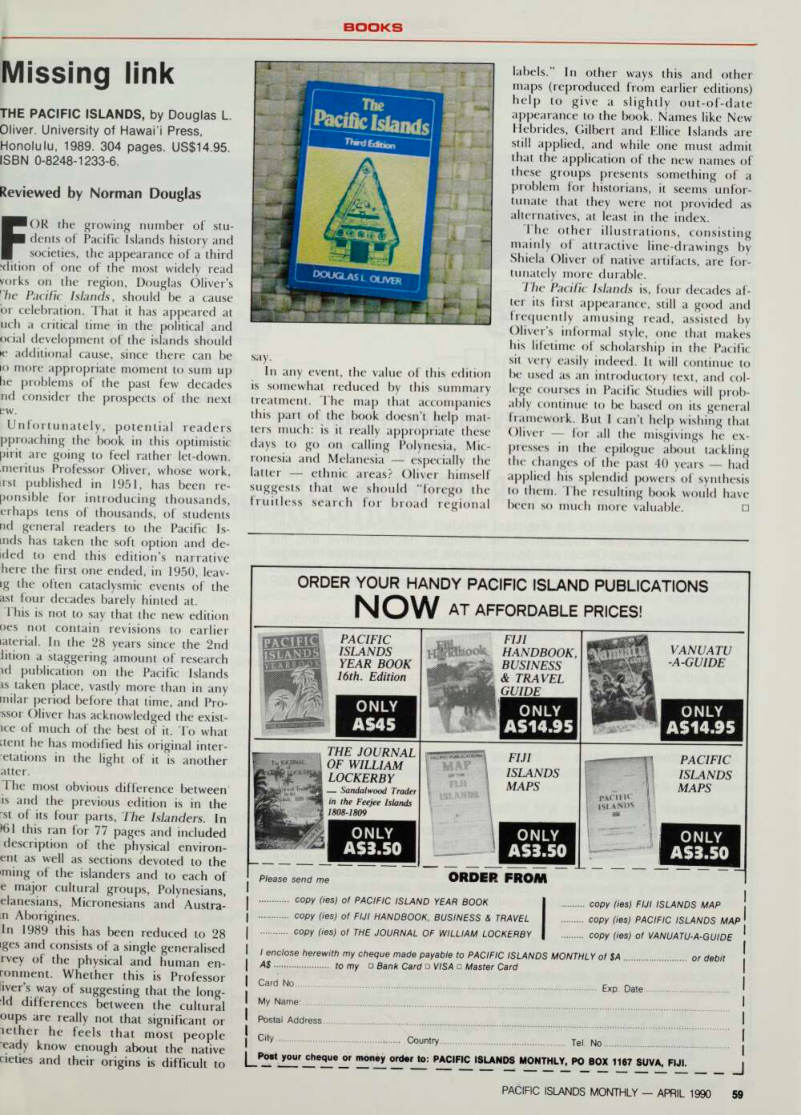
The Pacific Islands, By Douglas L.
Oliver. University of Hawai’i Press, Honolulu, 1989. 304 pages. U 5514.95.
Isbn 0-8248-1233-6.
Reviewed by Norman Douglas
FOR the growing number of stu dents of Pacific Islands history and societies, the appearance of a third edition of one of the most widely read vorks on the region, Douglas Oliver’s r he Pacific Islands, should be a cause or celebration. That it has appeared at uch a critical time in the political and ocial development of the islands should ►e additional cause, since there can be io more appropriate moment to sum up he problems of the past few decades nd consider the prospects of the next ew.
Unfortunately, potential readers pproaching the book in this optimistic pirit are going to feel rather let-down, meritus Professor Oliver, whose work, irst published in 1951, has been re
ponsible for introducing thousands,
erhaps tens of thousands, of students nd general readers to the Pacific Is mds has taken the soft option and de ided to end this edition’s narrative here the first one ended, in 1950, leav ig the often cataclysmic events of the ast four decades barely hinted at. 1 his is not to say that the new edition oes not contain revisions to earlier laterial. In the 28 years since the 2nd lition a staggering amount of research id publication on the Pacific Islands as taken place, vastly more than in any milar period before that time, and Pre ssor Oliver has acknowledged the exist ice of much of the best of it. To what rtent he has modified his original inter etations in the light of it is another alter.
The most obvious difference between is and the previous edition is in the st of its four parts, The Islanders. In 161 this ran for 77 pages and included description of the physical environ ent as well as sections devoted to the mmg of the islanders and to each of e major cultural groups, Polynesians, elanesians, Micronesians and Austra
n Aborigines.
In 1989 this has been reduced to 28 iges and consists of a single generalised rvey of the physical and human en ronment. Whether this is Professor liver’s way of suggesting that the long id differences between the cultural oups are really not that significant or icther he feels that most people eady know enough about the native cieties and their origins is difficult to
say.
In any event, the value of this edition is somewhat reduced by this summary treatment. The map that accompanies this part of the book doesn’t help mat ters much: is it really appropriate these days to go on calling Polynesia, Mic ronesia and Melanesia especially the latter ethnic areas? Oliver himself suggests that we should “forego the fruitless search for broad regional
labels.” In other ways this and other maps (reproduced from earlier editions) help to give a slightly out-of-date appearance to the book. Names like New Hebrides, Gilbert and Ellice Islands are still applied, and while one must admit that the application of the new names of these groups presents something of a problem for historians, it seems unfor tunate that they were not provided as alternatives, at least in the index.
I he other illustrations, consisting mainly of attractive line-drawings by Shiela Oliver of native artifacts, are for tunately more durable.
The Pacific Islands is, four decades af ter its first appearance, still a good and frequently amusing read, assisted by Oliver’s informal style, one that makes his lifetime of scholarship in the Pacific sit very easily indeed. It will continue to be used as an introductory text, and col lege courses in Pacific Studies will prob ably continue to be based on its general framework. But I can’t help wishing that Oliver for all the misgivings he ex presses in the epilogue about tackling the changes of the past 40 years had applied his splendid powers of synthesis to them. The resulting book would have been so much more valuable. □