Pacific
pp. 27-29 · Read in the full issue
Islands
M Onthl Y
Business
U.S. gives coconut oil the bad label
Why are the Pacific Islands finding it hard to market coconut oil? The United States has one answer.
THROUGHOUT American super markets there are little stickers on
food packages saying in large,
bright letters: “this product contains no coconut or palm oil.”
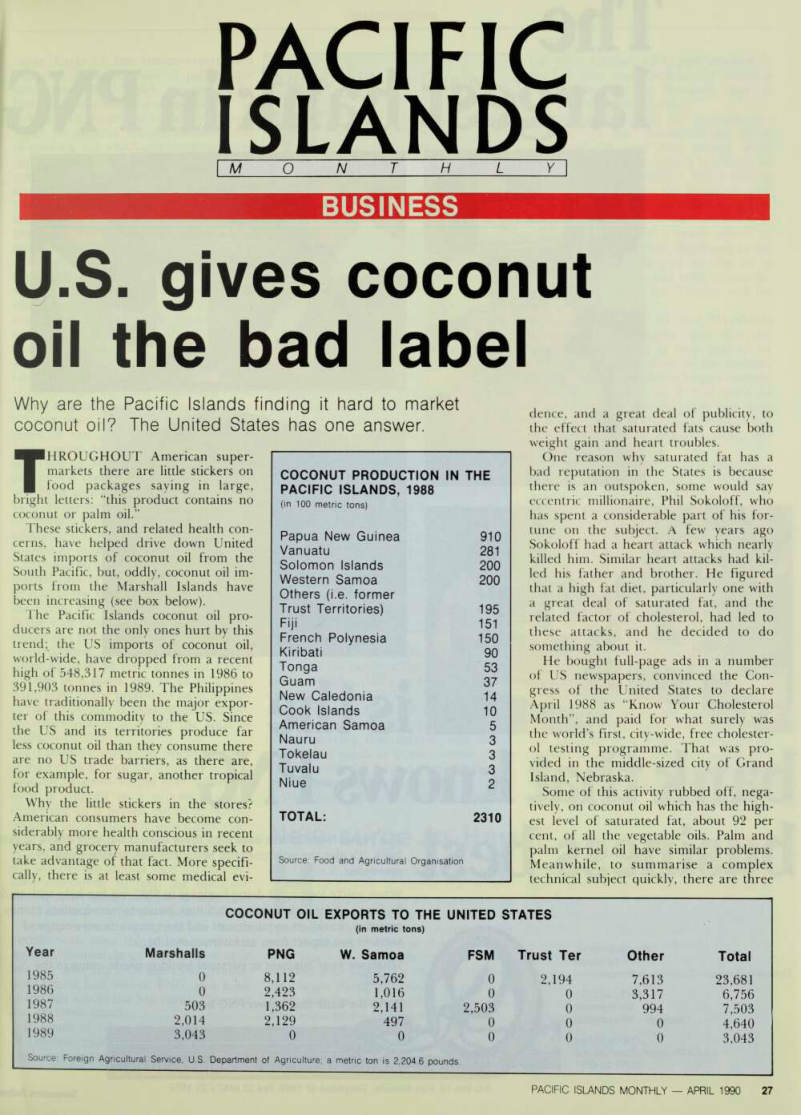
These stickers, and related health con cerns, have helped drive down United States imports of coconut oil from the South Pacific, but, oddly, coconut oil im ports from the Marshall Islands have been increasing (see box below).
The Pacific Islands coconut oil pro ducers are not the only ones hurt by this trend; the US imports of coconut oil, world-wide, have dropped from a recent high of 548,317 metric tonnes in 1986 to 391,903 tonnes in 1989. The Philippines have traditionally been the major expor ter of this commodity to the US. Since the US and its territories produce far less coconut oil than they consume there are no US trade barriers, as there are, for example, for sugar, another tropical food product.
Why the little stickers in the stores?
American consumers have become con siderably more health conscious in recent years, and grocery manufacturers seek to take advantage of that fact. More specifi cally, there is at least some medical evi-
Coconut Production In The
Pacific Islands, 1988
(in 100 metric tons)
dence, and a great deal of publicity, to the effect that saturated fats cause both weight gain and heart troubles.
One reason why saturated fat has a bad reputation in the States is because there is an outspoken, some would say eccentric millionaire, Phil Sokoloff, who has spent a considerable part of his for tune on the subject. A few years ago Sokoloff had a heart attack which nearly killed him. Similar heart attacks had kil led his father and brother. He figured that a high fat diet, particularly one with a great deal of saturated fat, and the related factor of cholesterol, had led to these attacks, and he decided to do something about it.
He bought full-page ads in a number of US newspapers, convinced the Con gress of the United States to declare April 1988 as “Know Your Cholesterol Month”, and paid for what surely was the world’s first, city-wide, free cholester ol testing programme. That was pro vided in the middle-sized city of Grand Island, Nebraska.
Some of this activity rubbed off, nega tively, on coconut oil which has the high est level of saturated fat, about 92 per cent, of all the vegetable oils. Palm and palm kernel oil have similar problems.
Meanwhile, to summarise a complex technical subject quickly, there are three
COCONUT OIL EXPORTS TO THE UNITED STATES (in metric tons)
Papua New Guinea 910 Vanuatu 281 Solomon Islands 200 Western Samoa 200 Others (i.e. former Trust Territories) 195 Fiji 151 French Polynesia 150 Kiribati 90 Tonga 53 Guam 37 New Caledonia 14 Cook Islands 10 American Samoa 5 Nauru 3 Tokelau 3 Tuvalu 3 Niue 2
Total:
2310 Source: Food and Agricultural Organisation
Year Marshalls
Png
W. Samoa
Fsm
Trust Ter Other Total 1985 0 8,112 5,762 0 2,194 7,613 23,681 1986 0 2,423 1,016 0 0 3,317 6,756 1987 503 1,362 2,141 2,503 0 994 7,503 1988 2,014 2,129 497 0 0 0 4,640 1989 3,043 0 0 0 0 0 3,043 Source.
Foreign Agricultural Service, U.S. Department of Agriculture; a metric ton is 2,204.6 pounds.
other kinds of fats (mono-unsaturated and two different kinds of polyunsatu rated fats) all of which are said to be better for you than saturated fat.
There are American health food firms which do nothing but sell various kinds of cooking oils which are predominantly composed of these other kinds of fats, and which contain only small amounts of saturated fat. Some of these rival oils, such as almond, flax, peanut, rapeseek and sunflower oil, have saturated fat percentages in the 6 per cent to 19 per cent range.
All of this has taken its toll in the marketplace. Whereas the US brought in at least 150,000 tons of coconut oil for edible uses in 1985 the estimate for last year was only 92,000 tons. Most coconut oil now used in the US finds its way into shampoos and other soap products where there are no objections of satu rated fat.
There may be some possibilities for larger shipments of coconut oil to the US this year, largely for non-food pur poses, if the price continues to drop.
The average price for the period Octo ber 1988 to September 1989 was $545 per metric ton. By November, 1989 it was $4BO and in January it dropped to $434. If the price of coconut oil drops to the point where it becomes an attractive substitute for other, more costly oils, the volume of imports should increase.
Coconut oil is one of the possible com mercial uses of coconuts. If they cannot be sold in the shell (and those that reach the US go for 80 cents to a dollar each in the East Coast supermarkets) one can scrape out the meat and sell it as dessi cated coconut. (American shoppers pay about $2.30 to $4 for a pound of flaked coconut in a plastic bag or in an alumi nium can). If the producers have neither of these options, as most islands do not, the other option is to sell the stuff as copra.
To produce copra one opens the nut, and air dries it until the moisture level is reduced to about 14 per cent. Then the meat is shipped to a processing plant where the oil is presed out of it, leaving coconut oil, a relatively heavy and valu able commodity, and copra meal, a light er and less valuable product. The latter is a low-protein animal food supplement used extensively to feed the cattle of, among other places, Denmark and Hol land (whose principal port is Rotterdam).
Coconuts grow throughout the South Pacific, with even the minor producers growing thousands of metric tons of it (see top table p 27). Of the 1988 produc tion, almost half was in PNG, and most of the rest was in the Solomons, Vanuatu and Western Samoa.
In terms of value, the principal forms of coconut exports from the Pacific Is lands are copra and coconut oil. The
former was worth U 5533,119,000 to the islands in the last year for which statistics are available, 1987, while the latter brought in $28,370,000. In contrast the islands shipped $320,000 worth of whole nuts that year (with Western Samoa and Tonga sharing that market) and about $1,300,000 worth of dried coconut (with PNG having the largest share, followed by the Solomons).
Why have PNG and Western Samoa
lost their coconut oil export markets in the US, once worth millions of dollars a year? Why have the Marshalls done so well in a declining market?
One answer is that the Japanese are less worried than Americans are about
saturated fat, and they import large
quantities to use as cooking oil. Some of the oil processing facilities which used to ship their product to the States are now owned by Japanese who like to sell in their own market.
The Marshalls had a ready answer to the question about their shipments to the US “we have shipped coconut oil to the States for years, and have an operat ing pressing plant, the Tobalar mill on
Majuro.”
Frank Solomon of the Marshalls embassy in Washington said that the plant was operating at only part of its capacity, given the state of the market, and that the Marshalls no longer imports copra for pressing, as it had done in prior years. The Majuro plant may have picked up some of the business from the plant that used to operate on Palau, but is now out of business.
Coconuts are probably of greater rela tive economic importance to Western Samoa than they are to any other Pacific Islands nation, given the extensive acreage devoted to plantations, some of which date back to the German days.
While PNG shipped more than $l6 mil lion worth of coconut oil in 1987, com pared to about $4 million for Western Samoa, PNG’s coconut sales were dwarfed by its mineral exports. In recent months Western Samoa’s coconut indus try have taken two body blows, the fall ing world prices of coconut oil, and Cyclone Ofa’s destruction of many coco nut trees.
Palm oil, produced much less widely in the region, is under the same kind of health-oriented pressures as coconut oil.
The principal area producers of palm oil in 1987 were PNG, which exported $37 million worth of it, and the Solomons, which sold palm oil valued at $3.4 mil lion. □